


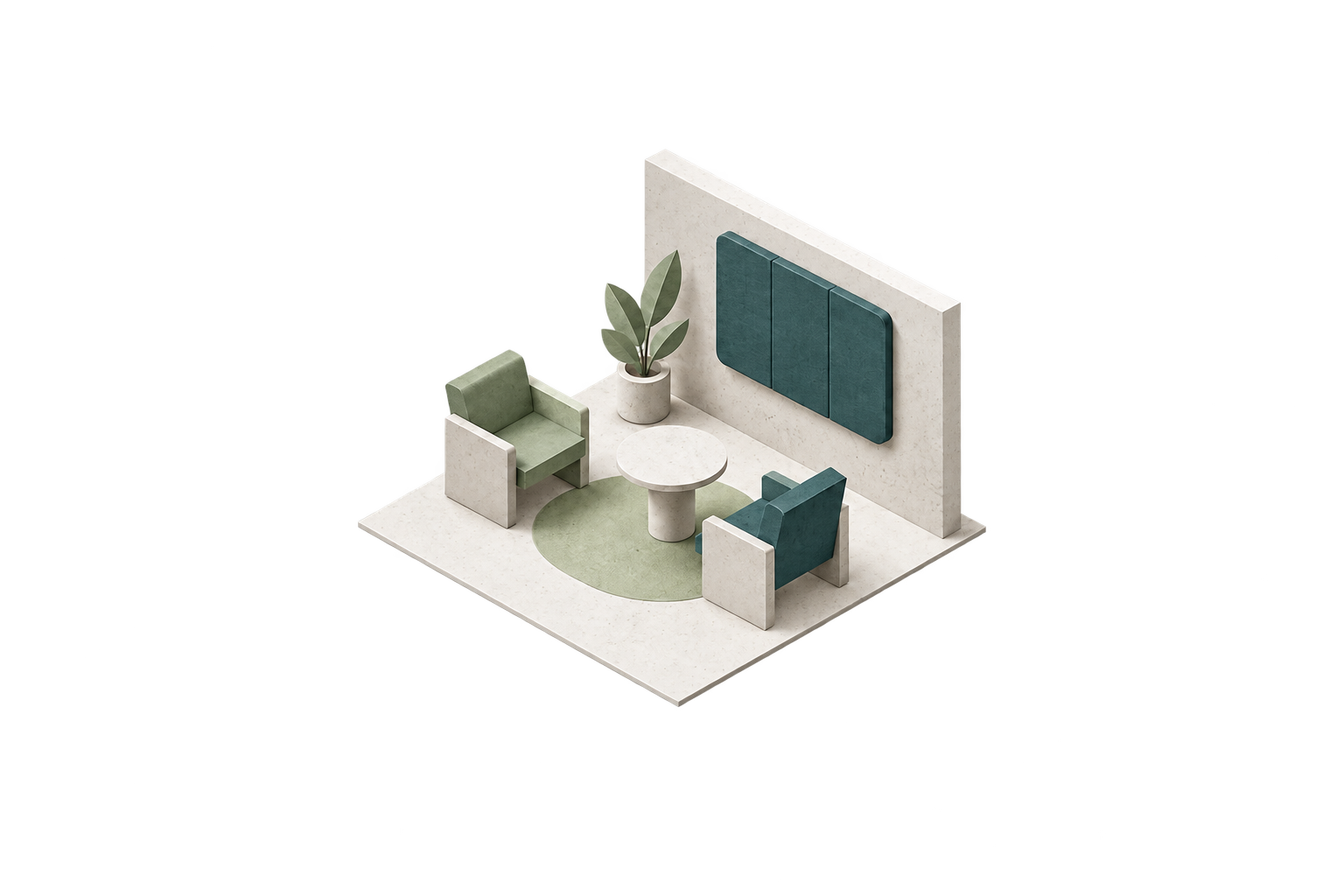
Aphasia and communication rehabilitation day centre
Can spatial cues and acoustic choices make arrival and group participation understandable?
Related-setting transfer2 linked sources · 1 peer-reviewedPeople & purpose
People with acquired communication difficulties, families and communication partners
Design question: Can spatial cues and acoustic choices make arrival and group participation understandable?
What the evidence supports
Use a clearly marked design transfer from studied populations/settings; do not imply the combined building programme was evaluated.
Application is an architectural inference from related guidance or research; this typology has no validated therapeutic design effect.
The label describes research relevance, not study quality or a proven whole-building benefit.
Design variables to investigate
Proposed moves to develop and test for this programme.
- Symbol and word wayfinding
- Speech-friendly acoustics
- Visible activity destinations
- Small-group and one-to-one rooms
Check the trade-offs
Architectural checks, not additional findings from the cited papers.
- Balance independent practice with supervision, rest and mobility assistance.
- A shorter route may reduce effort but also reduce opportunities for voluntary activity; agree the goal with users and care teams.
Evaluate with the intended users
- Destination identification in picture-supported tasks
- Observed use of conversation spaces
- User-rated communication accessibility
Choose a feasible outcome and comparison before testing. Record who used the space, occupancy, care or service changes, and environmental exposure; these can change the result.
Develop the design question
Related Atlas variables provide additional context. They do not verify this complete programme.
Peer-reviewed sources & research audit2 sources
Read study design, population and transfer limits together. A source reused for several building functions is still one study.
NICE NG236 — Stroke rehabilitation in adults (2023) ↗
Official clinical guideline · Official guidance · relevant sections checked
Guidance scope: Specialist rehabilitation, enabling homes, environmental assessment and hospital-to-community continuity.
Limits and contrary findings: Clinical service guidance; does not validate a particular building design or architectural treatment effect.
Research audit: Relevant recommendation body checked. Supports specialist rehabilitation environments, home assessment and continuity. It is clinical guidance, not a causal architectural efficacy study.
Record checked 2026-10-10Lipson-Smith et al. — Physical environment in stroke recovery: mixed-methods multiple case study (2023) ↗
Peer-reviewed research · Relevant full-paper sections checked
Reported finding or research scope: Patient perspectives and behavioural mapping identify legibility, variety, autonomy and privacy without isolation as design questions.
Limits and contrary findings: 36 participants at two Australian inpatient facilities; observational findings and a conceptual model, without isolated causal architectural effects.
Research audit: Body supports variety, privacy without isolation and patient-centred design as contextual research principles; the authors explicitly call the model non-prescriptive.
Record checked 2026-10-10