


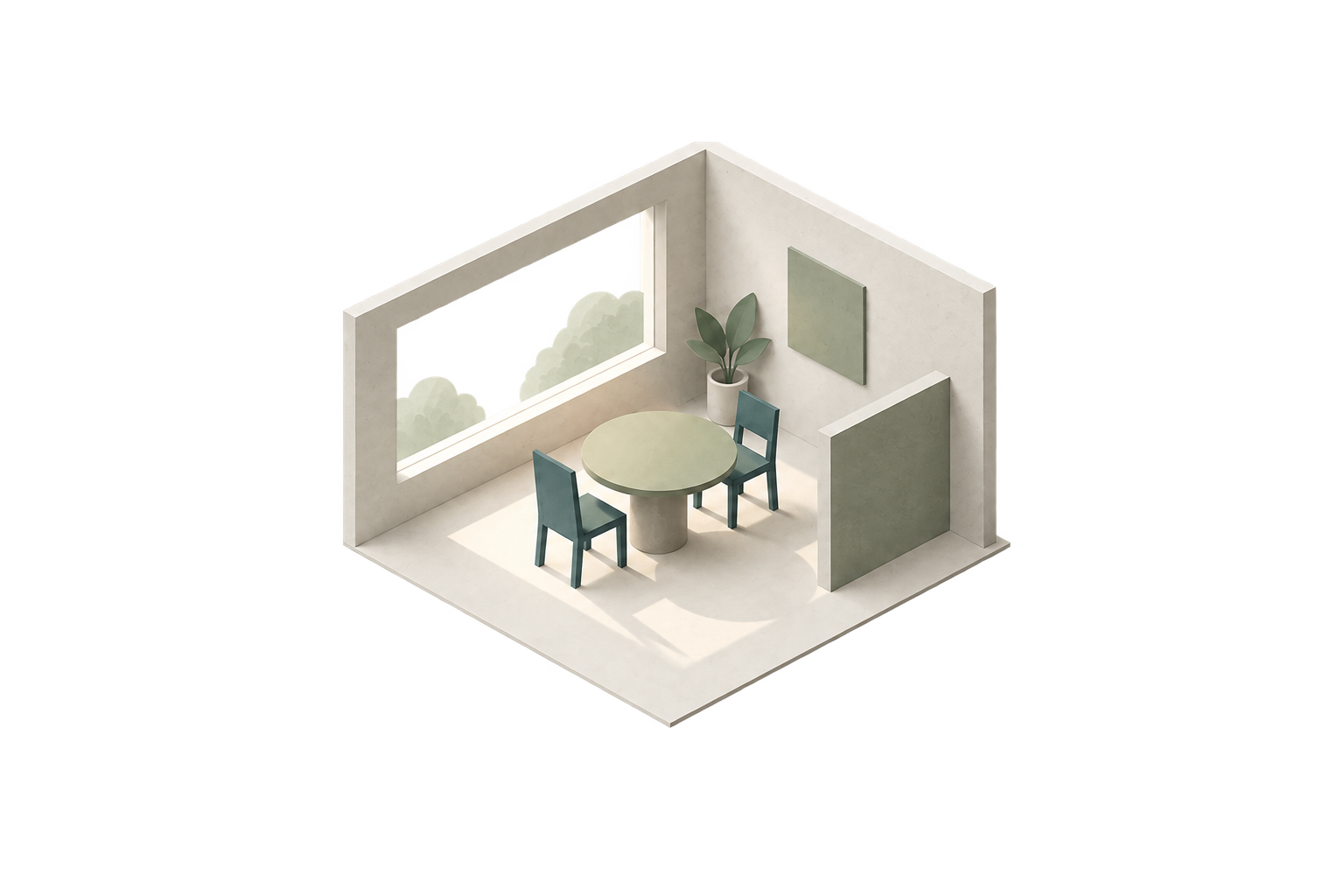
Eating-disorder treatment and supported-mealtime centre
How can meal, therapy and private rest spaces support dignity and different support needs?
Exploratory brief1 linked source · 0 peer-reviewedPeople & purpose
People receiving treatment, families and multidisciplinary teams
Design question: How can meal, therapy and private rest spaces support dignity and different support needs?
What the evidence supports
No sufficiently matched environmental-outcome evidence identified in this bounded scan. Keep as a research brief; hold benefit claims and prioritize population-specific search/co-design.
A testable architectural proposal; cited sources provide context, not evidence that this function produces neural or therapeutic benefits.
The label describes research relevance, not study quality or a proven whole-building benefit. The current references are guidance rather than peer-reviewed intervention research.
Design variables to investigate
Proposed moves to develop and test for this programme.
- Small and larger dining choices
- Confidential therapy rooms
- Sensory predictability
- Private family conversations
Check the trade-offs
Architectural checks, not additional findings from the cited papers.
- Offer retreat without creating isolation or obstructing staff response.
- User control must be compatible with agreed safety requirements and accessible support.
Evaluate with the intended users
- Dining-space preferences
- User-rated privacy and usability
- Meal-to-therapy circulation assessment
Choose a feasible outcome and comparison before testing. Record who used the space, occupancy, care or service changes, and environmental exposure; these can change the result.
Develop the design question
Related Atlas variables provide additional context. They do not verify this complete programme.
Peer-reviewed sources & research audit1 source
Read study design, population and transfer limits together. A source reused for several building functions is still one study.
SAMHSA — Concept of Trauma and Guidance for a Trauma-Informed Approach (2014) ↗
Official organizational framework · Official guidance · relevant sections checked
Guidance scope: Physical and emotional safety, choice, calming environments and participation of people with lived experience.
Limits and contrary findings: An organizational framework, not an architectural efficacy trial; proposed spatial applications need user-specific evaluation.
Research audit: Relevant body checked in a public mental-health provider copy of the SAMHSA report after official PDF retrieval failed. Supports safety, choice, calming spaces and lived-experience involvement as organizational principles, not proven architectural treatment effects.
Record checked 2026-10-10