


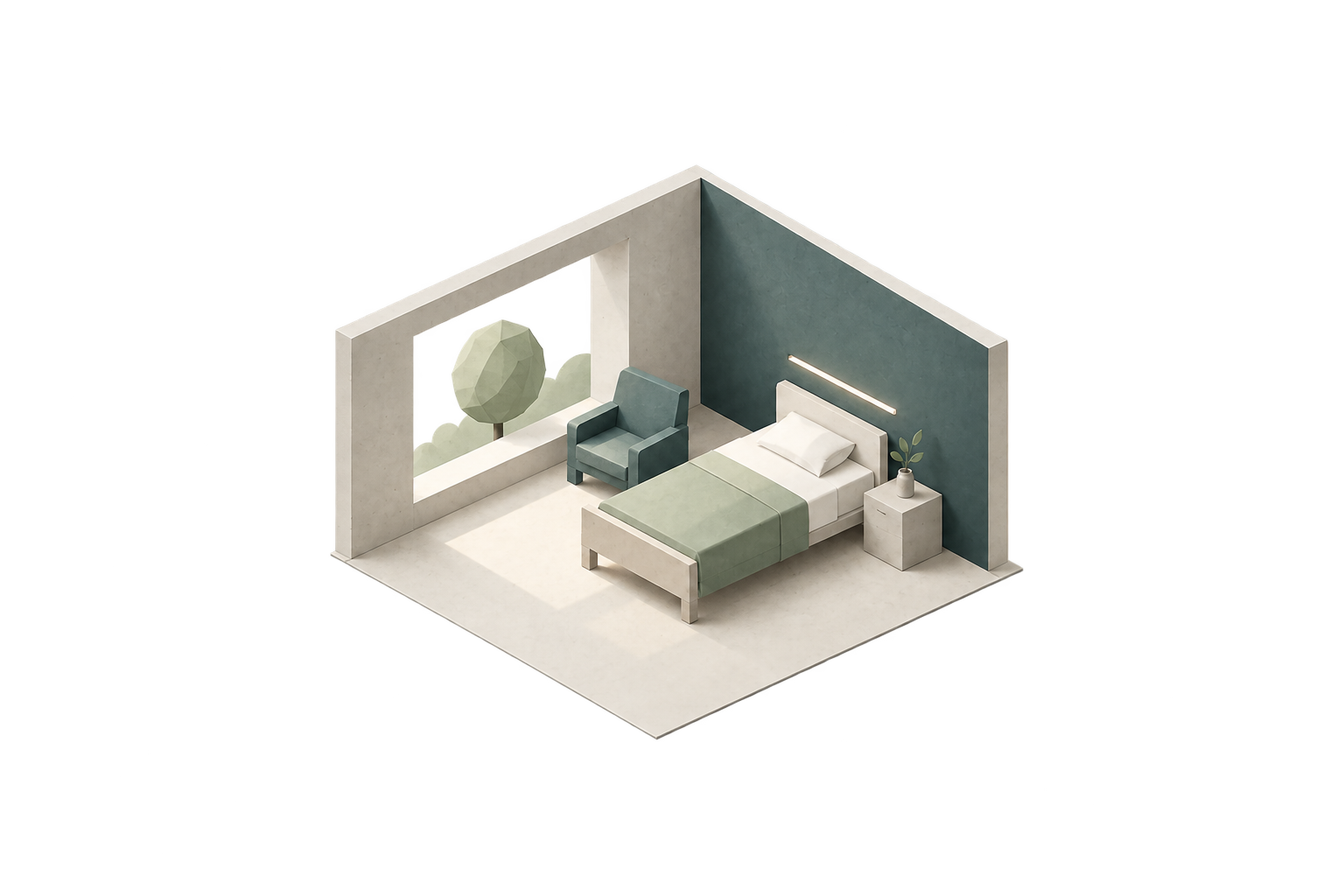
Hospice and palliative care centre
Can care, family life and chosen solitude be supported within a domestic-scale setting?
Related-setting transfer2 linked sources · 1 peer-reviewedPeople & purpose
People with life-limiting illness, families and staff
Design question: Can care, family life and chosen solitude be supported within a domestic-scale setting?
What the evidence supports
Use a clearly marked design transfer from studied populations/settings; do not imply the combined building programme was evaluated.
Application is an architectural inference from related guidance or research; this typology has no validated therapeutic design effect.
The label describes research relevance, not study quality or a proven whole-building benefit.
Design variables to investigate
Proposed moves to develop and test for this programme.
- Family overnight rooms
- Private outdoor access
- Bed-level views
- Domestic shared rooms
Check the trade-offs
Architectural checks, not additional findings from the cited papers.
- Privacy and quieter rooms can reduce passive observation and staff contact; test visibility and workflow.
- Maintain infection control, emergency access and essential clinical lighting while offering environmental choice.
Evaluate with the intended users
- Family usability and privacy ratings
- Outdoor and communal-space use
- User-rated environmental control
Choose a feasible outcome and comparison before testing. Record who used the space, occupancy, care or service changes, and environmental exposure; these can change the result.
Develop the design question
Related Atlas variables provide additional context. They do not verify this complete programme.
Peer-reviewed sources & research audit2 sources
Read study design, population and transfer limits together. A source reused for several building functions is still one study.
Ulrich — View through a window may influence recovery from surgery (1984) ↗
Peer-reviewed research · Partial verification
Reported finding or research scope: A small matched retrospective comparison of postoperative rooms with nature and wall views.
Limits and contrary findings: 46 patients in one historical surgical context; not proof of universal healing effects or transfer to other clinical populations.
Research audit: Same publication already audited in the atlas. Reused its documented audit status and inspected the catalogue support/limit wording for consistency; not an independent replication.
Verification limits: Prior quantitative passage remains from earlier article-reproduction extraction. The cited innotre PDF now returns 404; publisher/full author manuscript could not be re-retrieved in this pass. CI reporting and outcome hierarchy therefore not newly verified against the complete paper.
Record checked 2026-10-10SAMHSA — Concept of Trauma and Guidance for a Trauma-Informed Approach (2014) ↗
Official organizational framework · Official guidance · relevant sections checked
Guidance scope: Physical and emotional safety, choice, calming environments and participation of people with lived experience.
Limits and contrary findings: An organizational framework, not an architectural efficacy trial; proposed spatial applications need user-specific evaluation.
Research audit: Relevant body checked in a public mental-health provider copy of the SAMHSA report after official PDF retrieval failed. Supports safety, choice, calming spaces and lived-experience involvement as organizational principles, not proven architectural treatment effects.
Record checked 2026-10-10