


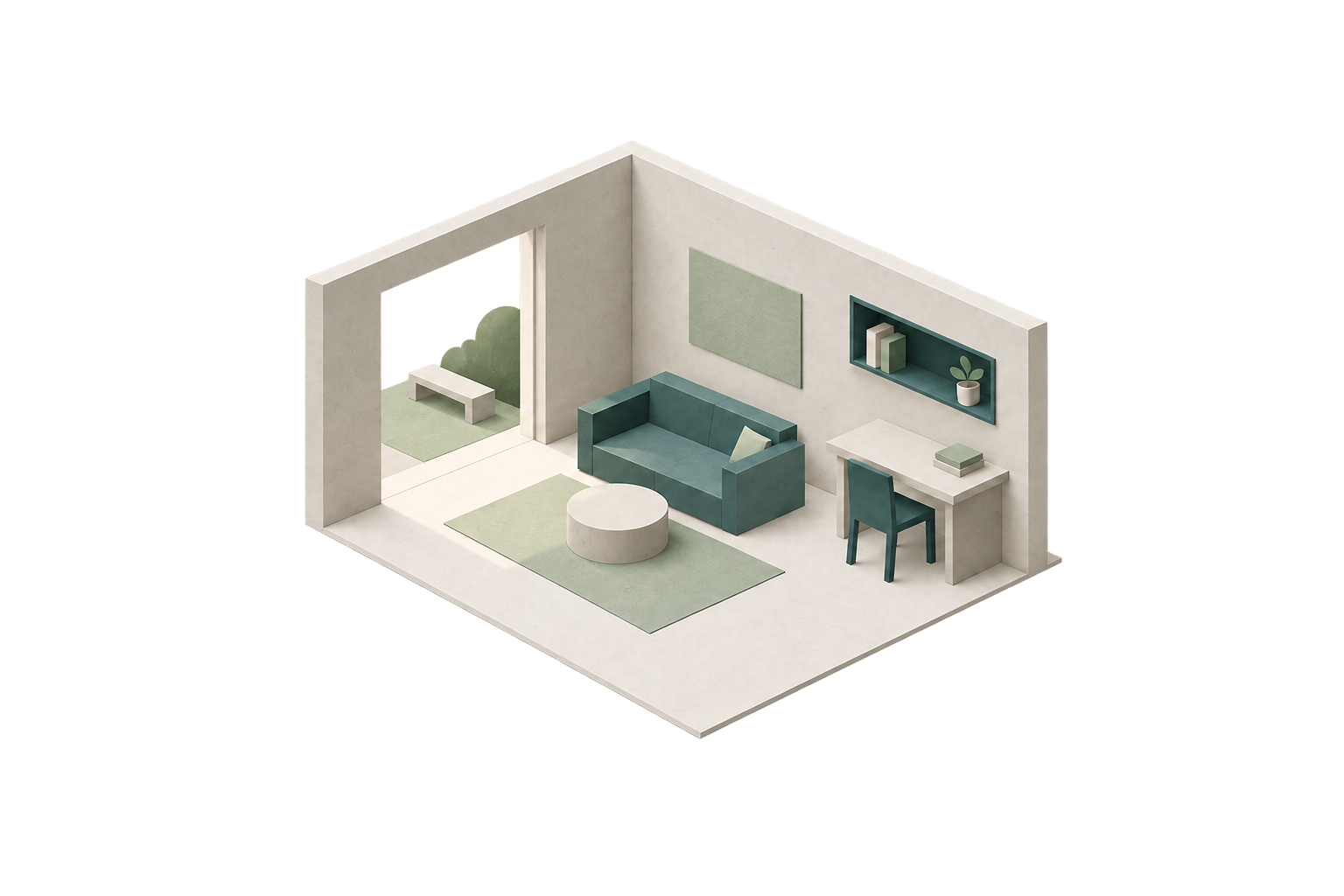
Juvenile justice residential and reintegration centre
Can developmentally appropriate daily settings make boundaries clear and offer family connection?
Exploratory brief3 linked sources · 1 peer-reviewedPeople & purpose
Young people in justice systems, families, educators and staff
Design question: Can developmentally appropriate daily settings make boundaries clear and offer family connection?
What the evidence supports
No sufficiently matched environmental-outcome evidence identified in this bounded scan. Keep as a research brief; hold benefit claims and prioritize population-specific search/co-design.
Adult custody and trauma principles are context only; youth-specific legal and service requirements must be established separately.
The label describes research relevance, not study quality or a proven whole-building benefit.
Design variables to investigate
Proposed moves to develop and test for this programme.
- Domestic-scale living groups
- Private family meeting rooms
- Legible activity sequence
- Accessible outdoor space
Check the trade-offs
Architectural checks, not additional findings from the cited papers.
- Safety observation does not remove the need for dignity, privacy and meaningful choice.
- An environmental intervention cannot compensate for harmful isolation or inadequate services.
Evaluate with the intended users
- Family-room use
- Age-appropriate privacy ratings
- Destination-finding task results
Choose a feasible outcome and comparison before testing. Record who used the space, occupancy, care or service changes, and environmental exposure; these can change the result.
Develop the design question
Related Atlas variables provide additional context. They do not verify this complete programme.
Peer-reviewed sources & research audit3 sources
Read study design, population and transfer limits together. A source reused for several building functions is still one study. Some newer sources have only selected sections or abstracts checked; the individual audit records show what remains unresolved.
SAMHSA — Concept of Trauma and Guidance for a Trauma-Informed Approach (2014) ↗
Official organizational framework · Official guidance · relevant sections checked
Guidance scope: Physical and emotional safety, choice, calming environments and participation of people with lived experience.
Limits and contrary findings: An organizational framework, not an architectural efficacy trial; proposed spatial applications need user-specific evaluation.
Research audit: Relevant body checked in a public mental-health provider copy of the SAMHSA report after official PDF retrieval failed. Supports safety, choice, calming spaces and lived-experience involvement as organizational principles, not proven architectural treatment effects.
Record checked 2026-10-10UNODC — Assessing compliance with the Nelson Mandela Rules (2017) ↗
Official rights and inspection standard · Official guidance · relevant sections checked
Guidance scope: Humane custody conditions, adequate accommodation, light, ventilation and access to meaningful daily activities.
Limits and contrary findings: Rights and inspection standards for adult prisons; not neuroscience evidence and not a direct standard for courts or youth facilities.
Research audit: Relevant body checked. Supports humane accommodation and purposeful out-of-cell activity, education and meaningful work. This is an inspection checklist grounded in minimum rights standards, not a peer-reviewed intervention study.
Record checked 2026-10-10Impacts of nature imagery on people in severely nature-deprived environments (2017) ↗
Peer-reviewed research · Abstract or limited excerpts checked
Method: Nonrandomized prison nature-video field study
Population / setting: Maximum-security prison residents, one-year intervention
Reported finding or research scope: Nature-video viewers reported greater calm; intervention group had fewer violent infractions.
Limits and contrary findings: Nonrandom assignment/selection and operational confounding. Does not justify isolation or prove secure-facility geometry improves behaviour.
Research audit: Publisher abstract inspected; NSF author manuscript retrieval failed; full methods unresolved
Verification limits: Key findings and limitations were checked in the materials listed here. Exact effect estimates and supplementary analyses still require verification against the full tables and supplements.
This is a selected-source extraction, not a complete audit of every table and supplement. It does not establish numerical design thresholds or a whole-building benefit.
Record checked 2026-10-11