


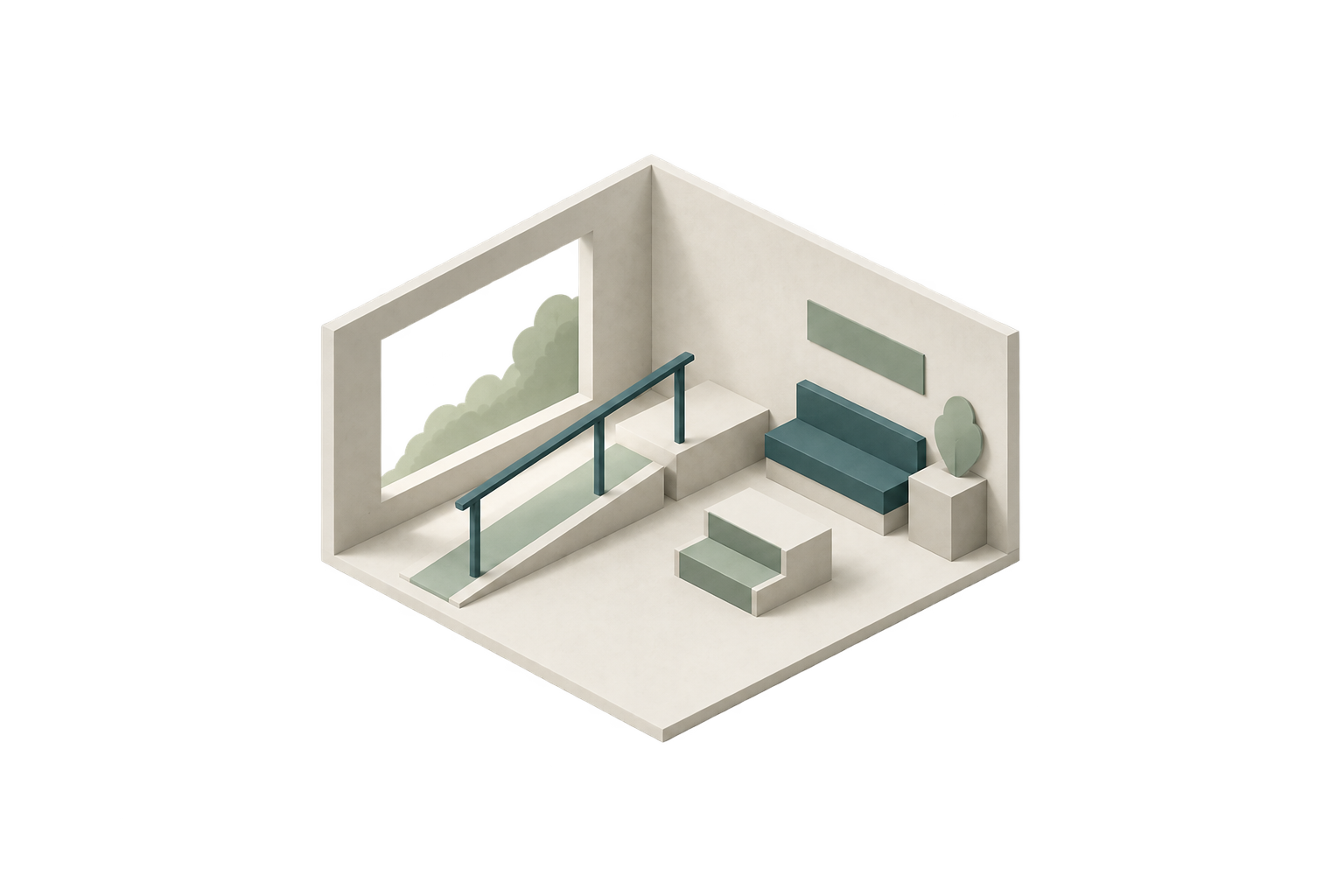
Limb-loss rehabilitation and prosthetic-training centre
Can varied everyday surfaces and domestic tasks be offered without forcing users into challenging routes?
Related-setting transfer2 linked sources · 0 peer-reviewedPeople & purpose
People using prostheses, families and rehabilitation staff
Design question: Can varied everyday surfaces and domestic tasks be offered without forcing users into challenging routes?
What the evidence supports
Use a clearly marked design transfer from studied populations/settings; do not imply the combined building programme was evaluated.
Application is an architectural inference from related guidance or research; this typology has no validated therapeutic design effect.
The label describes research relevance, not study quality or a proven whole-building benefit. The current references are guidance rather than peer-reviewed intervention research.
Design variables to investigate
Proposed moves to develop and test for this programme.
- Optional surface-training routes
- Bypass paths
- Practice kitchen and bathroom
- Seated recovery spaces
Check the trade-offs
Architectural checks, not additional findings from the cited papers.
- Balance independent practice with supervision, rest and mobility assistance.
- A shorter route may reduce effort but also reduce opportunities for voluntary activity; agree the goal with users and care teams.
Evaluate with the intended users
- Task completion in spatial prototypes
- Chosen training and bypass routes
- User-rated autonomy
Choose a feasible outcome and comparison before testing. Record who used the space, occupancy, care or service changes, and environmental exposure; these can change the result.
Develop the design question
Related Atlas variables provide additional context. They do not verify this complete programme.
Peer-reviewed sources & research audit2 sources
Read study design, population and transfer limits together. A source reused for several building functions is still one study.
WHO — Housing and health guidelines (2018) ↗
Official public-health guideline · Official guidance · overview checked
Guidance scope: Crowding, indoor temperature, accessibility and injury hazards as healthy-housing considerations.
Limits and contrary findings: Public-health housing guidance; does not establish neural outcomes or validate each residential typology in this catalogue.
Research audit: Official overview confirms housing crowding, temperatures, injury hazards and accessibility are within scope. Full guideline chapters and supporting evidence reviews were not checked in this targeted pass; this is not a neural-outcome study.
Verification limits: Detailed recommendations and underlying evidence synthesis were not independently checked in the complete guideline.
Record checked 2026-10-10NICE NG252 — Rehabilitation for chronic neurological disorders including acquired brain injury (2025) ↗
Official clinical guideline · Official guidance · relevant sections checked
Guidance scope: Goal-relevant everyday settings and removal of environmental barriers to independent activities.
Limits and contrary findings: Clinical recommendations across several conditions; excludes stroke, dementia and cerebral palsy and does not establish building-specific efficacy.
Research audit: Recommendation body and official scope checked. Supports goal-appropriate settings and addressing daily-living barriers. Excludes cerebral palsy, dementia, epilepsy and adult stroke rehabilitation; do not transfer its scope to all neurological conditions.
Record checked 2026-10-10