


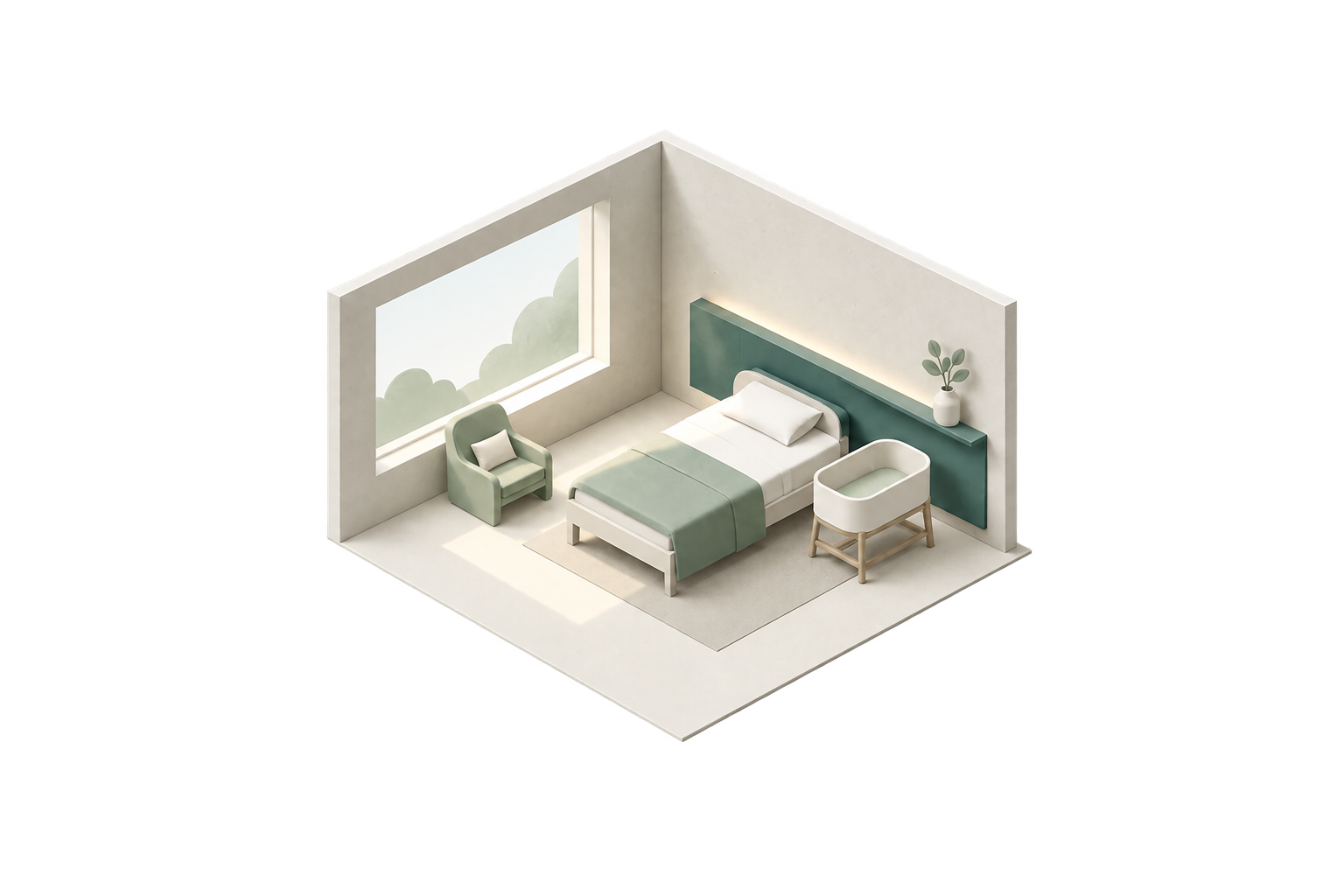
Maternity and postnatal care centre
How can privacy, environmental control and a clear care journey coexist?
Setting-matched research3 linked sources · 2 peer-reviewedPeople & purpose
Birthing people, partners, infants and maternity teams
Design question: How can privacy, environmental control and a clear care journey coexist?
What the evidence supports
Birthing-room RCT directly tests a room package; no significant primary composite benefit.
A testable architectural proposal; cited sources provide context, not evidence that this function produces neural or therapeutic benefits.
The label describes research relevance, not study quality or a proven whole-building benefit.
Design variables to investigate
Proposed moves to develop and test for this programme.
- Private arrival and recovery rooms
- User lighting and temperature controls
- Family accommodation
- Acoustic privacy
Check the trade-offs
Architectural checks, not additional findings from the cited papers.
- Privacy and quieter rooms can reduce passive observation and staff contact; test visibility and workflow.
- Maintain infection control, emergency access and essential clinical lighting while offering environmental choice.
Evaluate with the intended users
- User-rated control and privacy
- Family room-use patterns
- Staff movement in layout simulations
Choose a feasible outcome and comparison before testing. Record who used the space, occupancy, care or service changes, and environmental exposure; these can change the result.
Develop the design question
Related Atlas variables provide additional context. They do not verify this complete programme.
Peer-reviewed sources & research audit3 sources
Read study design, population and transfer limits together. A source reused for several building functions is still one study. Some newer sources have only selected sections or abstracts checked; the individual audit records show what remains unresolved.
SAMHSA — Concept of Trauma and Guidance for a Trauma-Informed Approach (2014) ↗
Official organizational framework · Official guidance · relevant sections checked
Guidance scope: Physical and emotional safety, choice, calming environments and participation of people with lived experience.
Limits and contrary findings: An organizational framework, not an architectural efficacy trial; proposed spatial applications need user-specific evaluation.
Research audit: Relevant body checked in a public mental-health provider copy of the SAMHSA report after official PDF retrieval failed. Supports safety, choice, calming spaces and lived-experience involvement as organizational principles, not proven architectural treatment effects.
Record checked 2026-10-10Ulrich — View through a window may influence recovery from surgery (1984) ↗
Peer-reviewed research · Partial verification
Reported finding or research scope: A small matched retrospective comparison of postoperative rooms with nature and wall views.
Limits and contrary findings: 46 patients in one historical surgical context; not proof of universal healing effects or transfer to other clinical populations.
Research audit: Same publication already audited in the atlas. Reused its documented audit status and inspected the catalogue support/limit wording for consistency; not an independent replication.
Verification limits: Prior quantitative passage remains from earlier article-reproduction extraction. The cited innotre PDF now returns 404; publisher/full author manuscript could not be re-retrieved in this pass. CI reporting and outcome hierarchy therefore not newly verified against the complete paper.
Record checked 2026-10-10Room4Birth – The effect of giving birth in a hospital birthing room designed with person-centred considerations: A Swedish randomised controlled trial (2022) ↗
Peer-reviewed research · Selected full-paper sections checked
Method: Randomized controlled trial, terminated early
Population / setting: 406 nulliparous women in spontaneous labour
Reported finding or research scope: No significant primary composite benefit. Secondary findings included less epidural use and higher reported safety/control.
Limits and contrary findings: Underpowered trial; bundled room plus bath access. No claim of shorter labour, less blood loss or hormone changes.
Research audit: Full author manuscript: methods/results/methodological considerations inspected at https://pub.epsilon.slu.se/28301/1/goldkuhl-l-et-al-220610.pdf
Verification limits: Key findings and limitations were checked in the materials listed here. Exact effect estimates and supplementary analyses still require verification against the full tables and supplements.
This is a selected-source extraction, not a complete audit of every table and supplement. It does not establish numerical design thresholds or a whole-building benefit.
Record checked 2026-10-11