


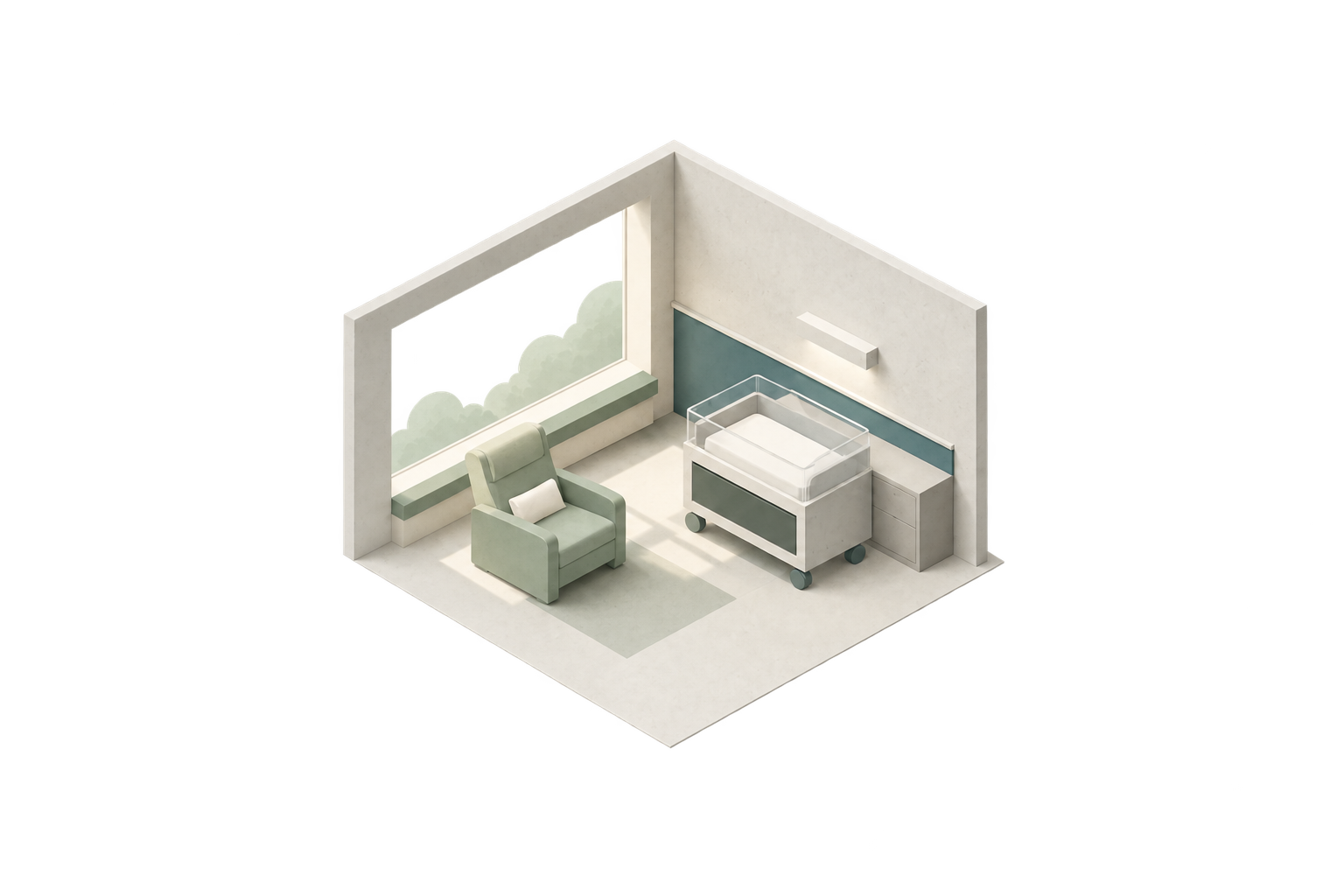
Neonatal and family-integrated care unit
Can parental proximity and privacy be balanced with safe observation and movement?
Setting-matched research2 linked sources · 1 peer-reviewedPeople & purpose
Infants, parents and neonatal staff
Design question: Can parental proximity and privacy be balanced with safe observation and movement?
What the evidence supports
NICU architectural relocation cohort directly measures parent presence; no isolated building causality.
A testable architectural proposal; cited sources provide context, not evidence that this function produces neural or therapeutic benefits.
The label describes research relevance, not study quality or a proven whole-building benefit.
Design variables to investigate
Proposed moves to develop and test for this programme.
- Family sleeping and expressing rooms
- Bedside parental space
- Acoustic zoning
- Clinical sightlines
Check the trade-offs
Architectural checks, not additional findings from the cited papers.
- Privacy and quieter rooms can reduce passive observation and staff contact; test visibility and workflow.
- Maintain infection control, emergency access and essential clinical lighting while offering environmental choice.
Evaluate with the intended users
- Family-space occupancy
- Privacy and usability ratings
- Staff route conflicts in mock-ups
Choose a feasible outcome and comparison before testing. Record who used the space, occupancy, care or service changes, and environmental exposure; these can change the result.
Develop the design question
Related Atlas variables provide additional context. They do not verify this complete programme.
Peer-reviewed sources & research audit2 sources
Read study design, population and transfer limits together. A source reused for several building functions is still one study. Some newer sources have only selected sections or abstracts checked; the individual audit records show what remains unresolved.
SAMHSA — Concept of Trauma and Guidance for a Trauma-Informed Approach (2014) ↗
Official organizational framework · Official guidance · relevant sections checked
Guidance scope: Physical and emotional safety, choice, calming environments and participation of people with lived experience.
Limits and contrary findings: An organizational framework, not an architectural efficacy trial; proposed spatial applications need user-specific evaluation.
Research audit: Relevant body checked in a public mental-health provider copy of the SAMHSA report after official PDF retrieval failed. Supports safety, choice, calming spaces and lived-experience involvement as organizational principles, not proven architectural treatment effects.
Record checked 2026-10-10Effect of Shifting From Open Bay to Single-Family Rooms on Closeness in a NICU (2025) ↗
Peer-reviewed research · Selected full-paper sections checked
Method: Prospective observational relocation cohort
Population / setting: 833 parent–infant dyads in a Dutch NICU
Reported finding or research scope: Parental presence and skin-to-skin contact increased after relocation to single-family rooms.
Limits and contrary findings: Architecture, care practices and calendar period changed together; parent diaries and no random allocation. Does not establish infant neurological recovery.
Research audit: Full text: methods and results body sections inspected
Verification limits: Key findings and limitations were checked in the materials listed here. Exact effect estimates and supplementary analyses still require verification against the full tables and supplements.
This is a selected-source extraction, not a complete audit of every table and supplement. It does not establish numerical design thresholds or a whole-building benefit.
Record checked 2026-10-11