


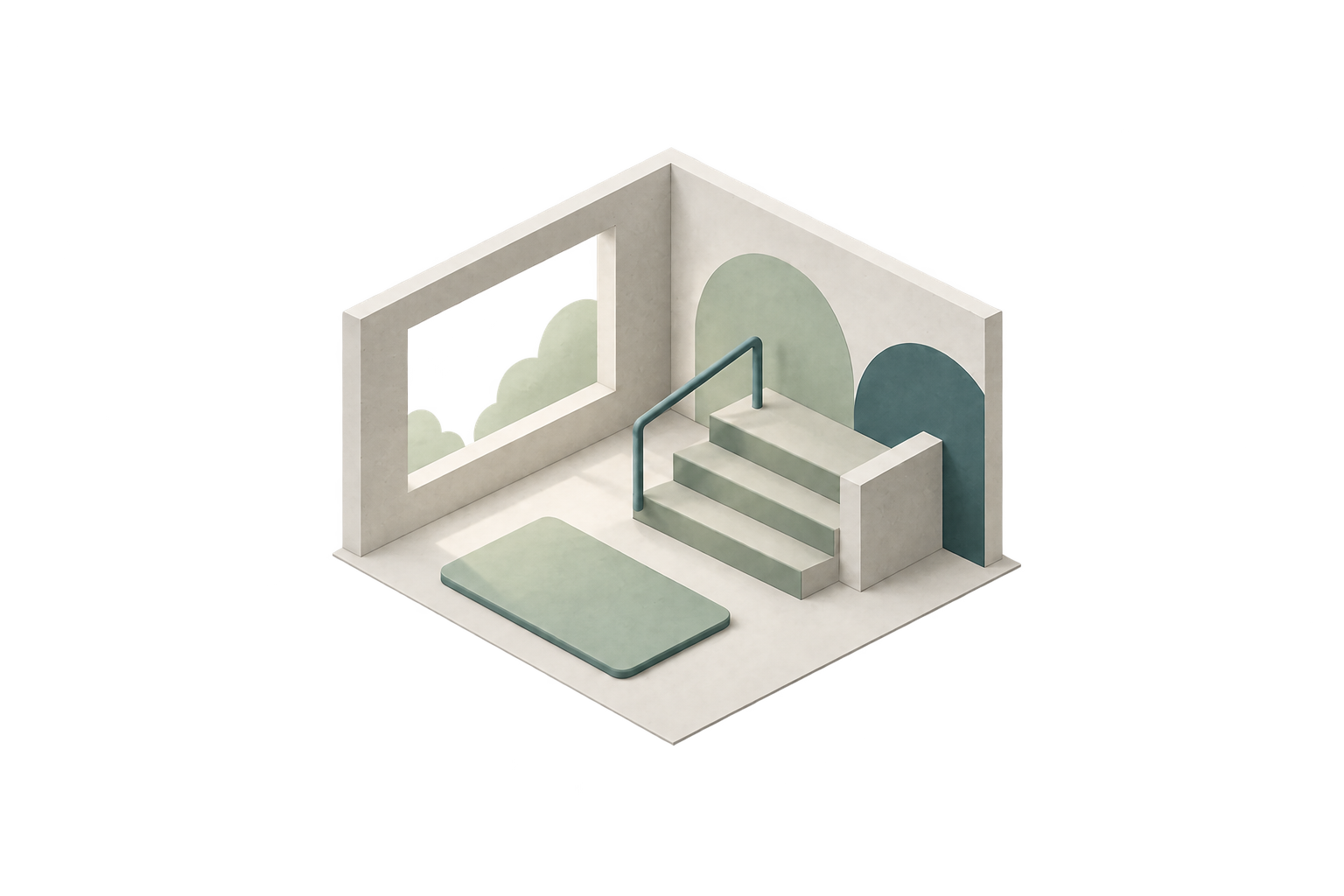
Paediatric neurorehabilitation centre
How can therapy, play and family routines share a navigable environment?
Exploratory brief2 linked sources · 1 peer-reviewedPeople & purpose
Children with neurological conditions, families and therapists
Design question: How can therapy, play and family routines share a navigable environment?
What the evidence supports
No sufficiently matched environmental-outcome evidence identified in this bounded scan. Keep as a research brief; hold benefit claims and prioritize population-specific search/co-design.
A testable architectural proposal; cited sources provide context, not evidence that this function produces neural or therapeutic benefits.
The label describes research relevance, not study quality or a proven whole-building benefit.
Design variables to investigate
Proposed moves to develop and test for this programme.
- Child-readable landmarks
- Play-to-therapy adjacency
- Family refuge rooms
- Sensory transition zones
Check the trade-offs
Architectural checks, not additional findings from the cited papers.
- Balance independent practice with supervision, rest and mobility assistance.
- A shorter route may reduce effort but also reduce opportunities for voluntary activity; agree the goal with users and care teams.
Evaluate with the intended users
- Family route-finding errors
- Play and shared-space occupancy
- Caregiver-rated usability
Choose a feasible outcome and comparison before testing. Record who used the space, occupancy, care or service changes, and environmental exposure; these can change the result.
Develop the design question
Related Atlas variables provide additional context. They do not verify this complete programme.
Peer-reviewed sources & research audit2 sources
Read study design, population and transfer limits together. A source reused for several building functions is still one study.
Lipson-Smith et al. — Physical environment in stroke recovery: mixed-methods multiple case study (2023) ↗
Peer-reviewed research · Relevant full-paper sections checked
Reported finding or research scope: Patient perspectives and behavioural mapping identify legibility, variety, autonomy and privacy without isolation as design questions.
Limits and contrary findings: 36 participants at two Australian inpatient facilities; observational findings and a conceptual model, without isolated causal architectural effects.
Research audit: Body supports variety, privacy without isolation and patient-centred design as contextual research principles; the authors explicitly call the model non-prescriptive.
Record checked 2026-10-10SAMHSA — Concept of Trauma and Guidance for a Trauma-Informed Approach (2014) ↗
Official organizational framework · Official guidance · relevant sections checked
Guidance scope: Physical and emotional safety, choice, calming environments and participation of people with lived experience.
Limits and contrary findings: An organizational framework, not an architectural efficacy trial; proposed spatial applications need user-specific evaluation.
Research audit: Relevant body checked in a public mental-health provider copy of the SAMHSA report after official PDF retrieval failed. Supports safety, choice, calming spaces and lived-experience involvement as organizational principles, not proven architectural treatment effects.
Record checked 2026-10-10