


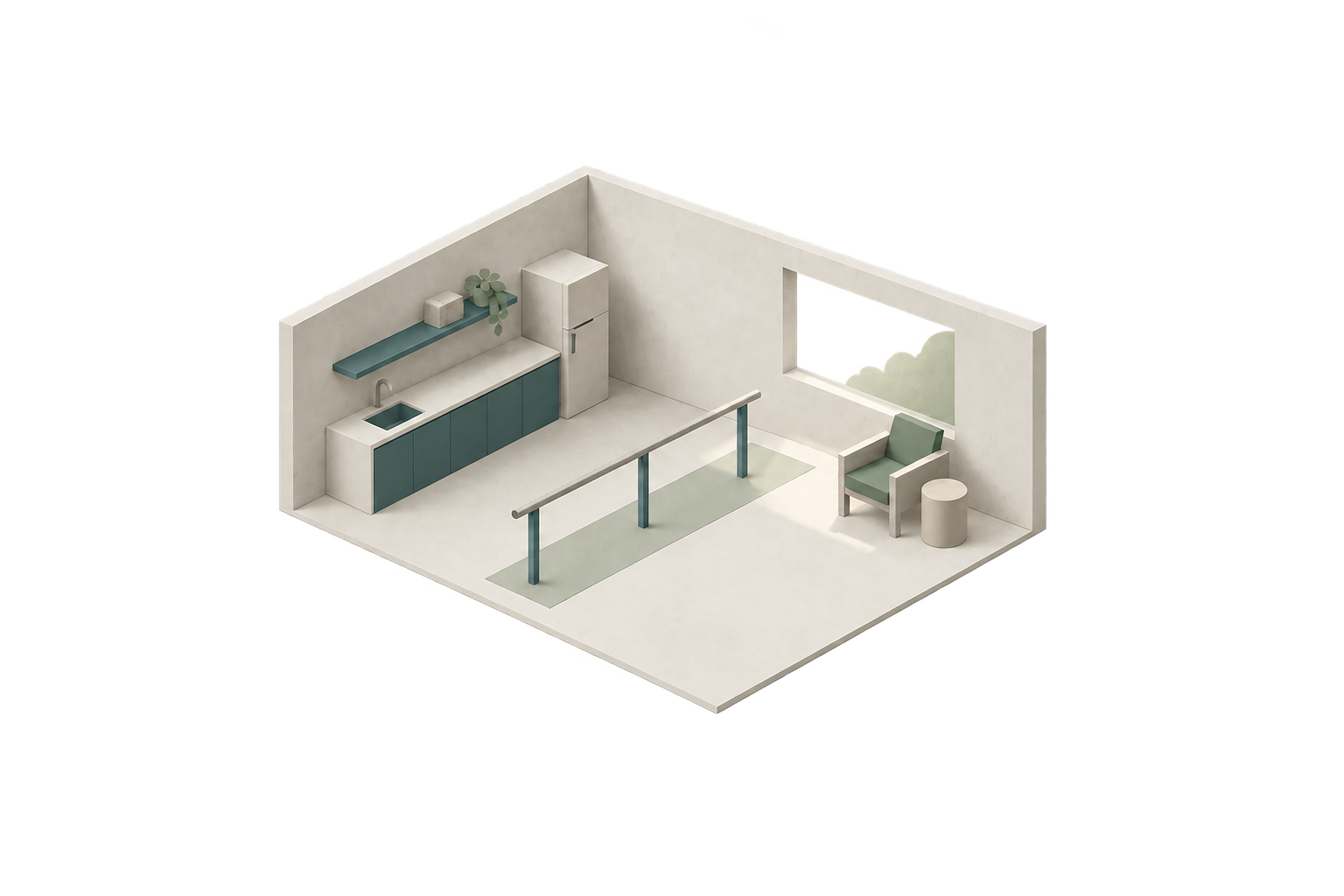
Post-stroke rehabilitation and community transition centre
How can a route from private rest to everyday activity make participation legible and optional?
Related-setting transfer4 linked sources · 3 peer-reviewedPeople & purpose
Stroke survivors, families, rehabilitation staff
Design question: How can a route from private rest to everyday activity make participation legible and optional?
What the evidence supports
The strongest cited studies concern inpatient stroke rehabilitation or virtual bedrooms, not the full community-transition programme. Retain as a priority transfer concept, not an exact setting match.
Population-specific evidence identifies relevant needs; the architectural proposal still requires evaluation.
The label describes research relevance, not study quality or a proven whole-building benefit.
Design variables to investigate
Proposed moves to develop and test for this programme.
- Bedroom-to-activity distance
- Distinctive route landmarks
- Rest points and sensory retreat
- Practice kitchen and domestic settings
- Accessible garden and neighbourhood threshold
Check the trade-offs
Architectural checks, not additional findings from the cited papers.
- Balance independent practice with supervision, rest and mobility assistance.
- A shorter route may reduce effort but also reduce opportunities for voluntary activity; agree the goal with users and care teams.
Evaluate with the intended users
- Wayfinding errors in a supported route task
- Observed use of shared and outdoor spaces
- User-rated choice and privacy
Choose a feasible outcome and comparison before testing. Record who used the space, occupancy, care or service changes, and environmental exposure; these can change the result.
Develop the design question
Related Atlas variables provide additional context. They do not verify this complete programme.
Peer-reviewed sources & research audit4 sources
Read study design, population and transfer limits together. A source reused for several building functions is still one study.
NICE NG236 — Stroke rehabilitation in adults (2023) ↗
Official clinical guideline · Official guidance · relevant sections checked
Guidance scope: Specialist rehabilitation, enabling homes, environmental assessment and hospital-to-community continuity.
Limits and contrary findings: Clinical service guidance; does not validate a particular building design or architectural treatment effect.
Research audit: Relevant recommendation body checked. Supports specialist rehabilitation environments, home assessment and continuity. It is clinical guidance, not a causal architectural efficacy study.
Record checked 2026-10-10Lipson-Smith et al. — Physical environment in stroke recovery: mixed-methods multiple case study (2023) ↗
Peer-reviewed research · Relevant full-paper sections checked
Reported finding or research scope: Patient perspectives and behavioural mapping identify legibility, variety, autonomy and privacy without isolation as design questions.
Limits and contrary findings: 36 participants at two Australian inpatient facilities; observational findings and a conceptual model, without isolated causal architectural effects.
Research audit: Body supports variety, privacy without isolation and patient-centred design as contextual research principles; the authors explicitly call the model non-prescriptive.
Record checked 2026-10-10Lipson-Smith et al. — Built environments for inpatient stroke rehabilitation services and care: a systematic literature review (2021) ↗
Peer-reviewed review · Relevant full-paper sections checked
Reported finding or research scope: Synthesis of 24 articles on stroke rehabilitation environments, including bedrooms, communal settings, activity and user experience.
Limits and contrary findings: Mostly exploratory and qualitative studies with heterogeneous variables. Inpatient findings need separate evaluation in a community-transition programme.
Research audit: Full body confirms 24 articles, predominance of qualitative/exploratory research and heterogeneous outcomes that prevented comparison. Targeted outdoor-space research in stroke inpatient rehabilitation was absent from the included evidence.
Record checked 2026-10-10Shannon et al. — Re-Imagining Hospital Patient Room Design for People After stroke: A Randomized Controlled Study Using Virtual Reality (2024) ↗
Peer-reviewed research · Relevant full-paper sections checked
Reported finding or research scope: Controlled VR study in 44 adults after stroke comparing immediate affect and preference across room occupancy, size, social connection, noise and greenery outlook.
Limits and contrary findings: Immediate responses to virtual hospital bedrooms; does not demonstrate clinical recovery or validate the layout of a whole rehabilitation centre.
Research audit: Full body confirms controlled factorial exposure of 44 adults after stroke to virtual rooms and measurement of immediate affect/preference. Interacting attributes moderated responses; clinical recovery was not measured.
Record checked 2026-10-10