


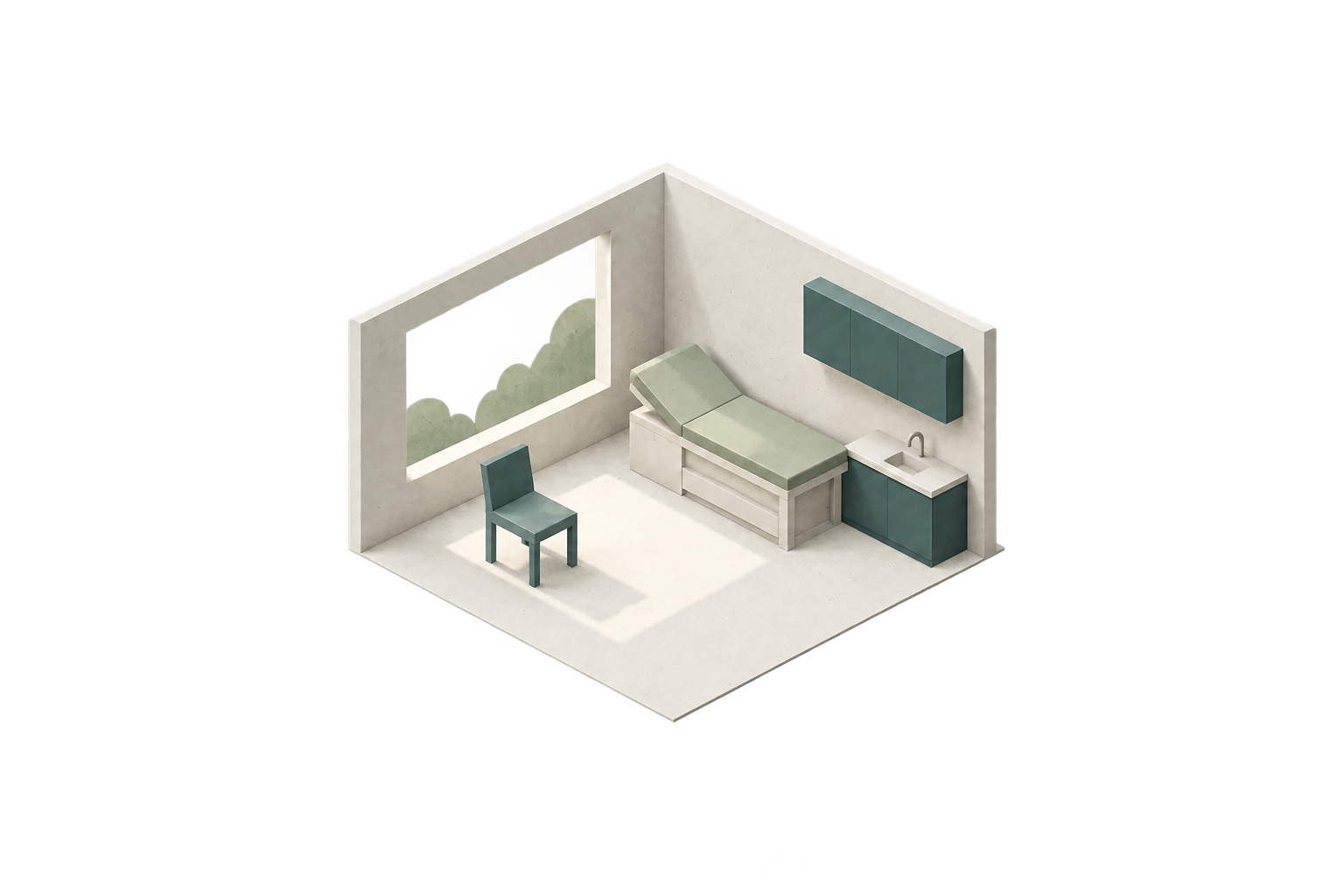
Primary healthcare and diagnostic outpatient centre
Can a first-time visitor understand where to go and choose a suitable waiting setting?
Related-setting transfer3 linked sources · 1 peer-reviewedPeople & purpose
Patients across ages, carers and healthcare teams
Design question: Can a first-time visitor understand where to go and choose a suitable waiting setting?
What the evidence supports
Use a clearly marked design transfer from studied populations/settings; do not imply the combined building programme was evaluated.
Application is an architectural inference from related guidance or research; this typology has no validated therapeutic design effect.
The label describes research relevance, not study quality or a proven whole-building benefit.
Design variables to investigate
Proposed moves to develop and test for this programme.
- Reception visibility
- Simple departmental routes
- Quiet waiting options
- Confidential consultation thresholds
Check the trade-offs
Architectural checks, not additional findings from the cited papers.
- Privacy and quieter rooms can reduce passive observation and staff contact; test visibility and workflow.
- Maintain infection control, emergency access and essential clinical lighting while offering environmental choice.
Evaluate with the intended users
- Time to locate reception and rooms
- Navigation assistance requests
- Waiting-space choice
Choose a feasible outcome and comparison before testing. Record who used the space, occupancy, care or service changes, and environmental exposure; these can change the result.
Develop the design question
Related Atlas variables provide additional context. They do not verify this complete programme.
Peer-reviewed sources & research audit3 sources
Read study design, population and transfer limits together. A source reused for several building functions is still one study. Some newer sources have only selected sections or abstracts checked; the individual audit records show what remains unresolved.
SAMHSA — Concept of Trauma and Guidance for a Trauma-Informed Approach (2014) ↗
Official organizational framework · Official guidance · relevant sections checked
Guidance scope: Physical and emotional safety, choice, calming environments and participation of people with lived experience.
Limits and contrary findings: An organizational framework, not an architectural efficacy trial; proposed spatial applications need user-specific evaluation.
Research audit: Relevant body checked in a public mental-health provider copy of the SAMHSA report after official PDF retrieval failed. Supports safety, choice, calming spaces and lived-experience involvement as organizational principles, not proven architectural treatment effects.
Record checked 2026-10-10NICE CG142 — Autism spectrum disorder in adults: physical and residential environments (2012) ↗
Official clinical guideline · Official guidance · relevant sections checked
Guidance scope: Individual sensory adaptations, visual supports, retreat spaces and activity zoning for autistic adults.
Limits and contrary findings: Guidance rather than an architectural trial; adult recommendations are not automatically transferable to children or all neurodivergent people.
Research audit: Relevant recommendation body checked. Supports individual sensory adjustments, designated activity spaces and opportunities for time alone in adult autism services; not a universal architectural rule for all neurodivergent people.
Record checked 2026-10-10Sensory Adaptations to Improve Physiological and Behavioral Distress During Dental Visits in Autistic Children: A Randomized Crossover Trial (2023) ↗
Peer-reviewed research · Indexed article sections checked
Method: Randomized crossover clinical trial
Population / setting: Autistic children aged 6–12; 162 first cleanings and 138 second cleanings analysed
Reported finding or research scope: Sensory-adapted care lowered skin-conductance level and some video-coded distress measures.
Limits and contrary findings: Not every outcome improved: nonspecific conductance responses, global behaviour ratings, pain and sensory-discomfort reports were not significantly different. Bundled intervention; clinic and population-specific.
Research audit: Full article indexed methods/results/limitations inspected
Verification limits: Key findings and limitations were checked in the materials listed here. Exact effect estimates and supplementary analyses still require verification against the full tables and supplements.
This is a selected-source extraction, not a complete audit of every table and supplement. It does not establish numerical design thresholds or a whole-building benefit.
Record checked 2026-10-11