


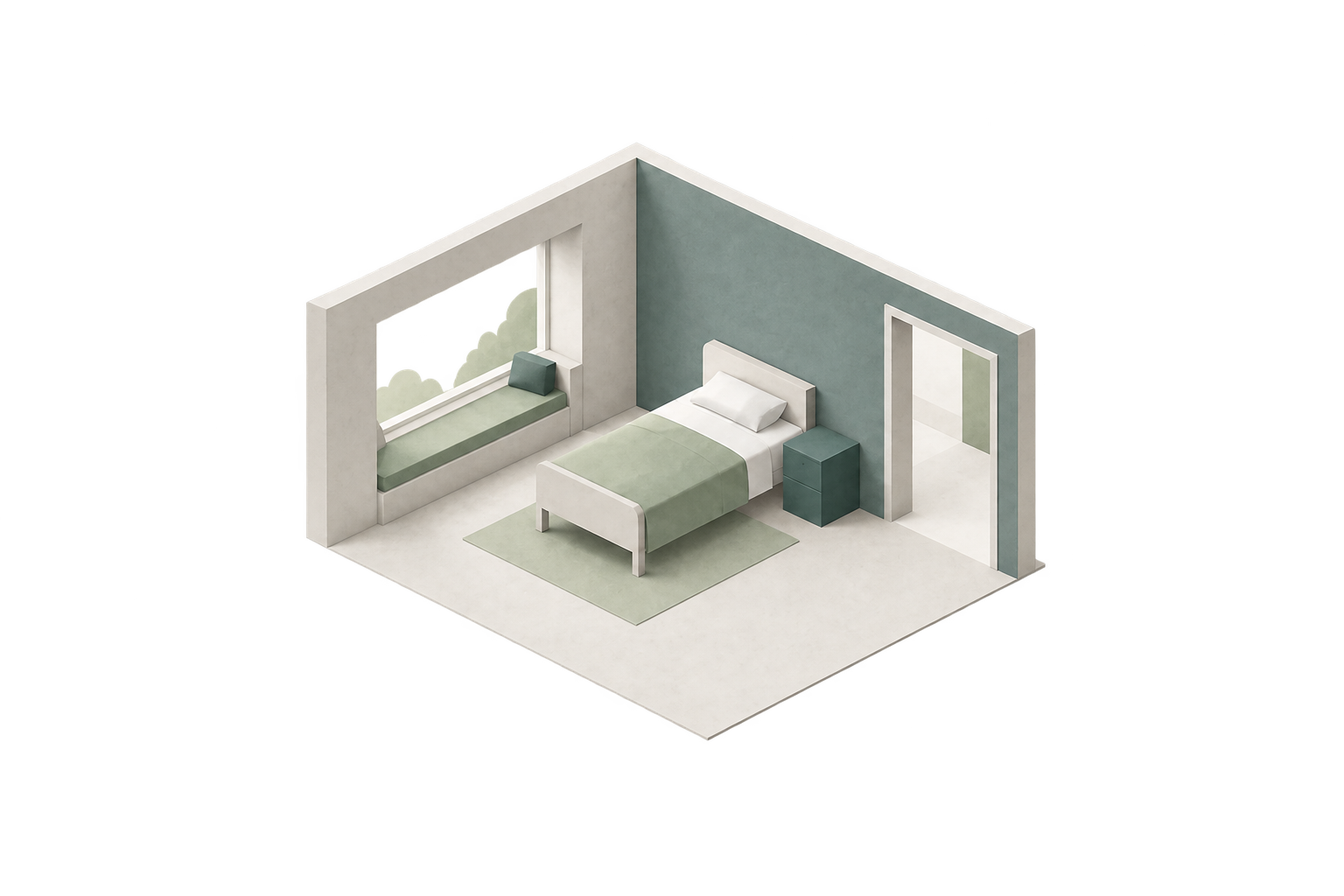
Acute psychiatric inpatient unit
Can observation coexist with privacy, chosen social contact and access to calmer places?
Setting-matched research1 linked source · 1 peer-reviewedPeople & purpose
People receiving inpatient mental healthcare and care teams
Design question: Can observation coexist with privacy, chosen social contact and access to calmer places?
What the evidence supports
Existing psychiatric ward before/after evidence; bundled design and operations.
A bundled, nonrandomized ward comparison supports inquiry; no single feature is proven to reduce aggression.
The label describes research relevance, not study quality or a proven whole-building benefit.
Design variables to investigate
Proposed moves to develop and test for this programme.
- Private bedrooms
- Choice of communal rooms
- Acoustic separation
- Accessible secure garden
- Legible staff presence
Check the trade-offs
Architectural checks, not additional findings from the cited papers.
- Offer retreat without creating isolation or obstructing staff response.
- User control must be compatible with agreed safety requirements and accessible support.
Evaluate with the intended users
- User-rated privacy and autonomy
- Room and garden occupancy
- Visibility and circulation assessment
Choose a feasible outcome and comparison before testing. Record who used the space, occupancy, care or service changes, and environmental exposure; these can change the result.
Develop the design question
Related Atlas variables provide additional context. They do not verify this complete programme.
Peer-reviewed sources & research audit1 source
Read study design, population and transfer limits together. A source reused for several building functions is still one study.
Ulrich et al. — Psychiatric ward design can reduce aggressive behavior (2018) ↗
Peer-reviewed research · Relevant full-paper sections checked
Reported finding or research scope: A comparative hospital study of bundled environmental features including privacy, noise, control, nature access and observation.
Limits and contrary findings: Nonrandomized comparison; architecture was bundled, and service factors may contribute. Individual design features are not separately validated.
Research audit: Body confirms a nonrandomized retrospective old/new/control-hospital comparison and bundled design factors. Injection prevalence decreased, but restraint prevalence did not significantly change; separate features were not causally isolated.
Record checked 2026-10-10