


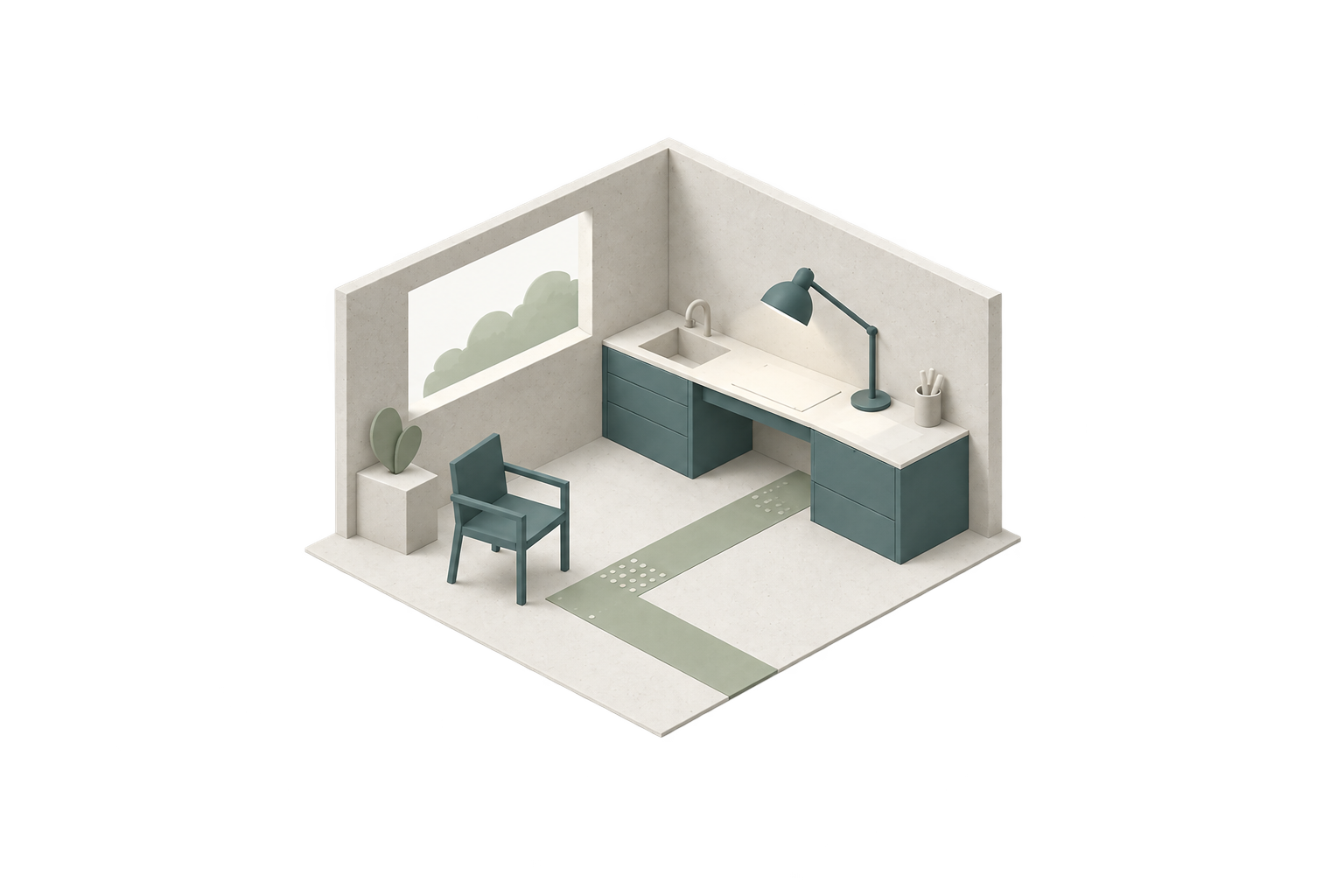
Sensory accessibility resource and independent-living centre
Can visitors compare environmental adaptations and choose what works for them?
Related-setting transfer2 linked sources · 0 peer-reviewedPeople & purpose
People with visual, hearing or sensory access needs and advisors
Design question: Can visitors compare environmental adaptations and choose what works for them?
What the evidence supports
Use a clearly marked design transfer from studied populations/settings; do not imply the combined building programme was evaluated.
Application is an architectural inference from related guidance or research; this typology has no validated therapeutic design effect.
The label describes research relevance, not study quality or a proven whole-building benefit. The current references are guidance rather than peer-reviewed intervention research.
Design variables to investigate
Proposed moves to develop and test for this programme.
- Demonstration lighting settings
- Acoustic and visual communication options
- Tactile and visual wayfinding
- Domestic adaptation mock-ups
Check the trade-offs
Architectural checks, not additional findings from the cited papers.
- Sensory preferences differ; a lower-stimulation setting is not every person’s preferred setting.
- Avoid relying on one sensory channel for an essential cue; retain choice and accessible alternatives.
Evaluate with the intended users
- Adaptation preferences
- Wayfinding task completion
- Demonstration-space usability
Choose a feasible outcome and comparison before testing. Record who used the space, occupancy, care or service changes, and environmental exposure; these can change the result.
Develop the design question
Related Atlas variables provide additional context. They do not verify this complete programme.
Peer-reviewed sources & research audit2 sources
Read study design, population and transfer limits together. A source reused for several building functions is still one study.
WHO — Housing and health guidelines (2018) ↗
Official public-health guideline · Official guidance · overview checked
Guidance scope: Crowding, indoor temperature, accessibility and injury hazards as healthy-housing considerations.
Limits and contrary findings: Public-health housing guidance; does not establish neural outcomes or validate each residential typology in this catalogue.
Research audit: Official overview confirms housing crowding, temperatures, injury hazards and accessibility are within scope. Full guideline chapters and supporting evidence reviews were not checked in this targeted pass; this is not a neural-outcome study.
Verification limits: Detailed recommendations and underlying evidence synthesis were not independently checked in the complete guideline.
Record checked 2026-10-10NICE CG142 — Autism spectrum disorder in adults: physical and residential environments (2012) ↗
Official clinical guideline · Official guidance · relevant sections checked
Guidance scope: Individual sensory adaptations, visual supports, retreat spaces and activity zoning for autistic adults.
Limits and contrary findings: Guidance rather than an architectural trial; adult recommendations are not automatically transferable to children or all neurodivergent people.
Research audit: Relevant recommendation body checked. Supports individual sensory adjustments, designated activity spaces and opportunities for time alone in adult autism services; not a universal architectural rule for all neurodivergent people.
Record checked 2026-10-10