


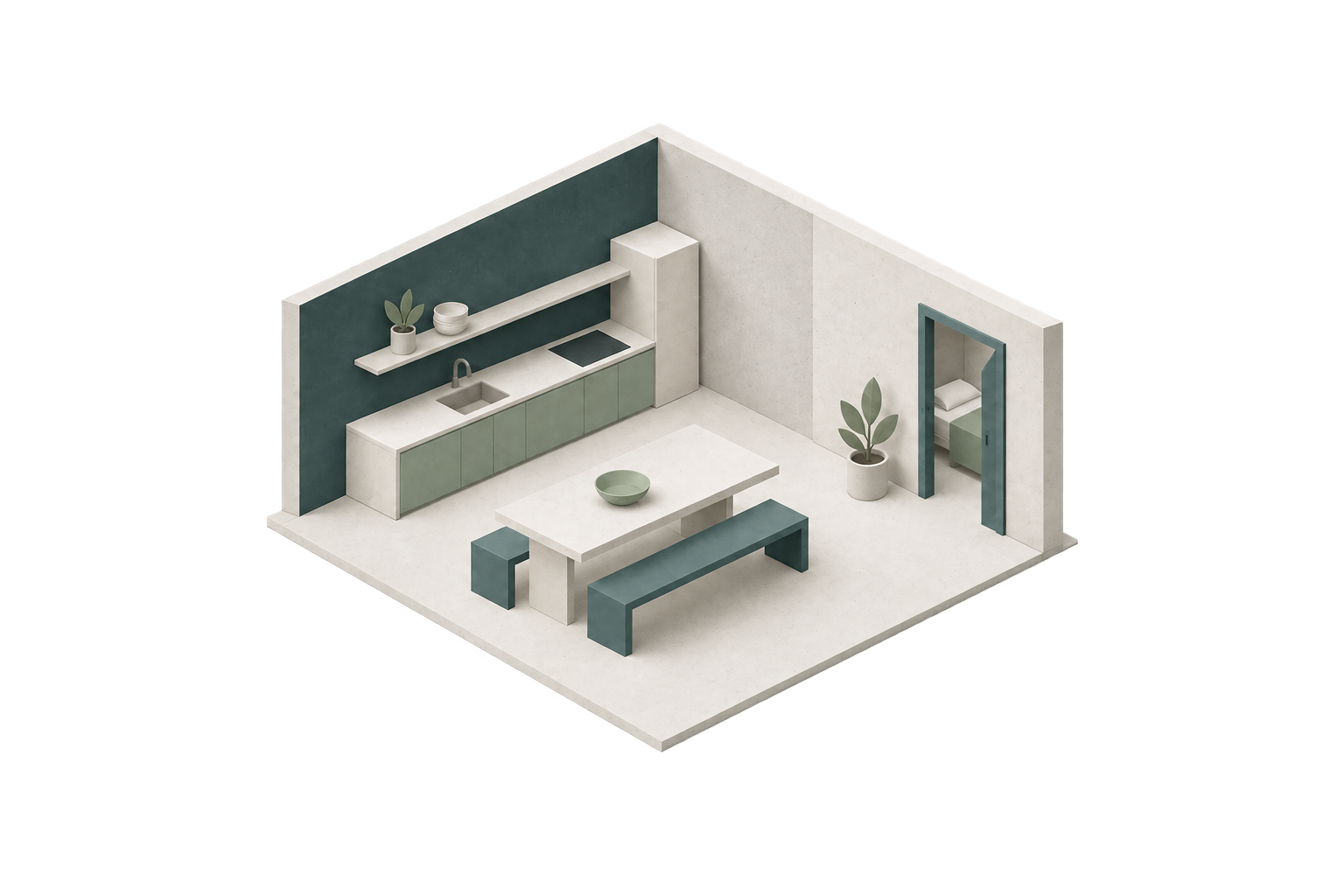
Cooperative and shared cohousing
Can communal living balance social choice with usable private space?
Related-setting transfer2 linked sources · 1 peer-reviewedPeople & purpose
Residents choosing shared amenities and collective daily life
Design question: Can communal living balance social choice with usable private space?
What the evidence supports
Use a clearly marked design transfer from studied populations/settings; do not imply the combined building programme was evaluated.
Application is an architectural inference from related guidance or research; this typology has no validated therapeutic design effect.
The label describes research relevance, not study quality or a proven whole-building benefit.
Design variables to investigate
Proposed moves to develop and test for this programme.
- Private room provision
- Shared kitchen capacity
- Acoustic buffers
- Optional routes through common areas
Check the trade-offs
Architectural checks, not additional findings from the cited papers.
- Balance daylight, ventilation and outdoor contact with glare, heat, noise and privacy.
- Adaptable layouts need practical storage, maintenance and affordable controls users can reach.
Evaluate with the intended users
- Private and shared-room use
- Crowding and privacy ratings
- Activity-route choices
Choose a feasible outcome and comparison before testing. Record who used the space, occupancy, care or service changes, and environmental exposure; these can change the result.
Develop the design question
Related Atlas variables provide additional context. They do not verify this complete programme.
Peer-reviewed sources & research audit2 sources
Read study design, population and transfer limits together. A source reused for several building functions is still one study. Some newer sources have only selected sections or abstracts checked; the individual audit records show what remains unresolved.
WHO — Housing and health guidelines (2018) ↗
Official public-health guideline · Official guidance · overview checked
Guidance scope: Crowding, indoor temperature, accessibility and injury hazards as healthy-housing considerations.
Limits and contrary findings: Public-health housing guidance; does not establish neural outcomes or validate each residential typology in this catalogue.
Research audit: Official overview confirms housing crowding, temperatures, injury hazards and accessibility are within scope. Full guideline chapters and supporting evidence reviews were not checked in this targeted pass; this is not a neural-outcome study.
Verification limits: Detailed recommendations and underlying evidence synthesis were not independently checked in the complete guideline.
Record checked 2026-10-10Effect of insulating existing houses on health inequality: cluster randomised study in the community (2007) ↗
Peer-reviewed research · Selected full-paper sections checked
Method: Community cluster randomized trial
Population / setting: 1350 households, 4407 participants in seven low-income New Zealand communities
Reported finding or research scope: Retrofit insulation improved cold/damp exposure and several self-reported health/comfort outcomes.
Limits and contrary findings: Housing intervention, not evidence of cerebral oxygenation or neural recovery. Climate, baseline housing and implementation matter.
Research audit: Full publisher abstract/methods/results inspected
Verification limits: Key findings and limitations were checked in the materials listed here. Exact effect estimates and supplementary analyses still require verification against the full tables and supplements.
This is a selected-source extraction, not a complete audit of every table and supplement. It does not establish numerical design thresholds or a whole-building benefit.
Record checked 2026-10-11