


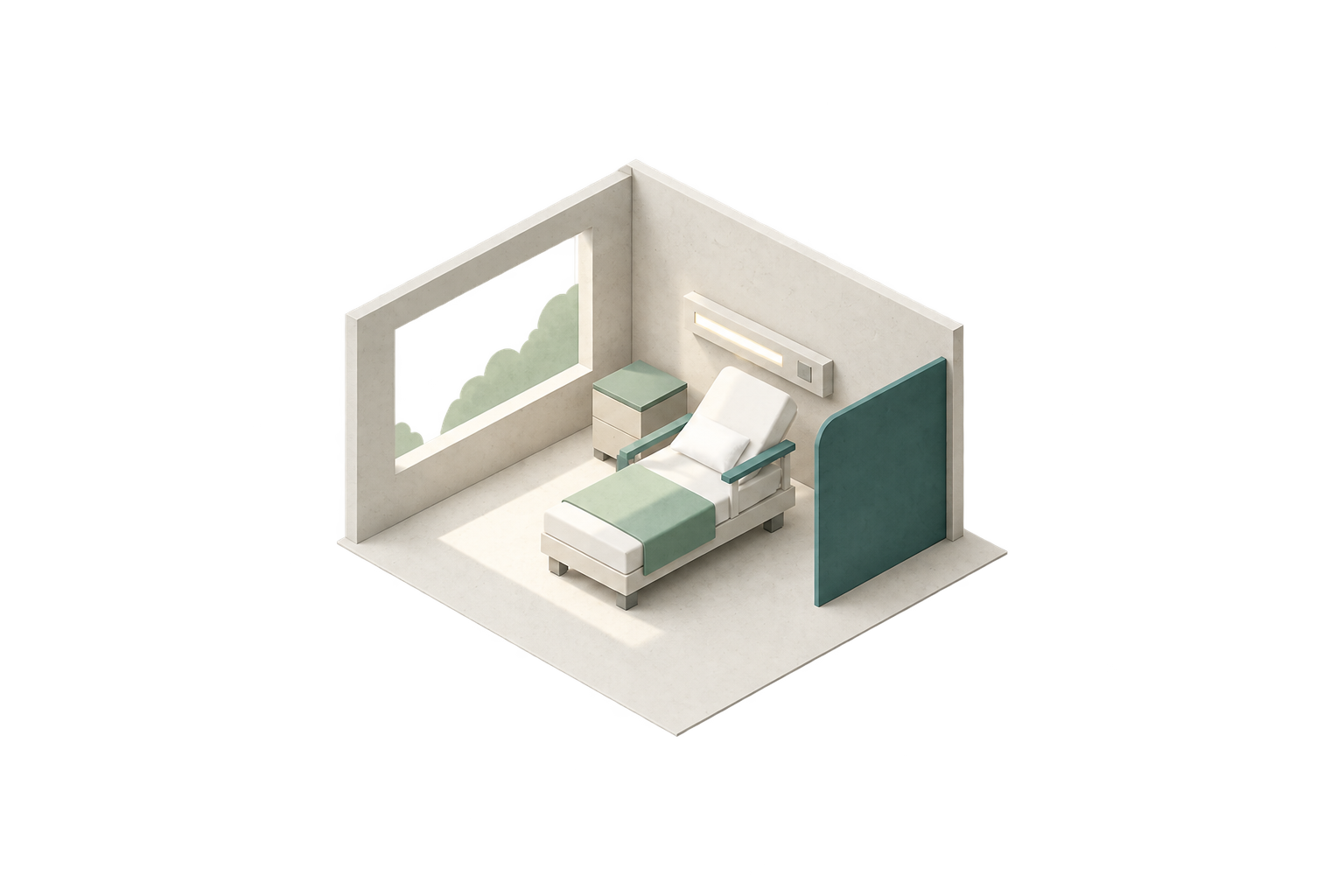
Surgical day unit and postoperative recovery ward
How can unfamiliar arrival and discharge journeys remain understandable while supporting privacy?
Setting-matched research2 linked sources · 2 peer-reviewedPeople & purpose
People undergoing surgery, escorts and clinical staff
Design question: How can unfamiliar arrival and discharge journeys remain understandable while supporting privacy?
What the evidence supports
Postoperative window cohort is directly relevant but small/old; add occupancy review and retain uncertainty.
A small surgical-room study motivates a view question; it does not validate this whole unit or its proposed outcomes.
The label describes research relevance, not study quality or a proven whole-building benefit.
Design variables to investigate
Proposed moves to develop and test for this programme.
- Arrival-to-recovery sequence
- Waiting-room choice
- Bed-level views
- Private discharge conversation rooms
Check the trade-offs
Architectural checks, not additional findings from the cited papers.
- Privacy and quieter rooms can reduce passive observation and staff contact; test visibility and workflow.
- Maintain infection control, emergency access and essential clinical lighting while offering environmental choice.
Evaluate with the intended users
- Arrival and discharge route errors
- Privacy ratings
- Visibility of required destinations
Choose a feasible outcome and comparison before testing. Record who used the space, occupancy, care or service changes, and environmental exposure; these can change the result.
Develop the design question
Related Atlas variables provide additional context. They do not verify this complete programme.
Peer-reviewed sources & research audit2 sources
Read study design, population and transfer limits together. A source reused for several building functions is still one study. Some newer sources have only selected sections or abstracts checked; the individual audit records show what remains unresolved.
Ulrich — View through a window may influence recovery from surgery (1984) ↗
Peer-reviewed research · Partial verification
Reported finding or research scope: A small matched retrospective comparison of postoperative rooms with nature and wall views.
Limits and contrary findings: 46 patients in one historical surgical context; not proof of universal healing effects or transfer to other clinical populations.
Research audit: Same publication already audited in the atlas. Reused its documented audit status and inspected the catalogue support/limit wording for consistency; not an independent replication.
Verification limits: Prior quantitative passage remains from earlier article-reproduction extraction. The cited innotre PDF now returns 404; publisher/full author manuscript could not be re-retrieved in this pass. CI reporting and outcome hierarchy therefore not newly verified against the complete paper.
Record checked 2026-10-10Clinical, humanistic and economic outcomes, including experiencing of patient safety events, associated with admitting patients to single rooms compared with shared accommodation for acute hospital admissions: a systematic review and narrative synthesis (2023) ↗
Peer-reviewed review · Abstract or limited excerpts checked
Method: Systematic review and narrative synthesis
Population / setting: Acute hospital inpatients across comparative studies
Reported finding or research scope: Reviews clinical outcomes, patient experience and economic trade-offs for single versus shared rooms in acute hospital admissions. Detailed outcome extraction remains unresolved.
Limits and contrary findings: Heterogeneous studies and often nonrandom allocation. Extract each outcome separately before making directional claims.
Research audit: Abstract and indexed body excerpts inspected; direct full-page retrieval returned CAPTCHA; detailed outcome extraction unresolved
Verification limits: Key findings and limitations were checked in the materials listed here. Exact effect estimates and supplementary analyses still require verification against the full tables and supplements.
This is a selected-source extraction, not a complete audit of every table and supplement. It does not establish numerical design thresholds or a whole-building benefit.
Record checked 2026-10-11