


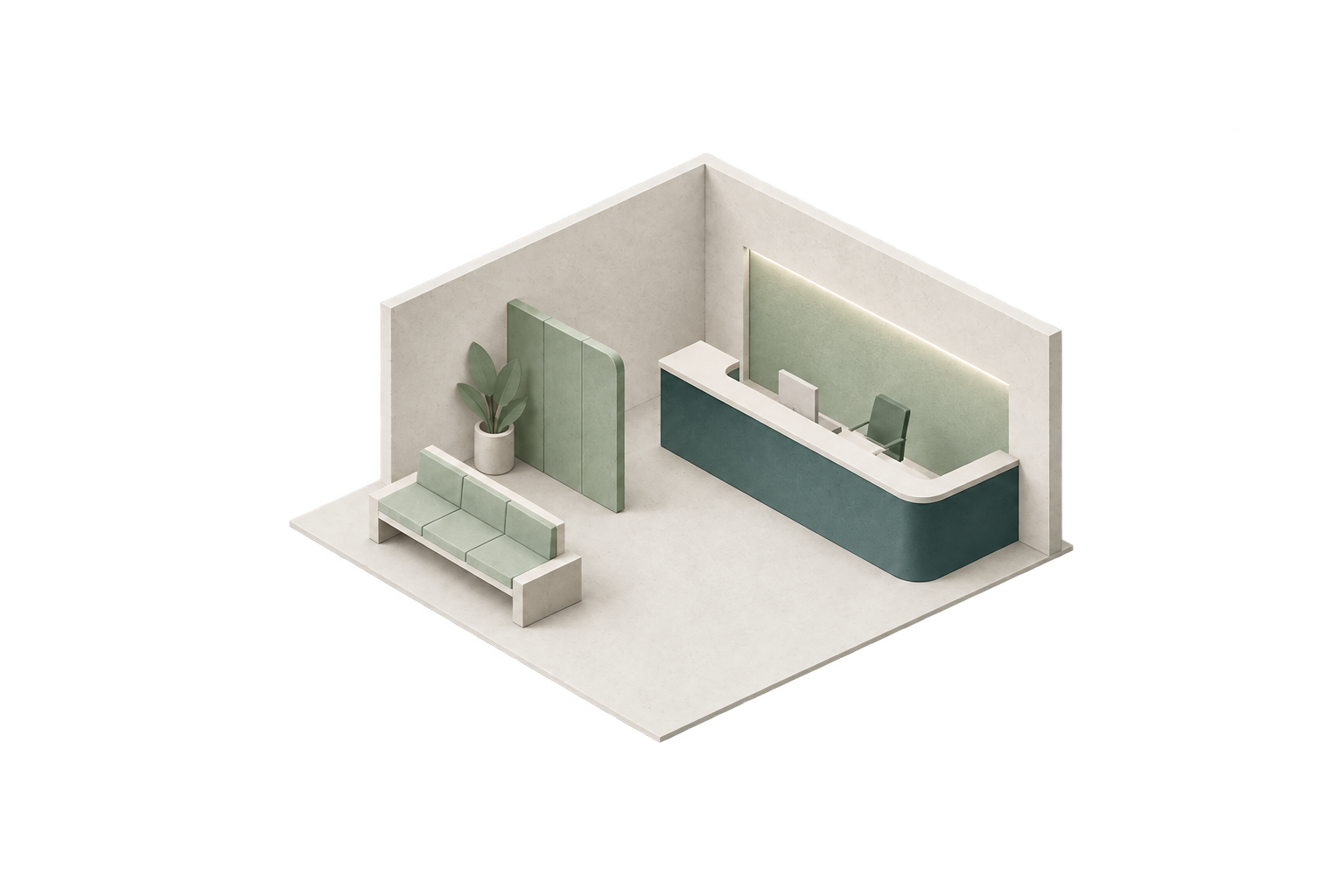
Municipal one-stop civic service centre
How can a public-service building make arrival, queuing and service routes understandable?
Related-setting transfer2 linked sources · 2 peer-reviewedPeople & purpose
Residents, first-time visitors and public-service staff
Design question: How can a public-service building make arrival, queuing and service routes understandable?
What the evidence supports
Use a clearly marked design transfer from studied populations/settings; do not imply the combined building programme was evaluated.
Transfer from multilevel-building navigation.
The label describes research relevance, not study quality or a proven whole-building benefit.
Design variables to investigate
Proposed moves to develop and test for this programme.
- Service-zone identity
- Queue legibility
- Waiting-seat choice
- Speech privacy
Check the trade-offs
Architectural checks, not additional findings from the cited papers.
- Social contact should remain optional; include quieter and more private places.
- Speech clarity, privacy and group capacity can compete; test realistic occupancy and access needs.
Evaluate with the intended users
- Wrong-counter and route observations
- User-rated waiting comfort
Choose a feasible outcome and comparison before testing. Record who used the space, occupancy, care or service changes, and environmental exposure; these can change the result.
Develop the design question
Related Atlas variables provide additional context. They do not verify this complete programme.
Peer-reviewed sources & research audit2 sources
Read study design, population and transfer limits together. A source reused for several building functions is still one study. Some newer sources have only selected sections or abstracts checked; the individual audit records show what remains unresolved.
Hölscher et al. (2006) — Up the down staircase: Wayfinding strategies in multi-level buildings (2006) ↗
Peer-reviewed research · Full-paper verification unresolved
Reported finding or research scope: Empirical navigation study in a complex multilevel building comparing experienced and inexperienced users; supports studying route choice, floor changes and spatial strategies.
Limits and contrary findings: Small study in one building. Transfers to terminals, retail and civic programmes are hypotheses, rather than population-specific findings.
Research audit: Publisher access did not provide the full body and the ETH institutional record is explicitly metadata-only; existing general scope remains abstract-supported.
Verification limits: Full methods, detailed findings and limitations not independently verified from a publisher or author/institutional full-text copy.
Record checked 2026-10-10Visual attention allocation between social and navigational cues during wayfinding: An eye-tracking study in virtual reality (2026) ↗
Peer-reviewed research · Abstract or limited excerpts checked
Method: VR airport navigation with eye tracking
Population / setting: Participants navigating a model based on Istanbul Airport; sample details need full extraction
Reported finding or research scope: Avatars drew attention from signs; no overall navigation-performance difference between conditions; signage attention predicted fewer errors.
Limits and contrary findings: Mediation is not proof avatars caused worse total performance. Simulated airport and simplified geometry.
Research audit: Author university repository abstract and indexed methods inspected: https://open.metu.edu.tr/handle/11511/118579
Verification limits: Key findings and limitations were checked in the materials listed here. Exact effect estimates and supplementary analyses still require verification against the full tables and supplements.
This is a selected-source extraction, not a complete audit of every table and supplement. It does not establish numerical design thresholds or a whole-building benefit.
Record checked 2026-10-11