


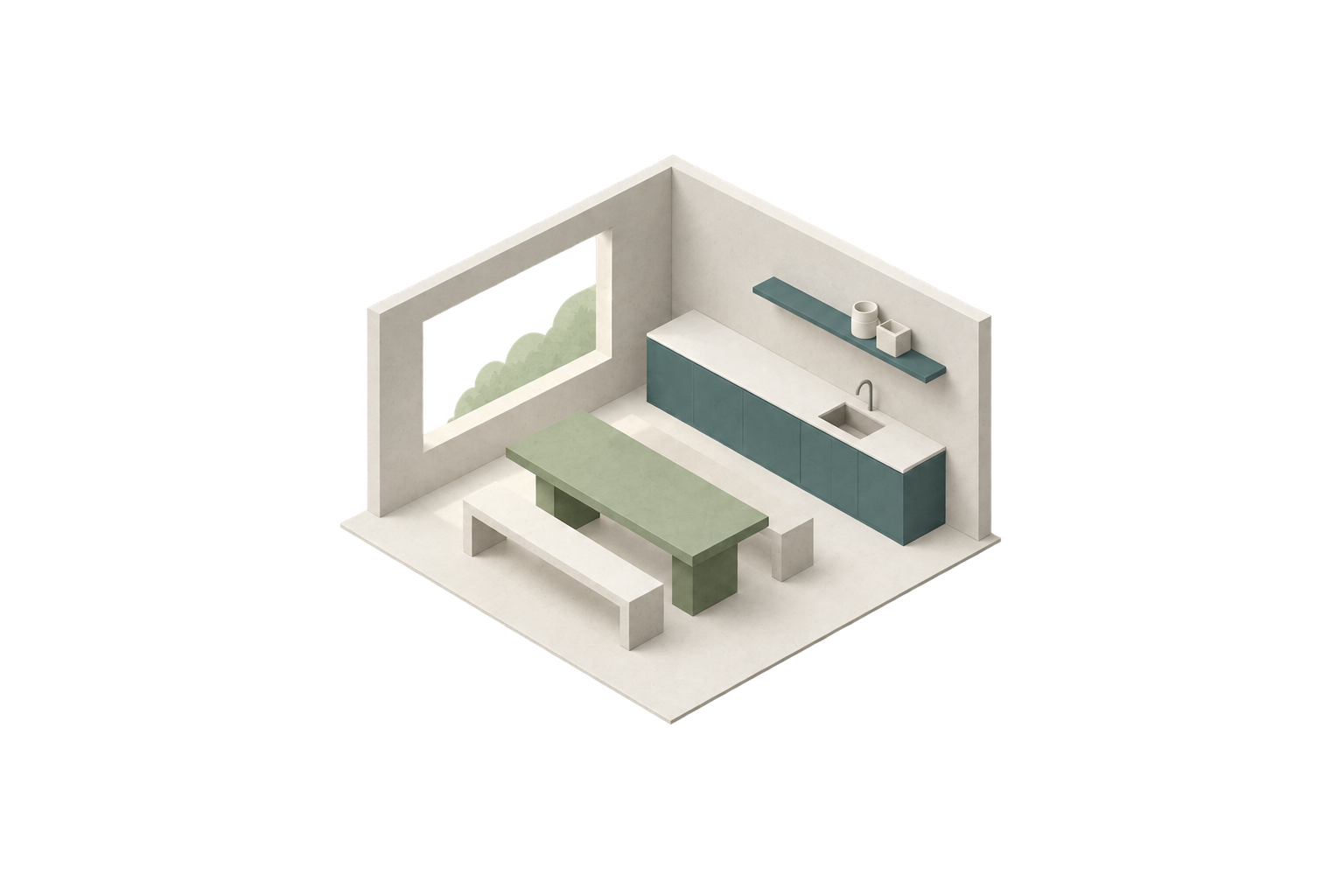
Neighbourhood food hub / community kitchen
How can food preparation and shared dining support inclusive participation?
Related-setting transfer4 linked sources · 4 peer-reviewedPeople & purpose
Residents, volunteers, cooks and programme staff
Design question: How can food preparation and shared dining support inclusive participation?
What the evidence supports
Use a clearly marked design transfer from studied populations/settings; do not imply the combined building programme was evaluated.
Shared-food-space hypothesis; verify locally.
The label describes research relevance, not study quality or a proven whole-building benefit.
Design variables to investigate
Proposed moves to develop and test for this programme.
- Kitchen/dining legibility
- Sound separation
- Small/large table choice
- Accessible work surfaces
Check the trade-offs
Architectural checks, not additional findings from the cited papers.
- Social contact should remain optional; include quieter and more private places.
- Speech clarity, privacy and group capacity can compete; test realistic occupancy and access needs.
Evaluate with the intended users
- Participation across activity zones
- User-rated social comfort
Choose a feasible outcome and comparison before testing. Record who used the space, occupancy, care or service changes, and environmental exposure; these can change the result.
Develop the design question
Related Atlas variables provide additional context. They do not verify this complete programme.
Peer-reviewed sources & research audit4 sources
Read study design, population and transfer limits together. A source reused for several building functions is still one study. Some newer sources have only selected sections or abstracts checked; the individual audit records show what remains unresolved.
Hölscher et al. (2006) — Up the down staircase: Wayfinding strategies in multi-level buildings (2006) ↗
Peer-reviewed research · Full-paper verification unresolved
Reported finding or research scope: Empirical navigation study in a complex multilevel building comparing experienced and inexperienced users; supports studying route choice, floor changes and spatial strategies.
Limits and contrary findings: Small study in one building. Transfers to terminals, retail and civic programmes are hypotheses, rather than population-specific findings.
Research audit: Publisher access did not provide the full body and the ETH institutional record is explicitly metadata-only; existing general scope remains abstract-supported.
Verification limits: Full methods, detailed findings and limitations not independently verified from a publisher or author/institutional full-text copy.
Record checked 2026-10-10Bernstein and Turban (2018) — The impact of the ‘open’ workspace on human collaboration (2018) ↗
Peer-reviewed research · Relevant full-paper sections checked
Reported finding or research scope: Two corporate-office field interventions measured changes in face-to-face and electronic communication after transitions to open layouts.
Limits and contrary findings: Two organisations; layout, privacy and organisational practice interact. Does not establish a single optimal office type.
Research audit: Same publication already audited in the atlas. Reused its documented audit status and inspected the catalogue support/limit wording for consistency; not an independent replication.
Record checked 2026-10-10Effects of a community gardening intervention on diet, physical activity, and anthropometry outcomes in the USA (CAPS): an observer-blind, randomised controlled trial (2023) ↗
Peer-reviewed research · Selected full-paper sections checked
Method: Observer-blind randomized controlled trial
Population / setting: 291 adults on Colorado community-garden waiting lists
Reported finding or research scope: Gardening allocation changed activity/fibre trajectories and reduced perceived stress/anxiety; no significant BMI, waist or combined fruit/vegetable effect.
Limits and contrary findings: A plot-plus-programme package, not geometry alone. Point-in-time confidence intervals and null outcomes must remain visible.
Research audit: Full text: methods, findings, discussion and limitations inspected
Verification limits: Key findings and limitations were checked in the materials listed here. Exact effect estimates and supplementary analyses still require verification against the full tables and supplements.
This is a selected-source extraction, not a complete audit of every table and supplement. It does not establish numerical design thresholds or a whole-building benefit.
Record checked 2026-10-11Effect of background noise on food perception (2011) ↗
Peer-reviewed research · Abstract or limited excerpts checked
Method: Two controlled sensory experiments
Population / setting: Participants tasting foods with quiet/loud/no white noise
Reported finding or research scope: Loud noise reduced reported sweetness/saltiness and increased crunchiness ratings.
Limits and contrary findings: Laboratory white noise and sensory ratings; not evidence of better digestion, nutrition or clinical eating-disorder outcomes.
Research audit: Publisher abstract/method summary inspected
Verification limits: Key findings and limitations were checked in the materials listed here. Exact effect estimates and supplementary analyses still require verification against the full tables and supplements.
This is a selected-source extraction, not a complete audit of every table and supplement. It does not establish numerical design thresholds or a whole-building benefit.
Record checked 2026-10-11