


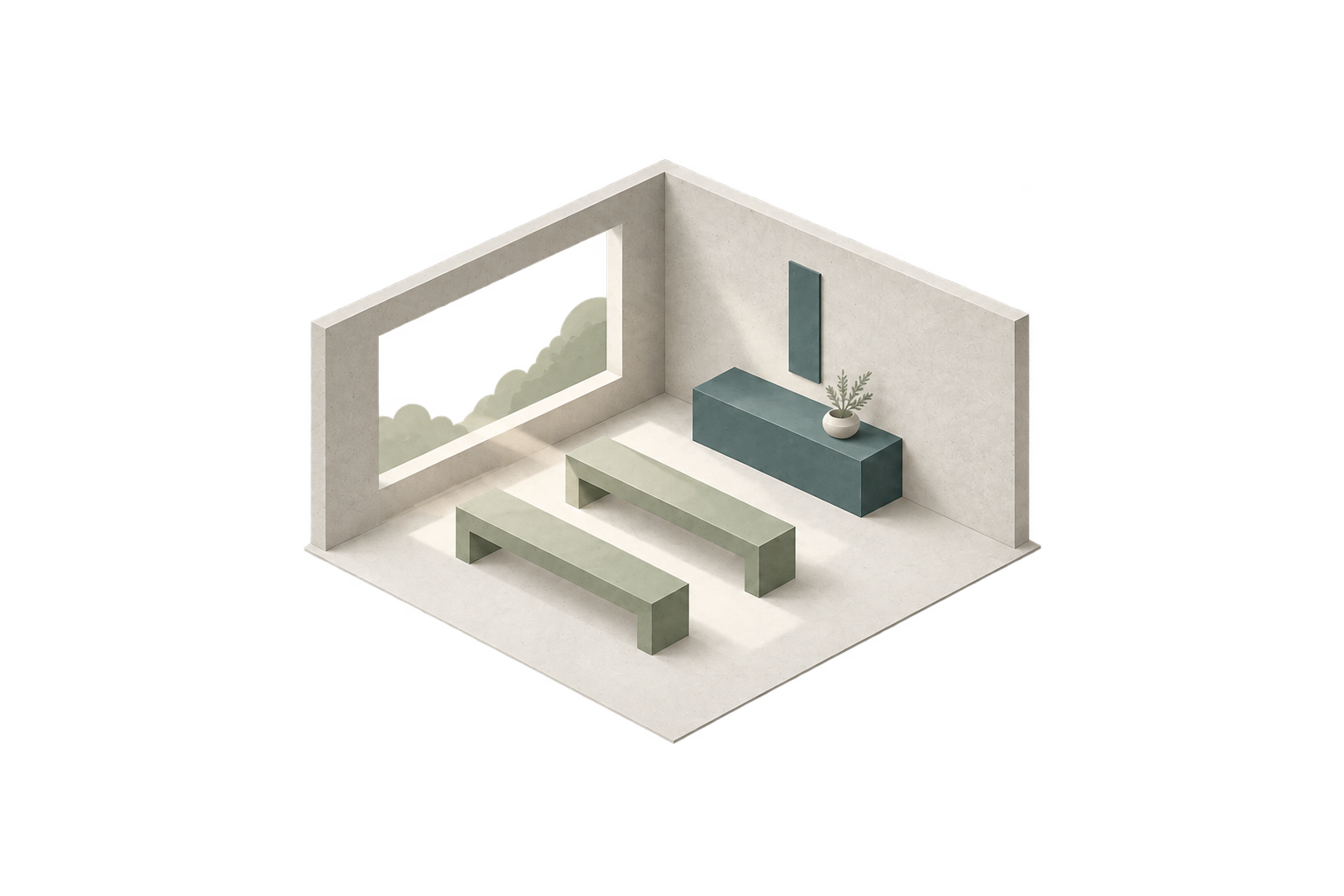
Funeral / memorial gathering building
How can a ceremonial building provide understandable routes and choices for privacy?
Exploratory brief2 linked sources · 2 peer-reviewedPeople & purpose
Bereaved families, visitors and ceremony staff
Design question: How can a ceremonial building provide understandable routes and choices for privacy?
What the evidence supports
No sufficiently matched environmental-outcome evidence identified in this bounded scan. Keep as a research brief; hold benefit claims and prioritize population-specific search/co-design.
Bereavement-space effects require sensitive study.
The label describes research relevance, not study quality or a proven whole-building benefit.
Design variables to investigate
Proposed moves to develop and test for this programme.
- Arrival sequence
- Private/communal gradients
- Light and views
- Garden access
Check the trade-offs
Architectural checks, not additional findings from the cited papers.
- Social contact should remain optional; include quieter and more private places.
- Speech clarity, privacy and group capacity can compete; test realistic occupancy and access needs.
Evaluate with the intended users
- Use of private and communal areas
- User-rated dignity and spatial comfort
Choose a feasible outcome and comparison before testing. Record who used the space, occupancy, care or service changes, and environmental exposure; these can change the result.
Develop the design question
Related Atlas variables provide additional context. They do not verify this complete programme.
Peer-reviewed sources & research audit2 sources
Read study design, population and transfer limits together. A source reused for several building functions is still one study.
Hölscher et al. (2006) — Up the down staircase: Wayfinding strategies in multi-level buildings (2006) ↗
Peer-reviewed research · Full-paper verification unresolved
Reported finding or research scope: Empirical navigation study in a complex multilevel building comparing experienced and inexperienced users; supports studying route choice, floor changes and spatial strategies.
Limits and contrary findings: Small study in one building. Transfers to terminals, retail and civic programmes are hypotheses, rather than population-specific findings.
Research audit: Publisher access did not provide the full body and the ETH institutional record is explicitly metadata-only; existing general scope remains abstract-supported.
Verification limits: Full methods, detailed findings and limitations not independently verified from a publisher or author/institutional full-text copy.
Record checked 2026-10-10Berman, Jonides and Kaplan (2008) — The Cognitive Benefits of Interacting With Nature (2008) ↗
Peer-reviewed research · Relevant full-paper sections checked
Reported finding or research scope: Two small experiments compared nature with urban exposure: walking improved backward-span change; photograph exposure favored the executive-attention interaction, while its backward-span and alerting/orienting interactions were not reliable.
Limits and contrary findings: Short exposures and cognitive tasks; does not determine a universal planting recipe, guarantee restoration for every user or establish effects for specific buildings.
Research audit: Same publication already audited in the atlas. Reused its documented audit status and inspected the catalogue support/limit wording for consistency; not an independent replication.
Record checked 2026-10-10