


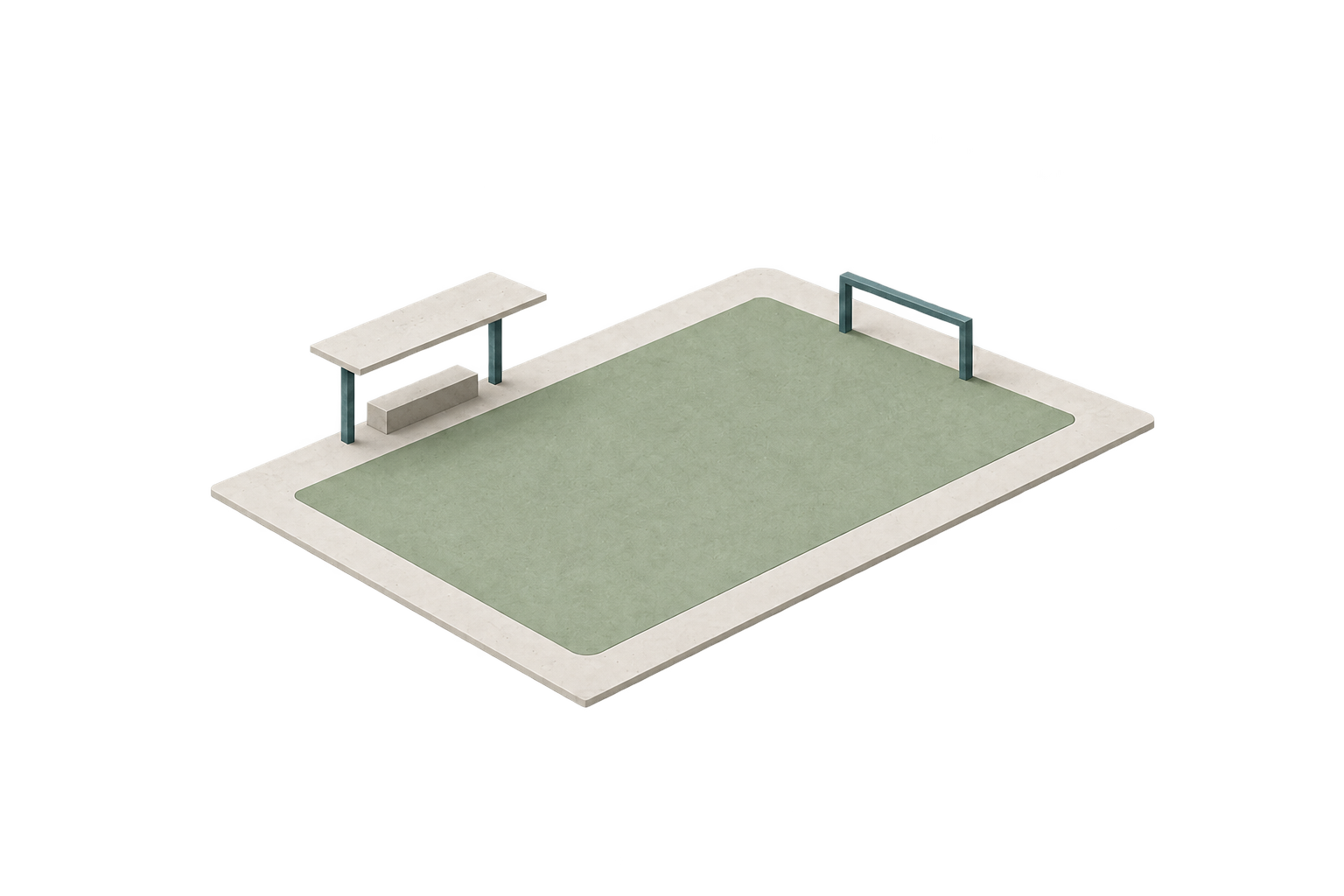
Outdoor sports / playing-field complex (landscape)
How can activity routes, rest areas and spectator places support inclusive use?
Related-setting transfer2 linked sources · 2 peer-reviewedPeople & purpose
Players, local residents, coaches and spectators
Design question: How can activity routes, rest areas and spectator places support inclusive use?
What the evidence supports
Use a clearly marked design transfer from studied populations/settings; do not imply the combined building programme was evaluated.
Park evidence; design variables remain hypotheses.
The label describes research relevance, not study quality or a proven whole-building benefit.
Design variables to investigate
Proposed moves to develop and test for this programme.
- Field-route legibility
- Shade and shelter
- Rest-space distribution
- Accessible perimeter paths
Check the trade-offs
Architectural checks, not additional findings from the cited papers.
- Offer manageable challenge with resting options and routes appropriate to mobility and experience.
- Outdoor access also brings heat, cold, air-quality and supervision constraints.
Evaluate with the intended users
- Observed activity participation
- Use of shaded and rest areas
Choose a feasible outcome and comparison before testing. Record who used the space, occupancy, care or service changes, and environmental exposure; these can change the result.
Develop the design question
Related Atlas variables provide additional context. They do not verify this complete programme.
Peer-reviewed sources & research audit2 sources
Read study design, population and transfer limits together. A source reused for several building functions is still one study. Some newer sources have only selected sections or abstracts checked; the individual audit records show what remains unresolved.
Cohen et al. (2013) — Increasing Physical Activity in Parks: Results of a Randomized Controlled Intervention Trial Using Community-Based Participatory Research (2013) ↗
Peer-reviewed research · Relevant full-paper sections checked
Reported finding or research scope: Trial in 50 Los Angeles neighbourhood park/recreation centres tested community feedback, outreach, training and discretionary programme funding; used observed park use and activity.
Limits and contrary findings: A programming and management intervention, not a trial of architectural form. Supports participation measures and co-design; proposed spatial variables require independent validation.
Research audit: Body confirms programming, outreach, feedback and discretionary funding rather than isolated architectural form. Parks were randomized and observed use/activity improved in combined intervention arms; added advisory-board involvement was not separately superior.
Record checked 2026-10-10Acute effects of outdoor versus indoor exercise: a systematic review and meta-analysis (2024) ↗
Peer-reviewed review · Selected full-paper sections checked
Method: Systematic review/meta-analysis of controlled acute exercise studies
Population / setting: 38 articles, 1168 participants, mainly healthy
Reported finding or research scope: Outdoor exercise was more enjoyable; other physiological/performance findings were inconclusive or nonsignificant.
Limits and contrary findings: Heterogeneity/high risk of bias; does not validate any gym layout or clinical recovery claim.
Research audit: Full publisher methods and synthesis inspected
Verification limits: Key findings and limitations were checked in the materials listed here. Exact effect estimates and supplementary analyses still require verification against the full tables and supplements.
This is a selected-source extraction, not a complete audit of every table and supplement. It does not establish numerical design thresholds or a whole-building benefit.
Record checked 2026-10-11