


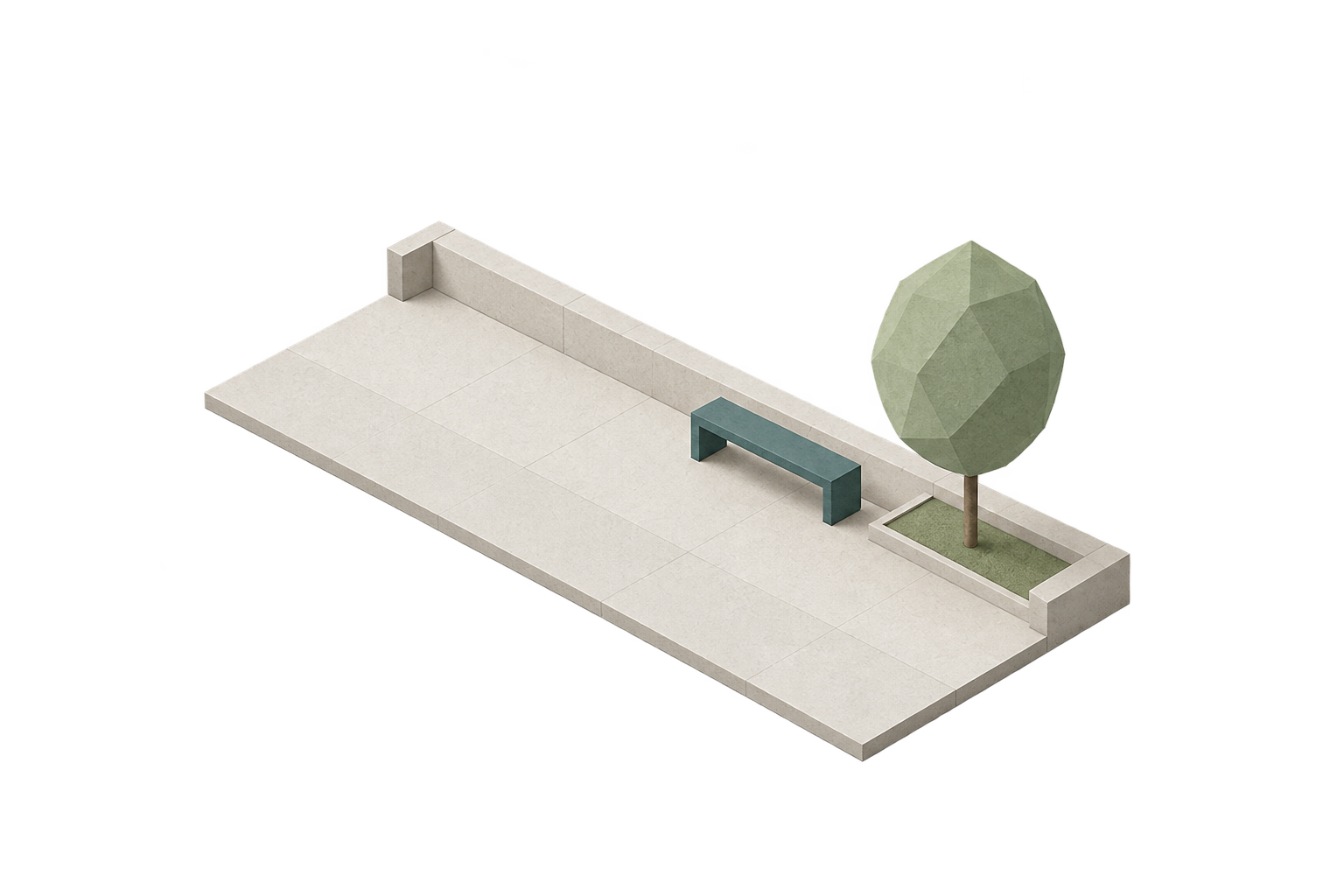
Pedestrian street / public promenade (landscape)
How can a linear public route balance movement, pauses and sensory variety?
Related-setting transfer3 linked sources · 3 peer-reviewedPeople & purpose
Pedestrians, local residents and visitors
Design question: How can a linear public route balance movement, pauses and sensory variety?
What the evidence supports
Use a clearly marked design transfer from studied populations/settings; do not imply the combined building programme was evaluated.
Transfer from walking and navigation studies.
The label describes research relevance, not study quality or a proven whole-building benefit.
Design variables to investigate
Proposed moves to develop and test for this programme.
- Route continuity
- Landmarks
- Shade and seating intervals
- Traffic-noise separation
Check the trade-offs
Architectural checks, not additional findings from the cited papers.
- Balance restorative contact with shade, accessibility, maintenance and perceived safety.
- Water, planting and varied terrain need appropriate hygiene, supervision and safe accessible routes.
Evaluate with the intended users
- Walking and stopping patterns
- User-rated route comfort
Choose a feasible outcome and comparison before testing. Record who used the space, occupancy, care or service changes, and environmental exposure; these can change the result.
Develop the design question
Related Atlas variables provide additional context. They do not verify this complete programme.
Peer-reviewed sources & research audit3 sources
Read study design, population and transfer limits together. A source reused for several building functions is still one study. Some newer sources have only selected sections or abstracts checked; the individual audit records show what remains unresolved.
Berman, Jonides and Kaplan (2008) — The Cognitive Benefits of Interacting With Nature (2008) ↗
Peer-reviewed research · Relevant full-paper sections checked
Reported finding or research scope: Two small experiments compared nature with urban exposure: walking improved backward-span change; photograph exposure favored the executive-attention interaction, while its backward-span and alerting/orienting interactions were not reliable.
Limits and contrary findings: Short exposures and cognitive tasks; does not determine a universal planting recipe, guarantee restoration for every user or establish effects for specific buildings.
Research audit: Same publication already audited in the atlas. Reused its documented audit status and inspected the catalogue support/limit wording for consistency; not an independent replication.
Record checked 2026-10-10Hölscher et al. (2006) — Up the down staircase: Wayfinding strategies in multi-level buildings (2006) ↗
Peer-reviewed research · Full-paper verification unresolved
Reported finding or research scope: Empirical navigation study in a complex multilevel building comparing experienced and inexperienced users; supports studying route choice, floor changes and spatial strategies.
Limits and contrary findings: Small study in one building. Transfers to terminals, retail and civic programmes are hypotheses, rather than population-specific findings.
Research audit: Publisher access did not provide the full body and the ETH institutional record is explicitly metadata-only; existing general scope remains abstract-supported.
Verification limits: Full methods, detailed findings and limitations not independently verified from a publisher or author/institutional full-text copy.
Record checked 2026-10-10Physical and mental health effects of repeated short walks in a blue space environment: a randomised crossover study (2020) ↗
Peer-reviewed research · Abstract or limited excerpts checked
Method: Randomized crossover repeated walking study
Population / setting: 59 healthy adult office workers in Barcelona
Reported finding or research scope: Blue-space walks improved immediate self-reported mood/wellbeing compared with urban walks/rest; cardiovascular benefit not established.
Limits and contrary findings: Whole coastal route plus movement, not an indoor fountain, aquatic centre or isolated water sound.
Research audit: Research-project report and university author-manuscript indexed abstract inspected; complete body audit pending
Verification limits: Key findings and limitations were checked in the materials listed here. Exact effect estimates and supplementary analyses still require verification against the full tables and supplements.
This is a selected-source extraction, not a complete audit of every table and supplement. It does not establish numerical design thresholds or a whole-building benefit.
Record checked 2026-10-11