


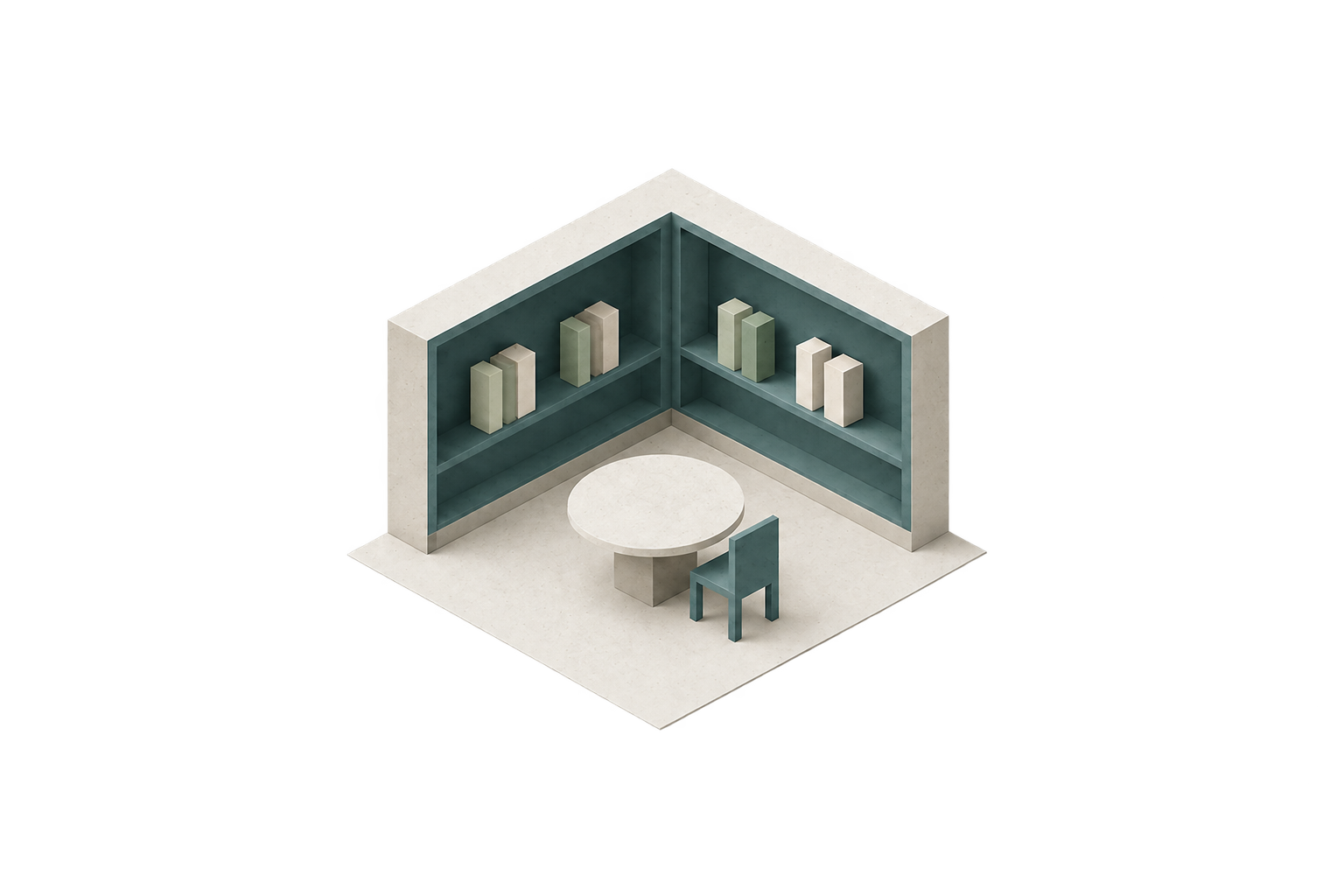
Public library
How can the library offer clear choices between silence, conversation and communal learning?
Setting-matched research3 linked sources · 3 peer-reviewedPeople & purpose
Readers, learners, families and library staff
Design question: How can the library offer clear choices between silence, conversation and communal learning?
What the evidence supports
Library-specific acoustic simulation exists; mainly null cognitive outcomes.
Inference; library effects need testing.
The label describes research relevance, not study quality or a proven whole-building benefit.
Design variables to investigate
Proposed moves to develop and test for this programme.
- Acoustic zoning
- Collection and route legibility
- Daylight
- Study-seat choice
Check the trade-offs
Architectural checks, not additional findings from the cited papers.
- Distinctive experiences can increase complexity; keep exits and basic destinations easy to identify.
- Control glare and sound while meeting exhibit conservation and accessibility requirements.
Evaluate with the intended users
- Requests for navigation help
- Reported concentration and inclusion
Choose a feasible outcome and comparison before testing. Record who used the space, occupancy, care or service changes, and environmental exposure; these can change the result.
Develop the design question
Related Atlas variables provide additional context. They do not verify this complete programme.
Peer-reviewed sources & research audit3 sources
Read study design, population and transfer limits together. A source reused for several building functions is still one study. Some newer sources have only selected sections or abstracts checked; the individual audit records show what remains unresolved.
Hölscher et al. (2006) — Up the down staircase: Wayfinding strategies in multi-level buildings (2006) ↗
Peer-reviewed research · Full-paper verification unresolved
Reported finding or research scope: Empirical navigation study in a complex multilevel building comparing experienced and inexperienced users; supports studying route choice, floor changes and spatial strategies.
Limits and contrary findings: Small study in one building. Transfers to terminals, retail and civic programmes are hypotheses, rather than population-specific findings.
Research audit: Publisher access did not provide the full body and the ETH institutional record is explicitly metadata-only; existing general scope remains abstract-supported.
Verification limits: Full methods, detailed findings and limitations not independently verified from a publisher or author/institutional full-text copy.
Record checked 2026-10-10Allen et al. (2016) — Associations of Cognitive Function Scores with Carbon Dioxide, Ventilation, and Volatile Organic Compound Exposures in Office Workers (2016) ↗
Peer-reviewed research · Relevant full-paper sections checked
Reported finding or research scope: Controlled exposure study in 24 office workers over six workdays; supports testing indoor air conditions alongside cognition in knowledge-work settings.
Limits and contrary findings: Small sample and simulated office exposures; scores on a decision-making test are not equivalent to productivity or clinical outcomes.
Research audit: Same publication already audited in the atlas. Reused its documented audit status and inspected the catalogue support/limit wording for consistency; not an independent replication.
Record checked 2026-10-10Noise perception and cognitive effort in the simulated reverberant and quiet environment of the New Central Civic Library of Torino (2026) ↗
Peer-reviewed research · Abstract or limited excerpts checked
Method: Laboratory headphone experiment with simulated library acoustics
Population / setting: 24 normal-hearing adults aged 20–55
Reported finding or research scope: Most cognitive outcomes did not differ between noise and silence; a semantic task showed slight deterioration.
Limits and contrary findings: Simulation, small sample and outcome-specific effects. Avoid the stronger general claim in article highlights that all complex task performance declines.
Research audit: Publisher abstract inspected; full body pending. Journal issue dated 1 January 2026
Verification limits: Key findings and limitations were checked in the materials listed here. Exact effect estimates and supplementary analyses still require verification against the full tables and supplements.
This is a selected-source extraction, not a complete audit of every table and supplement. It does not establish numerical design thresholds or a whole-building benefit.
Record checked 2026-10-11