


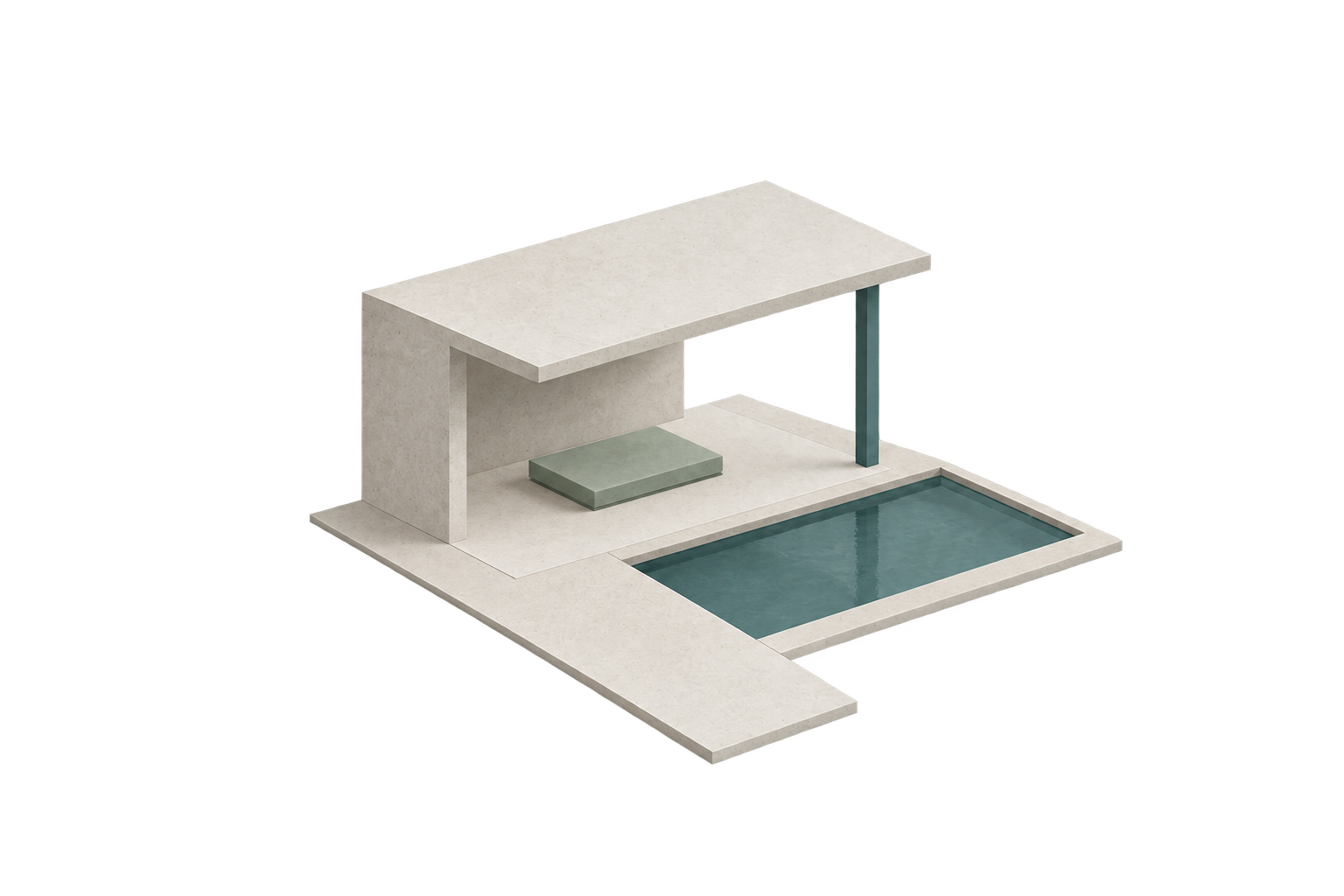
Retreat / contemplative centre (mixed-use)
How can communal programmes, private reflection and overnight rest coexist?
Related-setting transfer3 linked sources · 3 peer-reviewedPeople & purpose
Retreat guests, facilitators and staff
Design question: How can communal programmes, private reflection and overnight rest coexist?
What the evidence supports
Use a clearly marked design transfer from studied populations/settings; do not imply the combined building programme was evaluated.
Inference; programme-specific effects need testing.
The label describes research relevance, not study quality or a proven whole-building benefit.
Design variables to investigate
Proposed moves to develop and test for this programme.
- Quiet/social gradients
- Bedroom noise separation
- Outdoor contemplative routes
- Light control
Check the trade-offs
Architectural checks, not additional findings from the cited papers.
- Balance views and daylight with nighttime darkness, privacy, overheating and room noise.
- Provide simple controls and an alternative to unwanted ambient music, scent or bright light.
Evaluate with the intended users
- Use of private and communal settings
- User-rated restfulness
Choose a feasible outcome and comparison before testing. Record who used the space, occupancy, care or service changes, and environmental exposure; these can change the result.
Develop the design question
Related Atlas variables provide additional context. They do not verify this complete programme.
Peer-reviewed sources & research audit3 sources
Read study design, population and transfer limits together. A source reused for several building functions is still one study. Some newer sources have only selected sections or abstracts checked; the individual audit records show what remains unresolved.
Basner and McGuire (2018) — WHO Environmental Noise Guidelines for the European Region: A Systematic Review on Environmental Noise and Effects on Sleep (2018) ↗
Peer-reviewed review · Relevant full-paper sections checked
Reported finding or research scope: Systematic review of 74 non-laboratory studies evaluating environmental noise and sleep, with evidence quality assessed using GRADE.
Limits and contrary findings: Evidence strength differs by noise source and measure. Supports noise exposure research; hotel layouts and material choices still require local acoustic evaluation.
Research audit: Peer-reviewed systematic review commissioned for WHO guidance, not itself a hotel-design guideline. Evidence was stronger for transportation noise; hospital/wind-turbine evidence was conflicting or emerging.
Record checked 2026-10-10Berman, Jonides and Kaplan (2008) — The Cognitive Benefits of Interacting With Nature (2008) ↗
Peer-reviewed research · Relevant full-paper sections checked
Reported finding or research scope: Two small experiments compared nature with urban exposure: walking improved backward-span change; photograph exposure favored the executive-attention interaction, while its backward-span and alerting/orienting interactions were not reliable.
Limits and contrary findings: Short exposures and cognitive tasks; does not determine a universal planting recipe, guarantee restoration for every user or establish effects for specific buildings.
Research audit: Same publication already audited in the atlas. Reused its documented audit status and inspected the catalogue support/limit wording for consistency; not an independent replication.
Record checked 2026-10-10Examining key hotel attributes for guest sleep and overall satisfaction (2021) ↗
Peer-reviewed research · Indexed article sections checked
Method: Cross-sectional survey
Population / setting: 609 frequent business and leisure travellers
Reported finding or research scope: Bedding and room/HVAC noise complaints were associated with poorer sleep satisfaction.
Limits and contrary findings: Self-report/recall and confounding; no experiment or objective sleep measure. Sleep satisfaction is not sleep physiology.
Research audit: Indexed abstract and full-body limitations excerpts inspected; full page retrieval blocked
Verification limits: Key findings and limitations were checked in the materials listed here. Exact effect estimates and supplementary analyses still require verification against the full tables and supplements.
This is a selected-source extraction, not a complete audit of every table and supplement. It does not establish numerical design thresholds or a whole-building benefit.
Record checked 2026-10-11