


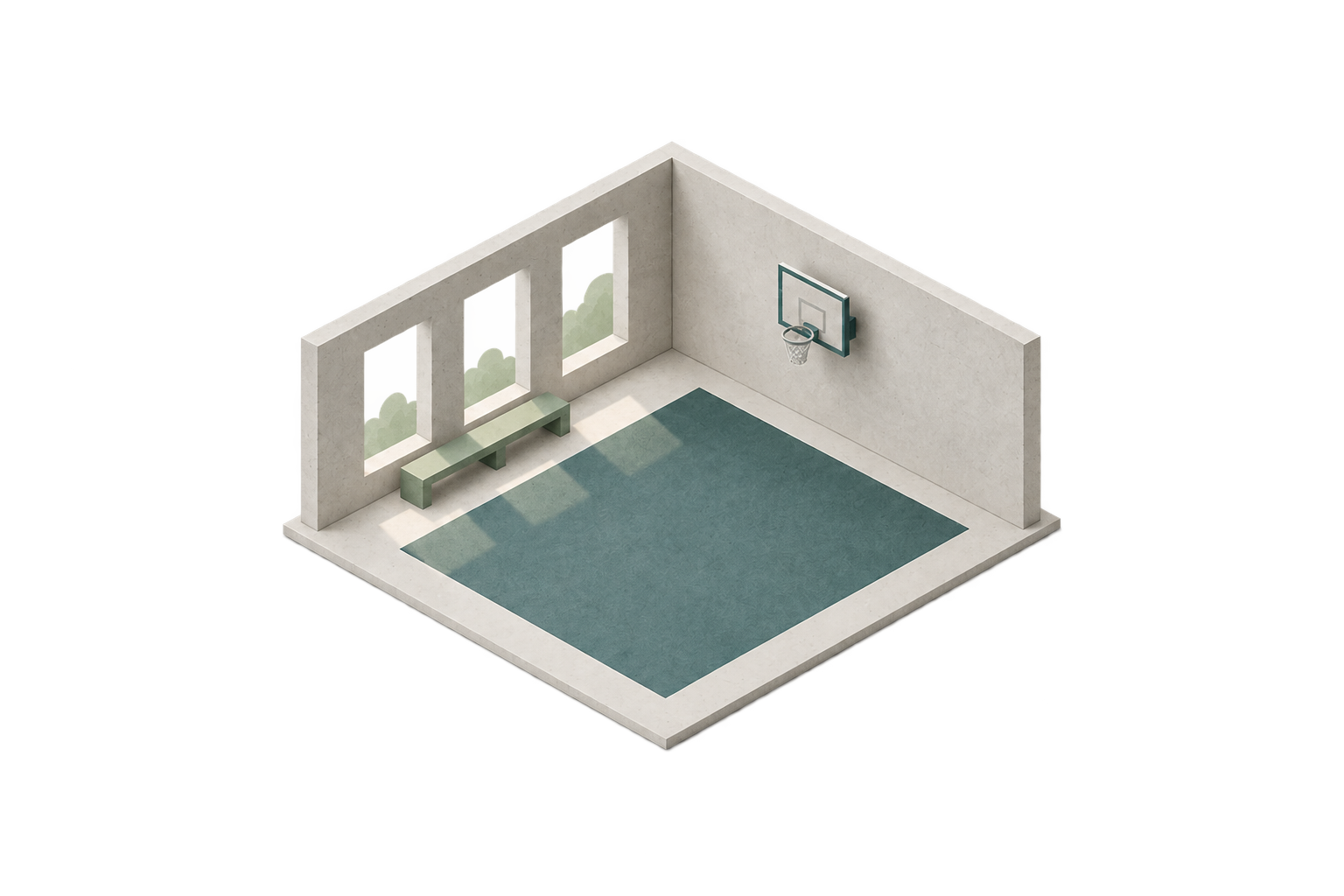
Community sports hall
How can a shared hall support understandable arrival and comfortable participation?
Related-setting transfer3 linked sources · 3 peer-reviewedPeople & purpose
Participants, instructors, spectators and staff
Design question: How can a shared hall support understandable arrival and comfortable participation?
What the evidence supports
Use a clearly marked design transfer from studied populations/settings; do not imply the combined building programme was evaluated.
Indoor-sport transfer requires validation.
The label describes research relevance, not study quality or a proven whole-building benefit.
Design variables to investigate
Proposed moves to develop and test for this programme.
- Changing/activity route clarity
- Spectator/player separation
- Acoustic zoning
- Rest-seat placement
Check the trade-offs
Architectural checks, not additional findings from the cited papers.
- Offer manageable challenge with resting options and routes appropriate to mobility and experience.
- Outdoor access also brings heat, cold, air-quality and supervision constraints.
Evaluate with the intended users
- Participation and spectator-use patterns
- User-rated spatial comfort
Choose a feasible outcome and comparison before testing. Record who used the space, occupancy, care or service changes, and environmental exposure; these can change the result.
Develop the design question
Related Atlas variables provide additional context. They do not verify this complete programme.
Peer-reviewed sources & research audit3 sources
Read study design, population and transfer limits together. A source reused for several building functions is still one study. Some newer sources have only selected sections or abstracts checked; the individual audit records show what remains unresolved.
Hölscher et al. (2006) — Up the down staircase: Wayfinding strategies in multi-level buildings (2006) ↗
Peer-reviewed research · Full-paper verification unresolved
Reported finding or research scope: Empirical navigation study in a complex multilevel building comparing experienced and inexperienced users; supports studying route choice, floor changes and spatial strategies.
Limits and contrary findings: Small study in one building. Transfers to terminals, retail and civic programmes are hypotheses, rather than population-specific findings.
Research audit: Publisher access did not provide the full body and the ETH institutional record is explicitly metadata-only; existing general scope remains abstract-supported.
Verification limits: Full methods, detailed findings and limitations not independently verified from a publisher or author/institutional full-text copy.
Record checked 2026-10-10Cohen et al. (2013) — Increasing Physical Activity in Parks: Results of a Randomized Controlled Intervention Trial Using Community-Based Participatory Research (2013) ↗
Peer-reviewed research · Relevant full-paper sections checked
Reported finding or research scope: Trial in 50 Los Angeles neighbourhood park/recreation centres tested community feedback, outreach, training and discretionary programme funding; used observed park use and activity.
Limits and contrary findings: A programming and management intervention, not a trial of architectural form. Supports participation measures and co-design; proposed spatial variables require independent validation.
Research audit: Body confirms programming, outreach, feedback and discretionary funding rather than isolated architectural form. Parks were randomized and observed use/activity improved in combined intervention arms; added advisory-board involvement was not separately superior.
Record checked 2026-10-10Acute effects of outdoor versus indoor exercise: a systematic review and meta-analysis (2024) ↗
Peer-reviewed review · Selected full-paper sections checked
Method: Systematic review/meta-analysis of controlled acute exercise studies
Population / setting: 38 articles, 1168 participants, mainly healthy
Reported finding or research scope: Outdoor exercise was more enjoyable; other physiological/performance findings were inconclusive or nonsignificant.
Limits and contrary findings: Heterogeneity/high risk of bias; does not validate any gym layout or clinical recovery claim.
Research audit: Full publisher methods and synthesis inspected
Verification limits: Key findings and limitations were checked in the materials listed here. Exact effect estimates and supplementary analyses still require verification against the full tables and supplements.
This is a selected-source extraction, not a complete audit of every table and supplement. It does not establish numerical design thresholds or a whole-building benefit.
Record checked 2026-10-11