


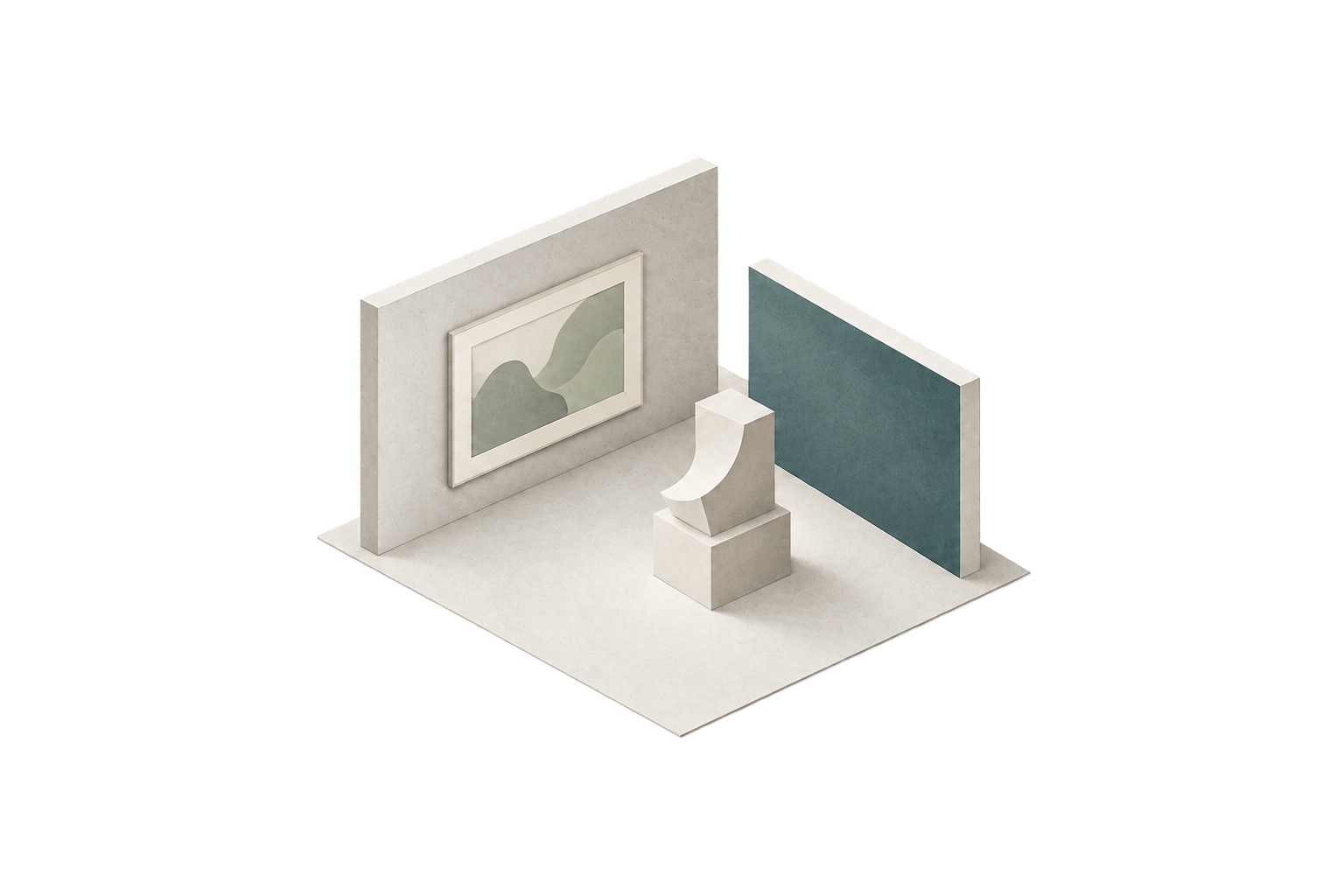
Curiosity with room to pause
Sequence offset exhibition walls and sculptural islands so visitors alternate between discovery and a clear next destination. Use a restrained visual rhythm and pause benches to offer choice in pace, while testing how much complexity invites curiosity rather than confusion.
People & purpose
emotion, perception, memory, curiosity
Evaluate the proposal
Route choices, recall, dwell time and reported curiosity or confusion.
Design decisions and supporting evidence
Design move · hypothesis
Compare curved and rectilinear furniture or room-edge treatments.
Findings across linked studies
In an exploratory photograph study, curved interiors were more often judged beautiful; no statistically significant contour difference was detected in approach–avoidance decisions. (Vartanian et al. (2013))
Peer-reviewed sources & research audit 3 papers
Vartanian et al. (2013) · PNAS
- Method
- Exploratory fMRI photograph experiment; two counterbalanced behavioral judgment runs.
- Participants / setting
- 18 neurologically healthy right-handed adults; 12 women, 6 men; mean age 23.39 years
- Study focus
- Compares curved and rectilinear interior photographs during beauty and approach judgments.
- Finding used
- Curved interiors received more beauty judgments and a task-related ACC contrast; no statistically significant difference in approach–avoidance choices was detected.
- Architectural relevance
- Compare contour preferences and entry choices independently.
- Study-specific quantitative result
- Geometry / contour: Binary beauty judgments and hypothetical entry choices Curvilinear versus rectilinear interiors 18 adults Architectural photographs shown for 3 seconds in an MRI task Beauty: Wilcoxon Z = −2.13, p < .05. Approach–avoidance: Z = −1.27, p = .21. Uncertainty: Confidence intervals for these contrasts were not reported in the inspected Results text. Analysis: exploratory The beauty contrast does not establish an effect on entry behavior, comfort or health. Material checked: Author-hosted published full text: Introduction explicitly describes exploratory study; Methods and Behavioral Results verified.
- Interpretation limits
- 18 participants; 2015 analyses reuse these data. Covarying image properties and small uncorrected neural contrasts limit interpretation.
- Verification status
- Full paper · relevant sections checked
- Sections checked
- Introduction p.1 · Methods p.6 · Behavioral Results p.3
- Unresolved / verification limits
- Study explicitly described as exploratory; formal primary/secondary outcome hierarchy not declared.
Vartanian et al. (2019) · Psychology of Aesthetics, Creativity, and the Arts
- Method
- Behavioral photograph judgments; binary beauty/entry decisions, mixed models, counterbalanced task/image assignment.
- Participants / setting
- 71 self-identified designers/architects at a Canadian conference; 71 Spanish university nonexperts.
- Study focus
- Compares contour judgments by architects/designers and nonexperts.
- Finding used
- Contour effects differed by expertise and task: experts favored curves for beauty, nonexperts for entry; the complementary contrasts were nonsignificant.
- Architectural relevance
- Compare beauty and willingness to enter separately with intended users.
- Interpretation limits
- Only eight photographs; expertise, country and collection setting covaried; no brain recording.
- Verification status
- Full paper · relevant sections checked
- Sections checked
- Methods pp.111–112 · Results pp.112–113 · Discussion pp.113–114
- Unresolved / verification limits
- Hypotheses stated; formal outcome hierarchy not declared.
Banaei et al. (2017) · Frontiers in Human Neuroscience
- Method
- Walking VR with EEG/source estimation and SAM affect ratings; preliminary rating-based room selection and further data-derived grouping.
- Participants / setting
- EEG study: 17 recruited, 15 analyzed. Preliminary room-rating study: 40 recruited, 39 analyzed.
- Study focus
- Records EEG while people walk through different virtual interior forms.
- Finding used
- Form and perspective contrasts were associated with estimated cingulate and occipital EEG sources.
- Architectural relevance
- Adds mobile EEG evidence about interior forms; it does not establish a universal benefit of curves.
- Interpretation limits
- Groups were formed from the same emotional ratings tested by the ANOVA; that contrast is descriptive, not independent validation. EEG localization is uncertain; circulation efficiency was not manipulated.
- Verification status
- Full paper · relevant sections checked
- Sections checked
- Participants · Experimental Design and Procedure · SAM Ratings
- Unresolved / verification limits
- Formal primary/secondary outcome hierarchy not declared in the inspected Methods/Results.
Transfer limit: Furniture is a transfer from interior-image research; curves are not a universal wellbeing intervention.
Design move · hypothesis
Compare a restrained display field with a visually busy one.
Findings across linked studies
Image statistics changed viewing behavior. (Valtchanov & Ellard (2015)) Decorated classroom walls increased off-task behavior and reduced learning gains in short lessons. (Fisher, Godwin & Seltman (2014))
Peer-reviewed sources & research audit 6 papers
Valtchanov & Ellard (2015) · Journal of Environmental Psychology
- Method
- Controlled image-viewing experiment; head-mounted display, monocular eye tracking and pleasantness ratings.
- Participants / setting
- 55 University of Waterloo participants (27 male, 28 female), fluent English speakers reporting normal 20/20 vision and no visual disorder.
- Study focus
- Tests altered and unaltered natural and urban photographs.
- Finding used
- Natural and urban images and their spatial-frequency alterations differed in gaze, blink rate and pleasantness. Cognitive load was inferred from blink rate rather than directly tested with a cognitive task.
- Architectural relevance
- Test visual hierarchy and task relevance with direct attention and performance measures.
- Interpretation limits
- Eight original scenes and 32 alterations; image statistics do not isolate furnished-room clutter. Blink rates are an indirect cognitive-load measure; no neural recording or health outcome.
- Verification status
- Full paper · relevant sections checked
- Sections checked
- §2.3 hypotheses · §3.1 Participants · §3.2 Materials · §3.4 Procedure · §4 Results
- Unresolved / verification limits
- No formal primary/secondary outcome hierarchy identified; amplitude-scrambling is explicitly exploratory.
Fisher, Godwin & Seltman (2014) · Psychological Science
- Method
- Within-child comparison of alternating decorated/sparse lessons; blinded behavioral coders and instructor, immediate pre/post lesson tests.
- Participants / setting
- 24 kindergarten children recruited (mean age 5.37 years); 23 analyzed after excluding one child absent from four of six lessons. One predominantly White, high-socioeconomic-status university laboratory school.
- Study focus
- Varies classroom wall displays during six introductory science lessons.
- Finding used
- Children showed more off-task behavior and smaller learning gains with highly decorated walls.
- Architectural relevance
- Keep teaching sightlines focused and test display relevance, distraction and learning.
- Study-specific quantitative result
- Visual complexity: Off-task time and immediate lesson learning Decorated versus sparse laboratory-classroom walls 24 kindergarten pupils enrolled; 23 analyzed Six 5–7-minute science lessons across 2 weeks Off-task time: 38.58% versus 28.42%, d = 0.85. Learning gains: 18 versus 33 percentage points, d = 0.73. Uncertainty: Off-task SDs 10.49 and 13.19 percentage points, p < .0001; learning-gain SDs 19 and 22 points, p = .002. CIs not reported for these contrasts. Analysis: Outcome hierarchy not specified in the material checked. Brief lessons in one predominantly affluent kindergarten sample; this does not establish that all displays or long-term classroom decoration impair learning. Material checked: Publisher full-issue PDF: Method pp.1363–1365 and Results p.1366 inspected; means, SDs and effect sizes verified. Outcome hierarchy not declared.
- Interpretation limits
- Short lessons in one kindergarten; lessons were assigned to conditions using pretest scores. SEM bars are not confidence intervals; novelty and lesson content limit transfer.
- Verification status
- Full paper · relevant sections checked
- Sections checked
- Method pp.1363–1365 · Results p.1366 · Figures 3–4
- Unresolved / verification limits
- Formal primary/secondary outcome hierarchy not declared in the inspected sections.
Taylor et al. (2011) · Frontiers in Human Neuroscience
- Method
- Research review · eye tracking, behavioral ratings, EDA and EEG
- Participants / setting
- Participants across visual-pattern experiments; no pooled sample extracted
- Study focus
- Reviews the authors’ research on visual fractal patterns, including eye tracking, preference, skin conductance and EEG.
- Finding used
- The reviewed experiments describe perceptual and physiological responses to fractal complexity and discuss their possible artistic implications.
- Architectural relevance
- Informs testing visual pattern complexity with user ratings and appropriate measures; it does not prescribe an optimal fractal dimension for wellbeing.
- Interpretation limits
- An author-group review is not an independent replication. Spatial fractals are not temporal rhythm, and image responses do not establish benefits of a façade.
- Verification status
- Full paper · relevant sections checked
- Sections checked
- The Esthetics of Fractals · Neurophysiological Response to Fractals · Conclusion
Tola et al. (2021) · International Journal of Environmental Research and Public Health
- Method
- Scoping review with eligibility screening and thematic data charting, combining case studies, surveys, participatory and post-occupancy/intervention work.
- Participants / setting
- 21 included studies from 801 identified; studies published 2008–2019 and include autistic people, professionals and caregivers.
- Study focus
- Maps research on the design of spaces for autistic users.
- Finding used
- Mapped sensory quality, intelligibility and orientation/predictability criteria for design.
- Architectural relevance
- Test visual information demands and predictability.
- Interpretation limits
- Design recommendations are heterogeneous; two papers required the reviewers to infer recommendations. No pooled intervention effect or universal sensory prescription.
- Verification status
- Full paper · relevant sections checked
- Sections checked
- Methods: eligibility and data extraction · Results: selection and study designs · Discussion/Table 3
- Unresolved / verification limits
- Supplementary evidence table not separately inspected.
Barrett et al. (2015) · Building and Environment
- Method
- Observational classroom assessments and two-level pupil/classroom modeling of annual reading, writing and maths progress.
- Participants / setting
- 4,924 pupils initially sampled in 203 classrooms/30 schools; final analysis: 3,766 pupils, 153 classrooms, 27 English schools.
- Study focus
- Relates classroom conditions to pupils’ academic progress.
- Finding used
- Seven environmental parameters produced a modeled classroom-effect range of 7.93 progress points, 16% of the observed 50-point pupil-progress range.
- Architectural relevance
- Test display complexity in the teaching context.
- Interpretation limits
- The 16% headline is a range-based model summary, not a causal improvement or 16% R². Overall model R² was 58%; teaching and environmental features covary.
- Verification status
- Full paper · relevant sections checked
- Sections checked
- §3 data collection/statistics · §4 Results, especially p.126 · §6 Conclusion
- Unresolved / verification limits
- No single-feature causal estimate or adult-learning transfer established.
Kastner et al. (1999) · Neuron
- Method
- fMRI · covert visual-attention task
- Participants / setting
- Human participants; sample details not extracted from the checked abstract.
- Study focus
- Tests covert spatial attention while participants expect peripheral visual stimuli.
- Finding used
- Expectation-related signals appeared in visual, frontal and parietal areas.
- Architectural relevance
- General visual/attention-system interpretation; not a neural result from the architectural anchors.
- Interpretation limits
- A laboratory attention experiment does not localize effects of classroom decoration or prescribe an optimum complexity.
- Verification status
- Abstract only · full text unresolved
- Sections checked
- Author institution’s abstract and bibliographic record
- Unresolved / verification limits
- Full participant characteristics, exclusions and statistical procedures remain unverified. No precise effect or architectural benefit is inferred.
Transfer limit: Object count is only a visual prototype, not the study’s spatial-frequency manipulation.
Design move · hypothesis
Place recognizable destination cues at choices.
Findings across linked studies
Signs supported speed or reduced errors depending on format. (O’Neill (1991)) Separate hospital observations showed frequent fixation on signs. (Ghamari & Golshany (2022))
Peer-reviewed sources & research audit 6 papers
O’Neill (1991) · Environment and Behavior
- Method
- Behavioral
- Participants / setting
- University-building wayfinding participants; sample size and demographics await full extraction
- Study focus
- Compares three signage conditions across five floor-plan configurations.
- Finding used
- Graphic signs supported speed; text signs reduced errors. Signage did not eliminate the effects of complex plans.
- Architectural relevance
- Test travel time, wrong turns and sign comprehension separately.
- Study-specific quantitative result
- Signage & information placement: Travel rate and wayfinding errors Added textual/graphic signs versus no signs Five settings; participant count unavailable in the accessible publisher abstract Five campus settings in a 5 × 3 floor-plan/signage experiment Reported aggregate changes: travel rate +13%, wrong turns −50%, backtracking −62%. Uncertainty: Relative changes, not percentage-point differences; CIs, baseline counts and participant n were not available in the inspected abstract. Analysis: Outcome hierarchy not specified in the material checked. Signage did not eliminate effects of plan complexity. These context-specific percentages are not guaranteed benefits of any new sign system. Material checked: Accessible primary abstract; full Methods/Results not recovered in this pass.
- Interpretation limits
- Floor plans and tasks were setting-specific; sign detection and comprehension were not measured with eye tracking.
- Verification status
- Abstract only · full text unresolved
- Sections checked
- Abstract
- Unresolved / verification limits
- Full Methods/Results unavailable; outcome hierarchy cannot be verified. Participant count, baseline counts/denominators and contrast CIs remain unverified.
Ghamari & Golshany (2022) · HERD
- Method
- Mobile eye tracking · observed navigation
- Participants / setting
- 24 adults navigating five routes of differing difficulty
- Study focus
- Tracks visual information used while navigating unfamiliar hospital routes.
- Finding used
- Signs occupied 62.3% of total fixation time; identifying and informative signs drew substantial attention.
- Architectural relevance
- Test whether users detect and understand information at real decision points.
- Interpretation limits
- Fixating a sign does not establish comprehension, causation or reduced anxiety.
- Verification status
- Abstract only · full text unresolved
- Sections checked
- Abstract
- Unresolved / verification limits
- Full Methods/Results unavailable; outcome hierarchy cannot be verified. ResearchGate author-upload record exposed abstract only; full gaze-coding methods and denominators not inspected.
Jamshidi, Ensafi & Pati (2020) · Frontiers in Psychology
- Method
- Integrative review · cognitive and behavioral navigation research
- Participants / setting
- 84 records on indoor wayfinding; the review excluded studies of children and participants with visual, physical or mental disabilities.
- Study focus
- Integrates 84 records on indoor navigation, including floor plans, landmarks, signs, maps and individual differences.
- Finding used
- Layout and cues matter together; signage cannot necessarily compensate for difficult floor-plan configuration.
- Architectural relevance
- Informs testing route legibility, decision points and landmarks together, rather than adding signs after fixing a complex layout.
- Interpretation limits
- The review excluded children and disability populations and combined heterogeneous settings and methods. It is not direct population-specific evidence for school, dementia, autism or inclusive-design applications, nor proof of one universal signage or circulation solution.
- Verification status
- Full paper · relevant sections checked
- Sections checked
- Method: search and exclusions · Findings: Floor Plan Configuration; Signs · Discussion
Tola et al. (2021) · International Journal of Environmental Research and Public Health
- Method
- Scoping review with eligibility screening and thematic data charting, combining case studies, surveys, participatory and post-occupancy/intervention work.
- Participants / setting
- 21 included studies from 801 identified; studies published 2008–2019 and include autistic people, professionals and caregivers.
- Study focus
- Maps research on the design of spaces for autistic users.
- Finding used
- Mapped sensory quality, intelligibility and orientation/predictability criteria for design.
- Architectural relevance
- Co-design intelligible orientation cues.
- Interpretation limits
- Design recommendations are heterogeneous; two papers required the reviewers to infer recommendations. No pooled intervention effect or universal sensory prescription.
- Verification status
- Full paper · relevant sections checked
- Sections checked
- Methods: eligibility and data extraction · Results: selection and study designs · Discussion/Table 3
- Unresolved / verification limits
- Supplementary evidence table not separately inspected.
Brock et al. (2015; online 2014) · Human–Computer Interaction 30(2), 156–194
- Method
- Behavioral within-participant comparison
- Participants / setting
- 24 blind participants.
- Study focus
- Compares conventional tactile maps with interactive audio-tactile maps.
- Finding used
- Interactive maps improved exploration efficiency and satisfaction; spatial-knowledge effectiveness did not depend on map type.
- Architectural relevance
- Prototype optional tactile maps with spoken labels.
- Interpretation limits
- Neighborhood-map learning, not real-route testing; audio was combined with an interaction change.
- Verification status
- Earlier full-text extraction retained
Janzen & van Turennout (2004) · Nature Neuroscience
- Method
- fMRI · object recognition
- Participants / setting
- 20 healthy right-handed adults, ages 18–30.
- Study focus
- Tests recognition of route-relevant objects.
- Finding used
- Decision-point objects elicited bilateral parahippocampal contrasts.
- Architectural relevance
- Context; printed signs untested.
- Interpretation limits
- Passive-route learning; recognition scanning, not occupied-building evaluation.
- Verification status
- Earlier full-text extraction retained
Transfer limit: Signs cannot fully compensate for an illegible floor plan.
Color & personal experience
Test the wall as a background for an exhibit and a cue between gallery sequences. The proposed benefit is directing attention toward the intended content without overwhelming it.
Test with users: Compare gaze toward exhibits, route choices, recall and visitor preference with the actual artworks.
Application boundary. Aesthetic image judgments and general wayfinding studies inform this proposal; memorable learning or emotional benefit is not proven. Image preference is not proof of memorable, educational or accessible museum experiences.