


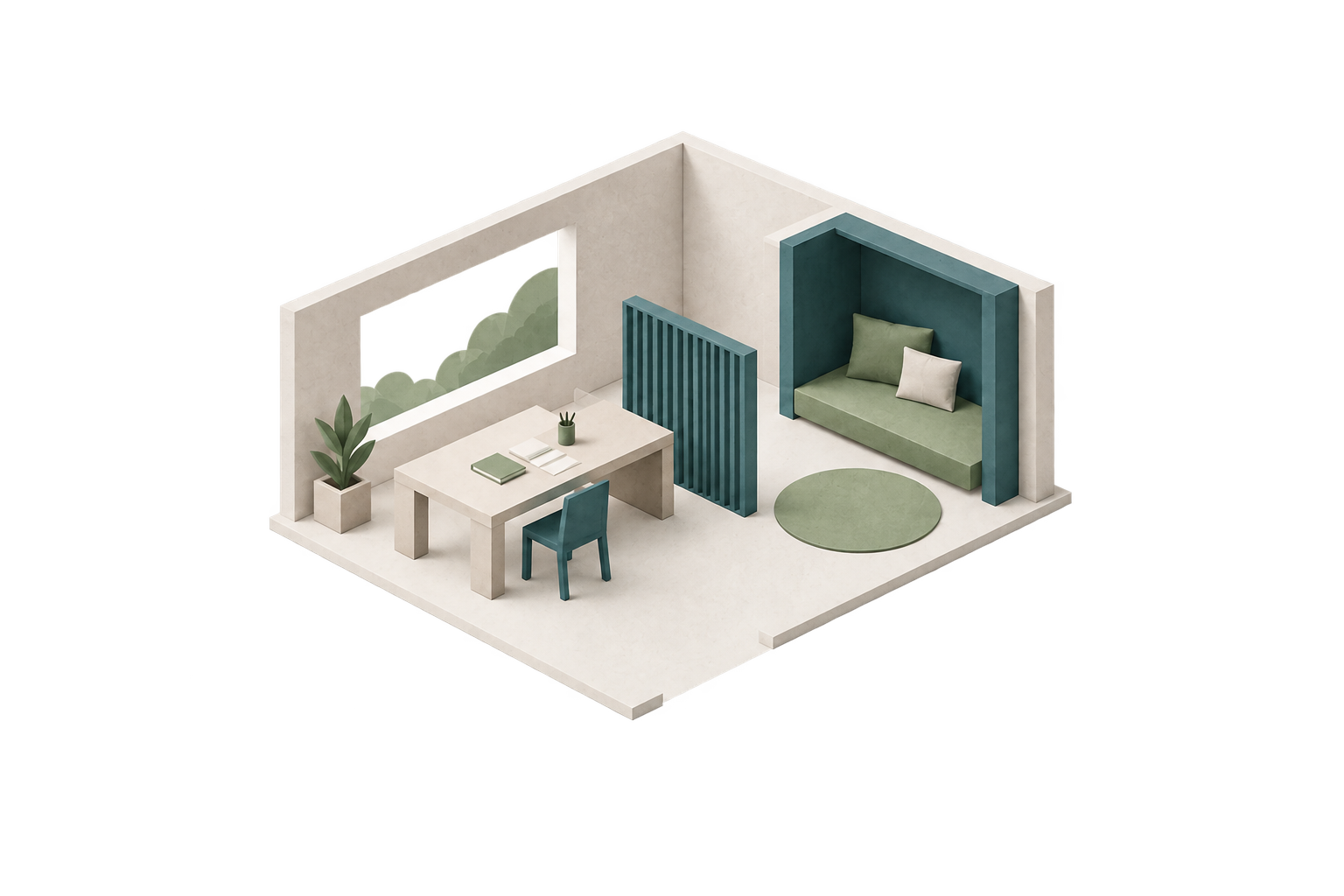
Autistic adult day and community support centre
Can users choose sensory exposure and understand changes between activities?
Related-setting transfer2 linked sources · 1 peer-reviewedPeople & purpose
Autistic adults, supporters and staff
Design question: Can users choose sensory exposure and understand changes between activities?
What the evidence supports
Use a clearly marked design transfer from studied populations/settings; do not imply the combined building programme was evaluated.
Adult autism guidance supports individualized adaptations; there is no universal autistic sensory profile or validated complete building.
The label describes research relevance, not study quality or a proven whole-building benefit.
Design variables to investigate
Proposed moves to develop and test for this programme.
- Predictable activity zones
- Adjustable light and sound
- Visual schedules and cues
- Indoor and outdoor retreat
Check the trade-offs
Architectural checks, not additional findings from the cited papers.
- Sensory preferences differ; a lower-stimulation setting is not every person’s preferred setting.
- Avoid relying on one sensory channel for an essential cue; retain choice and accessible alternatives.
Evaluate with the intended users
- User-rated sensory comfort
- Chosen retreat and activity-space use
- Destination recognition
Choose a feasible outcome and comparison before testing. Record who used the space, occupancy, care or service changes, and environmental exposure; these can change the result.
Develop the design question
Related Atlas variables provide additional context. They do not verify this complete programme.
Peer-reviewed sources & research audit2 sources
Read study design, population and transfer limits together. A source reused for several building functions is still one study. Some newer sources have only selected sections or abstracts checked; the individual audit records show what remains unresolved.
NICE CG142 — Autism spectrum disorder in adults: physical and residential environments (2012) ↗
Official clinical guideline · Official guidance · relevant sections checked
Guidance scope: Individual sensory adaptations, visual supports, retreat spaces and activity zoning for autistic adults.
Limits and contrary findings: Guidance rather than an architectural trial; adult recommendations are not automatically transferable to children or all neurodivergent people.
Research audit: Relevant recommendation body checked. Supports individual sensory adjustments, designated activity spaces and opportunities for time alone in adult autism services; not a universal architectural rule for all neurodivergent people.
Record checked 2026-10-10Impacts of school environment quality on autistic pupil's behaviours – A systematic review (2024) ↗
Peer-reviewed review · Indexed article sections checked
Method: Systematic review
Population / setting: Autistic pupils in learning environments
Reported finding or research scope: Identifies sensory-environment considerations and gaps in lighting, acoustics, air and thermal research.
Limits and contrary findings: Small unrepresentative samples, subjective measures and insufficient quantitative evidence. No universal autism-room recipe.
Research audit: Indexed full-article sections 5–7 inspected from university repository; direct PDF retrieval blocked. https://orca.cardiff.ac.uk/id/eprint/171464/1/1-s2.0-S0360132324008230-main.pdf
Verification limits: Key findings and limitations were checked in the materials listed here. Exact effect estimates and supplementary analyses still require verification against the full tables and supplements.
This is a selected-source extraction, not a complete audit of every table and supplement. It does not establish numerical design thresholds or a whole-building benefit.
Record checked 2026-10-11