


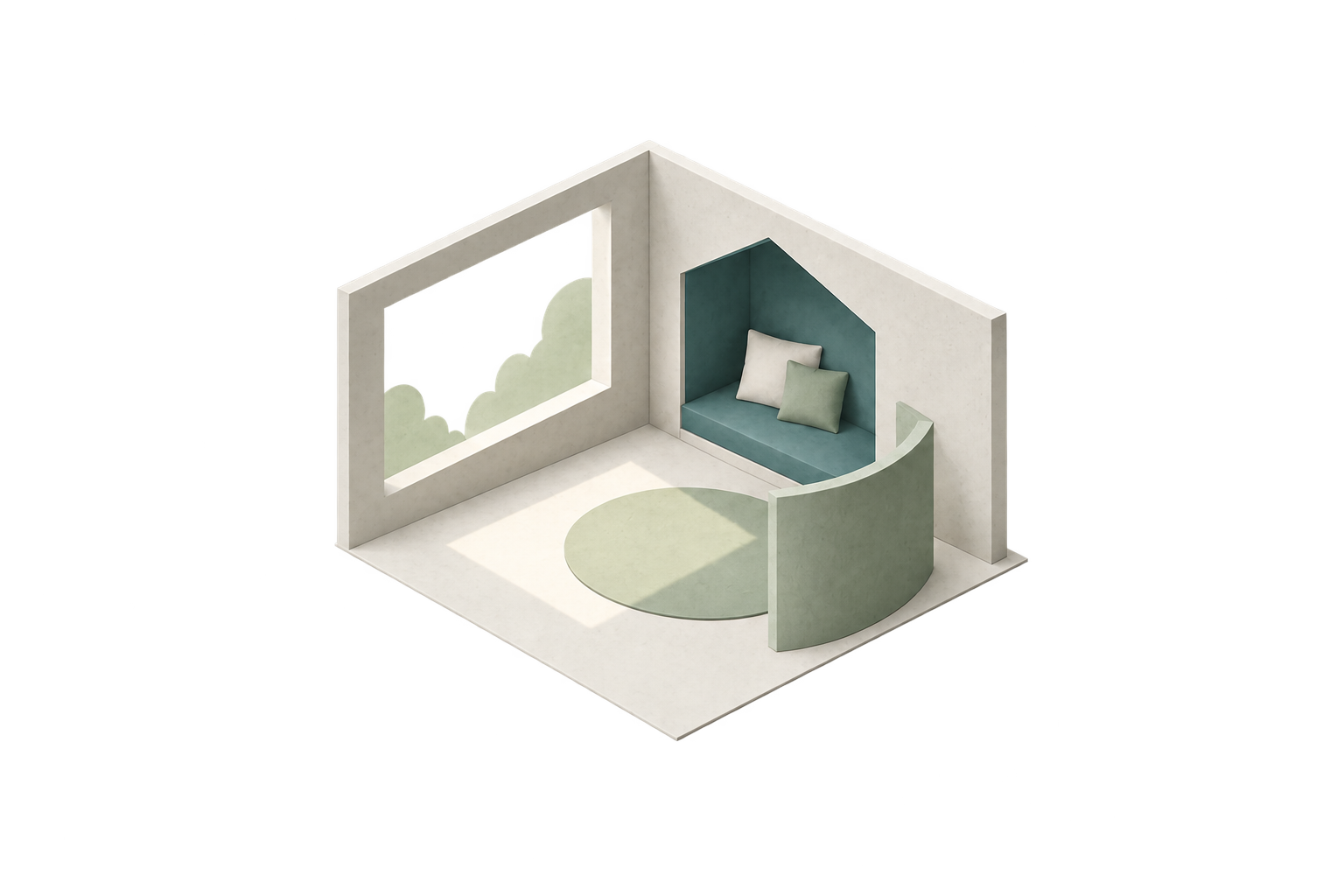
A gradient of choice
Arrange a readable sequence from an active room to a softly screened retreat. Pair acoustic treatment with uncluttered cues and user-controlled lighting, so people can choose their level of stimulation without leaving the community.
People & purpose
sensory regulation, overstimulation, predictability, control
Evaluate the proposal
User-reported sensory comfort and voluntary use of different zones.
Design decisions and supporting evidence
Design move · hypothesis
Offer a quiet retreat users can choose to enter.
Findings across linked studies
Negative stress and collaboration outcomes emerged in the office with fewer quiet rooms. (Haapakangas et al. (2018))
Peer-reviewed sources & research audit 7 papers
Haapakangas et al. (2018) · Journal of Environmental Psychology
- Method
- Behavioral · Survey
- Participants / setting
- Two workplace relocations; pre samples 65/64, post 135/71
- Study focus
- Two office relocations compare environments with different availability of quiet rooms.
- Finding used
- Distractions increased at both organizations; poorer stress and collaboration ratings emerged where quiet rooms were scarce.
- Architectural relevance
- Test user-controlled retreat options before proposing automated sensor-driven adaptation.
- Study-specific quantitative result
- Environmental choice & quiet-space access: Perceived noise distraction, stress and collaboration after office relocation Before and after relocation; workplaces with more versus fewer quiet rooms Organization samples reported as 65 and 64 before relocation, 135 and 71 afterward; these are survey response counts, not a fully paired cohort. Two organizational relocations to open-plan offices with differing availability of quiet workspaces. Noise distraction increased in both organizations. Worsening stress and collaboration were reported in the office with fewer quiet rooms. A numerical effect-size estimate was not retrieved from the accessible abstract. Uncertainty: Confidence intervals and exact outcome contrasts were not extracted; inaccessible full-text tables should not be treated as having no numerical results. Analysis: Outcome hierarchy not specified in the material checked. Evidence about quiet-workspace access in an office relocation, not a test of automated adaptive buildings or a causal demonstration that environmental control changes neural physiology. Material checked: Publisher and author-repository abstracts checked. Full-paper retrieval attempted at publisher and Theseus (handle 10024/165953, accepted manuscript, sequence=2), but full body remained unavailable; no PMC copy located. Outcome hierarchy could not be verified; numerical details are unextracted, not established absent.
- Interpretation limits
- Nonrandomized organizational changes; quiet-room access is not automated adaptation or biofeedback.
- Verification status
- Partial verification · see unresolved items
- Sections checked
- Publisher abstract; indexed author manuscript abstract and repository record
- Unresolved / verification limits
- Full Methods/Results/tables, exact contrasts, effect sizes, CIs and outcome hierarchy remain unverified. Publisher access was limited to indexed abstract; Theseus accepted-manuscript bitstream and alternative handle/download URLs repeatedly returned 403; no PMC copy located.
Zhang, Du & Chow (2023) · Building and Environment
- Method
- Systematic review · environmental perception and work outcomes
- Participants / setting
- 55 office studies in 22 countries; 30 were cross-sectional surveys.
- Study focus
- Reviews 55 office studies connecting perceived environmental characteristics with wellbeing and work outcomes.
- Finding used
- Indoor climate, naturalness, space and privacy were frequently associated with satisfaction and wellbeing. Cognitive-performance findings were inconsistent.
- Architectural relevance
- Supports evaluating comfort, privacy and user choice together, while keeping perceived productivity separate from tested cognition.
- Interpretation limits
- Heterogeneous measures and mostly nonrandomized evidence; perceived productivity is not objectively tested cognition.
- Verification status
- Full paper · relevant sections checked
- Sections checked
- 2. Method: search and eligibility · 3.1 Summary of included studies · 4.3 Strengths and limitations · 5. Conclusion
Li et al. (2023) · Journal of Building Engineering
- Method
- Review · cognitive tests and physiological sensing
- Participants / setting
- Occupants in the reviewed thermal studies; no pooled population extracted
- Study focus
- Reviews thermal conditions, cognitive testing, physiological sensors and prediction models.
- Finding used
- Skin temperature is frequently informative for thermal sensation; personal control appears relevant to satisfaction.
- Architectural relevance
- Informs testing thermal controls against actual comfort and task outcomes, rather than assuming a sensor reading proves benefit.
- Interpretation limits
- Prediction accuracy is not proof of improved cognition. Thermal sensation, satisfaction and task performance are separate outcomes.
- Verification status
- Full paper · relevant sections checked
- Sections checked
- 2. Review methods · 5. Applications of machine learning in indoor environment assessment · 6. Conclusion · 7. Implications for Future Research
Bernstein & Turban (2018) · Philosophical Transactions of the Royal Society B
- Method
- Before–after field studies · wearable interaction sensing and communication metadata
- Participants / setting
- Employees at two corporate headquarters
- Study focus
- Two corporate field studies track face-to-face and electronic communication before and after a move to more open offices.
- Finding used
- Face-to-face interaction fell by about 70% in both cases, while electronic interaction increased.
- Architectural relevance
- Challenges the assumption that fewer spatial boundaries automatically increase collaboration; test privacy and actual interaction patterns.
- Interpretation limits
- Open-plan relocation changes several factors. Interaction volume is not a direct measure of collaboration quality, cognition or neural change.
- Verification status
- Full paper · relevant sections checked
- Sections checked
- Study 1 design and results · Study 2 design and volume-of-interaction results · Discussion
Taylor, Card & Piatkowski (2018) · HERD
- Method
- Systematic review with independent dual evidence-level and methodological-quality appraisal; lower-quality studies were excluded from synthesis according to the abstract.
- Participants / setting
- 43 studies qualified for appraisal, concerning adult inpatient single-occupancy rooms and their users.
- Study focus
- Reviews adult inpatient outcomes and opinions about single-occupancy rooms.
- Finding used
- The review reports strongest support for communication, infection control, noise/perceived sleep quality and user preferences.
- Architectural relevance
- Assess user choice together with care workflow.
- Interpretation limits
- Staffing, workflow and privacy–isolation trade-offs limit a universal single-room prescription. Individual-study effects, appraisal tables and a declared outcome hierarchy could not be checked in full text.
- Verification status
- Abstract only · full text unresolved
- Sections checked
- Primary abstract and appraisal description; publisher, author-center and author-copy availability checks
- Unresolved / verification limits
- Publisher full text and supplements were inaccessible; the author-copy page offered no full text. Full Methods and Results tables remain unverified.
Tola et al. (2021) · International Journal of Environmental Research and Public Health
- Method
- Scoping review with eligibility screening and thematic data charting, combining case studies, surveys, participatory and post-occupancy/intervention work.
- Participants / setting
- 21 included studies from 801 identified; studies published 2008–2019 and include autistic people, professionals and caregivers.
- Study focus
- Maps research on the design of spaces for autistic users.
- Finding used
- Mapped sensory quality, intelligibility and orientation/predictability criteria for design.
- Architectural relevance
- Provide meaningful setting choice.
- Interpretation limits
- Design recommendations are heterogeneous; two papers required the reviewers to infer recommendations. No pooled intervention effect or universal sensory prescription.
- Verification status
- Full paper · relevant sections checked
- Sections checked
- Methods: eligibility and data extraction · Results: selection and study designs · Discussion/Table 3
- Unresolved / verification limits
- Supplementary evidence table not separately inspected.
Janssen et al. (2022; online 2021) · International Journal of Stroke
- Method
- Phase II nonrandomized cluster trial with blinded measurement, comparing communal and individual environmental enrichment with usual rehabilitation; activity was observed over ten days and clinical outcomes at three months.
- Participants / setting
- 193 stroke survivors in four rehabilitation units: 91 intervention and 102 control.
- Study focus
- Tests feasibility, safety and outcomes of communal/individual enrichment after stroke.
- Finding used
- Social activity increased modestly. No between-group benefit appeared in clinical outcomes at three months; communal enrichment was widely available, but individual materials were often out of reach or sight.
- Architectural relevance
- Check availability and accessibility of choices.
- Interpretation limits
- Equipment, access and organization formed a combined intervention. Nonrandomized allocation and implementation limitations prevent attributing a clinical benefit to any room feature. Full tables, participant flow and analysis hierarchy were inaccessible.
- Verification status
- Abstract only · full text unresolved
- Sections checked
- Primary structured abstract Methods, Results and Conclusions; publisher and repository availability checks
- Unresolved / verification limits
- Full Methods and Results, missing-data handling and prespecified outcome hierarchy remain unverified after publisher and author-repository searches.
Transfer limit: Quiet-room access and workplace relocation involve multiple changing factors.
Design move · hypothesis
Compare sound-absorbing surfaces around a listening activity.
Findings across linked studies
Longer reverberation amplified noise-related speech impairment; children were more vulnerable. Speech in silence showed no reverberation effect. (Klatte, Lachmann & Meis (2010)) In reproduced classroom noise, children and adults reported greater listening effort; behavioral dual-task effects depended on age. (Seitz, Loh & Fels (2024)) A 30-person simulated-office study found better recall in free field than in either office condition, with no significant difference between the two office conditions. Reaction times suggested greater listening effort with reverberation. (Ermert et al. (2026))
Peer-reviewed sources & research audit 8 papers
Klatte, Lachmann & Meis (2010) · Noise & Health
- Method
- Virtual-classroom between-group sound/reverberation experiment; word-to-picture matching; listening comprehension only in shorter-reverberation room.
- Participants / setting
- 94 adults, 108 first graders and 149 third graders enrolled. Speech perception used 94 adults, 108 first graders and 102 third graders; one first grader was excluded (303 analyzed). A separate 47 third graders performed listening comprehension.
- Study focus
- Tests speech perception and instruction following in classroom-like acoustic conditions.
- Finding used
- Longer reverberation increased noise-related speech-perception impairment; listening-comprehension results separately compare noise types in the favorable room.
- Architectural relevance
- Evaluate absorption and speech clarity for the intended learners and listening distances.
- Study-specific quantitative result
- Reverberation & speech clarity: Speech-perception impairment caused by background sound Longer versus shorter reverberation, conditional on background sound and age group 94 adults, 108 first graders and 149 third graders enrolled. Speech perception used 94 adults, 108 first graders and 102 third graders; one first grader was excluded (303 analyzed). A separate 47 third graders performed listening comprehension. Speech-perception tests in virtual classrooms with mean reverberation times 0.47 versus 1.1 seconds. Listening comprehension was tested only in the favorable (shorter-reverberation) room. Reverberation increased speech-perception impairment from background speech: F(1,135)=65.7, partial eta-squared=.33, p<.001; from classroom noise: F(1,132)=75.37, partial eta-squared=.36, p<.001. Speech perception in silence showed no reverberation effect (F<1). Uncertainty: Full results give ANOVA effect sizes and figures with SEs; no CI for these reverberation effects is reported. These are standardized ANOVA magnitudes, not percentage changes in everyday learning. Analysis: Outcome hierarchy not specified in the material checked. The evidence concerns interaction between reverberation, masking sounds and listener age; it is not a universal 0.47-second design standard or a direct measure of brain activation. Material checked: Full paper: Participants; speech-perception Results, pp. 273–275; Figures 2–3. Outcome hierarchy not declared in the reviewed Methods/analysis; planned comparisons alone do not establish preregistration.
- Interpretation limits
- Reverberation was not manipulated for listening comprehension; results depend on sound, seat position and age.
- Verification status
- Full paper · relevant sections checked
- Sections checked
- Participants; speech-perception Results, pp. 273–275; Figures 2–3
Prodi & Visentin (2022) · Ear and Hearing
- Method
- Controlled classroom experiment · speech/comprehension/arithmetic · response times
- Participants / setting
- 302 children, 11–13 years, with normal hearing
- Study focus
- Tests a modest reverberation change in real classrooms.
- Finding used
- Effects appeared with classroom noise and varied by age and task; quiet-condition effects were not significant.
- Architectural relevance
- Evaluate absorption in realistic occupied sound conditions.
- Interpretation limits
- Response time is a behavioral proxy, not measured neural effort. Early reflections and task difficulty also matter.
- Verification status
- Partial verification · see unresolved items
- Sections checked
- Publisher/PubMed abstract and author repository file access metadata
- Unresolved / verification limits
- Full Methods/Results, exact outcome estimates/CIs and hierarchy remain unverified. Publisher not retrievable; SFERA marks its PDF private/restricted and returned403. No PMC copy located; no access controls bypassed.
Picou et al. (2019) · Frontiers in Psychology
- Method
- Dual-task experiment · word recognition · subjective effort and fatigue
- Participants / setting
- 20 normal-hearing children aged 10–17 (5 male), mean 13.25 (SD2.34); rooms T30<.1s and .834s.
- Study focus
- Separates noise and moderate reverberation in listening tasks.
- Finding used
- Reverberation contrast: word recognition .94 RAU (95% CI −2.79 to4.67; p=.62), dual-task response time20.5ms (95% CI −50.4 to91.4; p=.57). Noise increased effort; fatigue increased similarly across rooms.
- Architectural relevance
- Do not assume improved speech recognition automatically means reduced fatigue.
- Interpretation limits
- Authors explicitly report preregistration (osf.io/9dj2q); primary/secondary dual tasks are task priorities, not outcome hierarchy. Null CIs permit some effects. Correlation analyses pooled repeated observations without participant adjustment.
- Verification status
- Full paper · relevant sections checked
- Sections checked
- Participants; Procedures; Data Analysis; Results; preregistration statement
Klatte, Bergström & Lachmann (2013) · Frontiers in Psychology
- Method
- Review · experimental and observational behavioral evidence
- Participants / setting
- Children, adult comparisons and specific learner groups across studies
- Study focus
- Reviews acute and chronic noise effects in children.
- Finding used
- Speech access and some cognitive tasks are vulnerable to noise; effects depend on sound structure, task and age.
- Architectural relevance
- Supports evaluating speech clarity with the intended learners and distinguishing acoustic access from broad claims about intelligence.
- Interpretation limits
- A review may include the original listening study and is not independent replication of each effect.
- Verification status
- Full paper · relevant sections checked
- Sections checked
- Effects of acute noise on children's performance in auditory tasks · Effects of acute noise on children's performance in nonauditory tasks · Chronic effects of noise on children's cognitive development · Conclusions
Tola et al. (2021) · International Journal of Environmental Research and Public Health
- Method
- Scoping review with eligibility screening and thematic data charting, combining case studies, surveys, participatory and post-occupancy/intervention work.
- Participants / setting
- 21 included studies from 801 identified; studies published 2008–2019 and include autistic people, professionals and caregivers.
- Study focus
- Maps research on the design of spaces for autistic users.
- Finding used
- Mapped sensory quality, intelligibility and orientation/predictability criteria for design.
- Architectural relevance
- Evaluate acoustic experience with intended users.
- Interpretation limits
- Design recommendations are heterogeneous; two papers required the reviewers to infer recommendations. No pooled intervention effect or universal sensory prescription.
- Verification status
- Full paper · relevant sections checked
- Sections checked
- Methods: eligibility and data extraction · Results: selection and study designs · Discussion/Table 3
- Unresolved / verification limits
- Supplementary evidence table not separately inspected.
Bidelman, Davis & Pridgen (2018) · Hearing Research
- Method
- 64-channel EEG · estimated sources/connectivity · speech tests
- Participants / setting
- 11 normal-hearing adults, mean age 24.7 years
- Study focus
- Compares neural speech encoding in matched noise and reverberation.
- Finding used
- Reverberation was less disruptive than matched noise; auditory, frontal and brainstem interactions related to listening performance.
- Architectural relevance
- Supplemental auditory-network evidence.
- Interpretation limits
- Small sample; source-model uncertainty; neither pediatric classroom imaging nor a room-acoustics design trial.
- Verification status
- Earlier full-text extraction retained
Seitz, Loh & Fels (2024) · Scientific Reports
- Method
- Laboratory word-recognition and digit-recall task in reproduced classroom noise
- Participants / setting
- 44 children recruited, 35 analyzed; 25 adults. Typical-hearing German-speaking sample
- Study focus
- Laboratory word-recognition and digit-recall task in reproduced classroom noise
- Finding used
- Subjective effort was greater in noise; behavioral dual-task effects varied with age. This supports distinguishing listening effort from word recognition alone.
- Architectural relevance
- Evaluate absorption and speech clarity for the intended learners and listening distances. Read the study-specific population and limits before transferring the finding.
- Interpretation limits
- Headphone task and selected sample; no automatic transfer to children with hearing loss or neurodevelopmental conditions.
- Verification status
- Partial verification · see unresolved items
- Sections checked
- Full published PDF retrieved; participant Methods and summary results inspected. Detailed outcome tables require extraction before adding numerical claims.
- Unresolved / verification limits
- Complete final-paper Methods, statistical tables and analysis hierarchy have not all been independently checked. No numerical claim beyond the material identified above is inferred.
Ermert et al. (2026) · Trends in Hearing
- Method
- VR open-plan office experiment with recall and a vibrotactile secondary task
- Participants / setting
- 30 participants
- Study focus
- VR open-plan office experiment with recall and a vibrotactile secondary task
- Finding used
- Recall was better in free field than in either simulated office; the two office conditions did not significantly differ. Reaction-time results suggested greater effort with reverberation.
- Architectural relevance
- Evaluate absorption and speech clarity for the intended learners and listening distances. Read the study-specific population and limits before transferring the finding.
- Interpretation limits
- The treated 0.5-second and untreated 1.0-second conditions do not establish a universal architectural target. Full tables and analysis hierarchy still need verification.
- Verification status
- Abstract only · full text unresolved
- Sections checked
- Primary structured abstract and figure captions only; full-paper verification pending.
- Unresolved / verification limits
- Complete final-paper Methods, statistical tables and analysis hierarchy have not all been independently checked. No numerical claim beyond the material identified above is inferred.
Transfer limit: Panel quantity is illustrative; acoustic modeling and testing are still required.
Design move · hypothesis
Compare a restrained display field with a visually busy one.
Findings across linked studies
Image statistics changed viewing behavior. (Valtchanov & Ellard (2015)) Decorated classroom walls increased off-task behavior and reduced learning gains in short lessons. (Fisher, Godwin & Seltman (2014))
Peer-reviewed sources & research audit 6 papers
Valtchanov & Ellard (2015) · Journal of Environmental Psychology
- Method
- Controlled image-viewing experiment; head-mounted display, monocular eye tracking and pleasantness ratings.
- Participants / setting
- 55 University of Waterloo participants (27 male, 28 female), fluent English speakers reporting normal 20/20 vision and no visual disorder.
- Study focus
- Tests altered and unaltered natural and urban photographs.
- Finding used
- Natural and urban images and their spatial-frequency alterations differed in gaze, blink rate and pleasantness. Cognitive load was inferred from blink rate rather than directly tested with a cognitive task.
- Architectural relevance
- Test visual hierarchy and task relevance with direct attention and performance measures.
- Interpretation limits
- Eight original scenes and 32 alterations; image statistics do not isolate furnished-room clutter. Blink rates are an indirect cognitive-load measure; no neural recording or health outcome.
- Verification status
- Full paper · relevant sections checked
- Sections checked
- §2.3 hypotheses · §3.1 Participants · §3.2 Materials · §3.4 Procedure · §4 Results
- Unresolved / verification limits
- No formal primary/secondary outcome hierarchy identified; amplitude-scrambling is explicitly exploratory.
Fisher, Godwin & Seltman (2014) · Psychological Science
- Method
- Within-child comparison of alternating decorated/sparse lessons; blinded behavioral coders and instructor, immediate pre/post lesson tests.
- Participants / setting
- 24 kindergarten children recruited (mean age 5.37 years); 23 analyzed after excluding one child absent from four of six lessons. One predominantly White, high-socioeconomic-status university laboratory school.
- Study focus
- Varies classroom wall displays during six introductory science lessons.
- Finding used
- Children showed more off-task behavior and smaller learning gains with highly decorated walls.
- Architectural relevance
- Keep teaching sightlines focused and test display relevance, distraction and learning.
- Study-specific quantitative result
- Visual complexity: Off-task time and immediate lesson learning Decorated versus sparse laboratory-classroom walls 24 kindergarten pupils enrolled; 23 analyzed Six 5–7-minute science lessons across 2 weeks Off-task time: 38.58% versus 28.42%, d = 0.85. Learning gains: 18 versus 33 percentage points, d = 0.73. Uncertainty: Off-task SDs 10.49 and 13.19 percentage points, p < .0001; learning-gain SDs 19 and 22 points, p = .002. CIs not reported for these contrasts. Analysis: Outcome hierarchy not specified in the material checked. Brief lessons in one predominantly affluent kindergarten sample; this does not establish that all displays or long-term classroom decoration impair learning. Material checked: Publisher full-issue PDF: Method pp.1363–1365 and Results p.1366 inspected; means, SDs and effect sizes verified. Outcome hierarchy not declared.
- Interpretation limits
- Short lessons in one kindergarten; lessons were assigned to conditions using pretest scores. SEM bars are not confidence intervals; novelty and lesson content limit transfer.
- Verification status
- Full paper · relevant sections checked
- Sections checked
- Method pp.1363–1365 · Results p.1366 · Figures 3–4
- Unresolved / verification limits
- Formal primary/secondary outcome hierarchy not declared in the inspected sections.
Taylor et al. (2011) · Frontiers in Human Neuroscience
- Method
- Research review · eye tracking, behavioral ratings, EDA and EEG
- Participants / setting
- Participants across visual-pattern experiments; no pooled sample extracted
- Study focus
- Reviews the authors’ research on visual fractal patterns, including eye tracking, preference, skin conductance and EEG.
- Finding used
- The reviewed experiments describe perceptual and physiological responses to fractal complexity and discuss their possible artistic implications.
- Architectural relevance
- Informs testing visual pattern complexity with user ratings and appropriate measures; it does not prescribe an optimal fractal dimension for wellbeing.
- Interpretation limits
- An author-group review is not an independent replication. Spatial fractals are not temporal rhythm, and image responses do not establish benefits of a façade.
- Verification status
- Full paper · relevant sections checked
- Sections checked
- The Esthetics of Fractals · Neurophysiological Response to Fractals · Conclusion
Tola et al. (2021) · International Journal of Environmental Research and Public Health
- Method
- Scoping review with eligibility screening and thematic data charting, combining case studies, surveys, participatory and post-occupancy/intervention work.
- Participants / setting
- 21 included studies from 801 identified; studies published 2008–2019 and include autistic people, professionals and caregivers.
- Study focus
- Maps research on the design of spaces for autistic users.
- Finding used
- Mapped sensory quality, intelligibility and orientation/predictability criteria for design.
- Architectural relevance
- Test visual information demands and predictability.
- Interpretation limits
- Design recommendations are heterogeneous; two papers required the reviewers to infer recommendations. No pooled intervention effect or universal sensory prescription.
- Verification status
- Full paper · relevant sections checked
- Sections checked
- Methods: eligibility and data extraction · Results: selection and study designs · Discussion/Table 3
- Unresolved / verification limits
- Supplementary evidence table not separately inspected.
Barrett et al. (2015) · Building and Environment
- Method
- Observational classroom assessments and two-level pupil/classroom modeling of annual reading, writing and maths progress.
- Participants / setting
- 4,924 pupils initially sampled in 203 classrooms/30 schools; final analysis: 3,766 pupils, 153 classrooms, 27 English schools.
- Study focus
- Relates classroom conditions to pupils’ academic progress.
- Finding used
- Seven environmental parameters produced a modeled classroom-effect range of 7.93 progress points, 16% of the observed 50-point pupil-progress range.
- Architectural relevance
- Test display complexity in the teaching context.
- Interpretation limits
- The 16% headline is a range-based model summary, not a causal improvement or 16% R². Overall model R² was 58%; teaching and environmental features covary.
- Verification status
- Full paper · relevant sections checked
- Sections checked
- §3 data collection/statistics · §4 Results, especially p.126 · §6 Conclusion
- Unresolved / verification limits
- No single-feature causal estimate or adult-learning transfer established.
Kastner et al. (1999) · Neuron
- Method
- fMRI · covert visual-attention task
- Participants / setting
- Human participants; sample details not extracted from the checked abstract.
- Study focus
- Tests covert spatial attention while participants expect peripheral visual stimuli.
- Finding used
- Expectation-related signals appeared in visual, frontal and parietal areas.
- Architectural relevance
- General visual/attention-system interpretation; not a neural result from the architectural anchors.
- Interpretation limits
- A laboratory attention experiment does not localize effects of classroom decoration or prescribe an optimum complexity.
- Verification status
- Abstract only · full text unresolved
- Sections checked
- Author institution’s abstract and bibliographic record
- Unresolved / verification limits
- Full participant characteristics, exclusions and statistical procedures remain unverified. No precise effect or architectural benefit is inferred.
Transfer limit: Object count is only a visual prototype, not the study’s spatial-frequency manipulation.
Research for this population or setting
Tola et al. (2021) · International Journal of Environmental Research and Public Health
- Method
- Scoping review with eligibility screening and thematic data charting, combining case studies, surveys, participatory and post-occupancy/intervention work.
- Participants / setting
- 21 included studies from 801 identified; studies published 2008–2019 and include autistic people, professionals and caregivers.
- Study focus
- Maps research on the design of spaces for autistic users.
- Finding used
- Mapped sensory quality, intelligibility and orientation/predictability criteria for design.
- Architectural relevance
- Use sensory preferences to guide acoustic design testing. Evaluate acoustic experience with intended users. Provide meaningful setting choice. Test visual information demands and predictability. Co-design intelligible orientation cues. Evaluate accessible retreat options. Assess personal-space preferences without a uniform spacing rule. Offer an adjustable sensory-care setting, with dimmable indirect light, manageable sound and individually chosen comfort supports. Proposed transfer; component efficacy is not assumed.
- Interpretation limits
- Design recommendations are heterogeneous; two papers required the reviewers to infer recommendations. No pooled intervention effect or universal sensory prescription.
- Verification status
- Full paper · relevant sections checked
- Sections checked
- Methods: eligibility and data extraction · Results: selection and study designs · Discussion/Table 3
- Unresolved / verification limits
- Supplementary evidence table not separately inspected.
Color & personal experience
Offer a predictable palette and a genuine choice of quiet-space color. The proposed benefit is greater sensory control; different autistic users may prefer very different visual environments.
Test with users: Co-design with autistic users; record individual comfort, avoidance and willingness to use each zone.
Application boundary. Autism-focused review supports these design considerations; the combined suite has not been tested as an intervention. Co-design with autistic users; sensory needs vary, and an autism study cannot represent every neurodivergent person.