


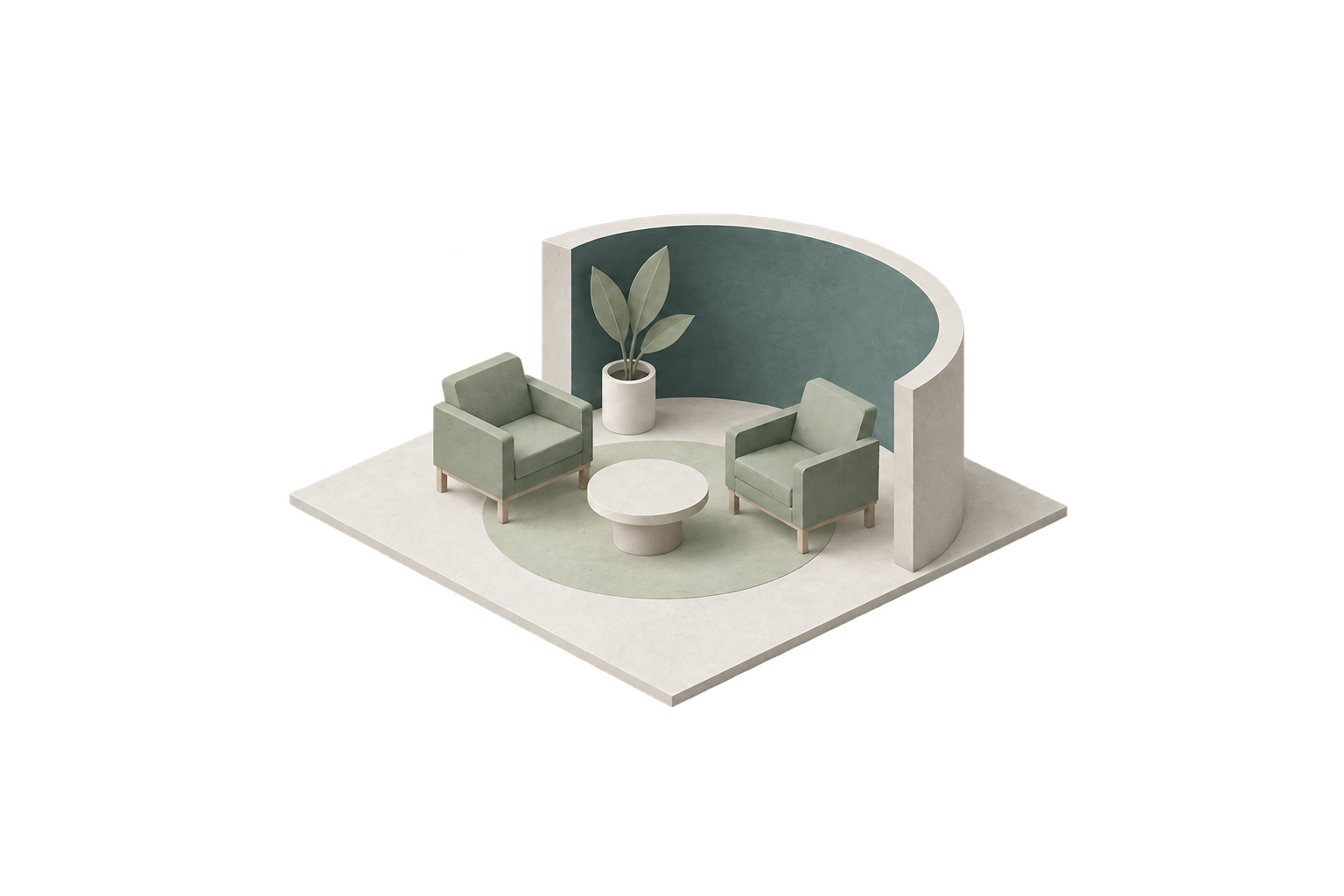
Community mental health and day recovery centre
Can arrival avoid institutional ambiguity while offering different levels of social participation?
Related-setting transfer3 linked sources · 2 peer-reviewedPeople & purpose
People attending mental health services, peers and clinicians
Design question: Can arrival avoid institutional ambiguity while offering different levels of social participation?
What the evidence supports
Use a clearly marked design transfer from studied populations/settings; do not imply the combined building programme was evaluated.
Application is an architectural inference from related guidance or research; this typology has no validated therapeutic design effect.
The label describes research relevance, not study quality or a proven whole-building benefit.
Design variables to investigate
Proposed moves to develop and test for this programme.
- Welcoming reception sequence
- Private-to-group room gradient
- Quiet retreat
- Local street and garden connection
Check the trade-offs
Architectural checks, not additional findings from the cited papers.
- Offer retreat without creating isolation or obstructing staff response.
- User control must be compatible with agreed safety requirements and accessible support.
Evaluate with the intended users
- First-visit route errors
- Choice of group and quiet spaces
- User-rated welcome and control
Choose a feasible outcome and comparison before testing. Record who used the space, occupancy, care or service changes, and environmental exposure; these can change the result.
Develop the design question
Related Atlas variables provide additional context. They do not verify this complete programme.
Peer-reviewed sources & research audit3 sources
Read study design, population and transfer limits together. A source reused for several building functions is still one study. Some newer sources have only selected sections or abstracts checked; the individual audit records show what remains unresolved.
Ulrich et al. — Psychiatric ward design can reduce aggressive behavior (2018) ↗
Peer-reviewed research · Relevant full-paper sections checked
Reported finding or research scope: A comparative hospital study of bundled environmental features including privacy, noise, control, nature access and observation.
Limits and contrary findings: Nonrandomized comparison; architecture was bundled, and service factors may contribute. Individual design features are not separately validated.
Research audit: Body confirms a nonrandomized retrospective old/new/control-hospital comparison and bundled design factors. Injection prevalence decreased, but restraint prevalence did not significantly change; separate features were not causally isolated.
Record checked 2026-10-10SAMHSA — Concept of Trauma and Guidance for a Trauma-Informed Approach (2014) ↗
Official organizational framework · Official guidance · relevant sections checked
Guidance scope: Physical and emotional safety, choice, calming environments and participation of people with lived experience.
Limits and contrary findings: An organizational framework, not an architectural efficacy trial; proposed spatial applications need user-specific evaluation.
Research audit: Relevant body checked in a public mental-health provider copy of the SAMHSA report after official PDF retrieval failed. Supports safety, choice, calming spaces and lived-experience involvement as organizational principles, not proven architectural treatment effects.
Record checked 2026-10-10Multisensory nature-based Recharge Rooms’ effect on healthcare workers in a multicenter study (2026) ↗
Peer-reviewed research · Selected full-paper sections checked
Method: Uncontrolled multisite before–after survey
Population / setting: 563 survey respondents across 18 US hospitals
Reported finding or research scope: Immediate self-reported stress decreased and reported hopefulness/alertness increased after room use.
Limits and contrary findings: Selection bias, bespoke survey and no control group. Not evidence of reduced burnout or improved patient recovery. Mechanistic explanations in the discussion were not independently established by this study.
Research audit: Full text: methods/results and discussion inspected; published 5 January 2026 although volume/DOI say 2025
Verification limits: Key findings and limitations were checked in the materials listed here. Exact effect estimates and supplementary analyses still require verification against the full tables and supplements.
This is a selected-source extraction, not a complete audit of every table and supplement. It does not establish numerical design thresholds or a whole-building benefit.
Record checked 2026-10-11