


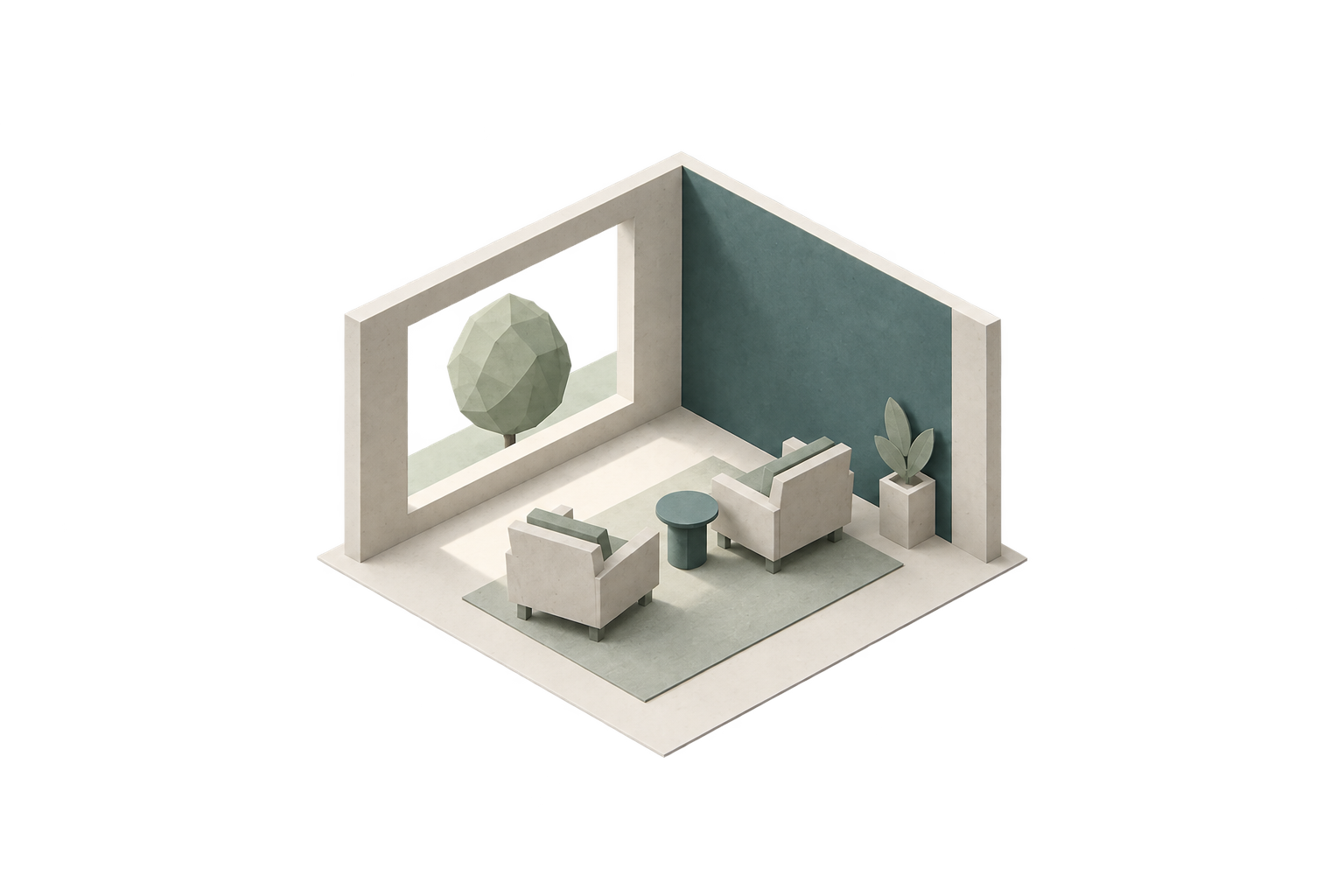
A room that lets people step back
Create a gentle arrival sequence leading to a garden-facing resting bay and a private conversation nook. Offer quiet, outward views and control over exposure, with the intention of supporting a restorative pause rather than prescribing one calming experience.
People & purpose
stress reduction, restoration, emotional regulation
Evaluate the proposal
Perceived restoration, comfort and willingness to use the retreat.
Design decisions and supporting evidence
Design move · hypothesis
Offer optional contact with nature and a place to pause.
Findings across linked studies
Rumination decreased within the nature group, but the between-group change comparison was inconclusive (p=.07). Subgenual prefrontal perfusion showed a significant group difference in change. (Bratman et al. (2015)) A separate 49-person laboratory fMRI experiment found lower pain ratings and nociceptive-signature responses during audiovisual nature; the other pain signature did not show the same differential result. (Steininger et al. (2025))
Peer-reviewed sources & research audit 9 papers
Bratman et al. (2015) · PNAS
- Method
- Arterial-spin-labeling MRI · rumination questionnaire
- Participants / setting
- 38 healthy adult urban residents randomized; 37 included in the rumination analysis and 31 in the perfusion analysis.
- Study focus
- Compares a 90-minute nature walk with an urban walk in healthy adults.
- Finding used
- Rumination decreased within the nature-walk group, but the group-by-time interaction did not reach the conventional .05 threshold (p=.07). Subgenual prefrontal perfusion showed a significant group difference in change.
- Architectural relevance
- Test accessible outdoor nature breaks; indoor planting is a separate hypothesis.
- Study-specific quantitative result
- Outdoor nature contact: Self-reported rumination before and after a walk Change over time in nature versus urban groups 38 randomized; 37 contributed rumination data (18 nature, 19 urban); 31 contributed usable perfusion data. A 90-minute nature or urban walk, approximately 5.3 km. The overall environment-by-time interaction for rumination was F(1,35)=3.51, p=.07, partial eta-squared=.09. The nature group's within-group change was -2.33 scale points (paired t(17)=-2.69, p<.05). Uncertainty: The main paper reports F, partial eta-squared, p-values and means with SEs, but no CI for the group-by-time rumination contrast. Interaction p=.07; within-group significance does not establish a between-group difference. Analysis: Outcome hierarchy not specified in the material checked. Keep the behavioral result distinct from the paper's subgenual perfusion result. A brief outdoor walk is not a trial of indoor biophilic architecture or proof of long-term mental-health benefit. Material checked: Full paper: Participants; rumination Results; Fig. 1. Outcome hierarchy not declared in reviewed Methods/analysis; no preregistration inferred.
- Interpretation limits
- Brief bundled outdoor exposures. The rumination interaction was p=.07; a significant within-group change alone does not establish a between-group effect. The perfusion result does not demonstrate treatment or mediation of rumination.
- Verification status
- Full paper · relevant sections checked
- Sections checked
- Participants; rumination Results; Fig. 1
Berman, Jonides & Kaplan (2008) · Psychological Science
- Method
- Behavioral experiments
- Participants / setting
- Experiment 1: 38 university students recruited, 37 after one exclusion; two missing mood records. Experiment 2: 12 students.
- Study focus
- Two experiments compare natural and urban experiences using walks or photographs.
- Finding used
- Nature walks improved backward-span change relative to urban walks. With photographs, the executive-attention interaction favored nature; alerting/orienting and the backward-span interaction were not reliable.
- Architectural relevance
- Supports a testable restorative-view or nature-break proposal, assessed with an attention task rather than assumed from preference.
- Interpretation limits
- Short exposures and small student samples. A within-nature improvement in Experiment 2 backward span does not establish a between-condition difference. No indoor-room intervention or long-term learning benefit was tested.
- Verification status
- Full paper · relevant sections checked
- Sections checked
- Experiment 1 Methods/Results · Experiment 2 Methods/Results · Table 1 and participant-exclusion footnote
Ulrich et al. (1991) · Journal of Environmental Psychology
- Method
- Controlled experiment · affect ratings, heart period, muscle tension, EDA and pulse transit time
- Participants / setting
- 120 participants
- Study focus
- After a stressful film, 120 participants viewed audiovisual recordings of natural or urban settings.
- Finding used
- Nature videos supported faster self-reported and physiological recovery after a stressful film.
- Architectural relevance
- Informs testing a nature-facing recovery space using both reported restoration and a relevant physiological measure.
- Interpretation limits
- Audiovisual scenes combined visual and acoustic differences and did not isolate a single design feature. Heart-period results do not directly establish a parasympathetic mechanism. Short passive recovery findings do not establish effects of long-term building exposure; later replication evidence should remain separate.
- Verification status
- Full paper · relevant sections checked
- Sections checked
- Methods: Stressor; Environments; Procedures; Measures (journal pp. 210–214) · Effects of Environments: physiological and self-rating results (pp. 218–221) · Summary and Discussion (pp. 222–224)
Hartig et al. (2003) · Journal of Environmental Psychology
- Method
- Randomized field experiment · ambulatory blood pressure, emotion and attention
- Participants / setting
- 112 young adults
- Study focus
- A field experiment compares restoration in natural and urban settings, including an initial seated window-view condition.
- Finding used
- Tree views supported a faster decline in diastolic blood pressure than a viewless room; subsequent nature and urban walks produced different restoration patterns.
- Architectural relevance
- Adds support for studying the quality of a resting view and the experience of a nearby walking route separately.
- Interpretation limits
- Seated views and later walks are different parts of the protocol. Effects cannot be attributed to every feature of a garden or window.
- Verification status
- Full paper · relevant sections checked
- Sections checked
- 2. Method (design, subjects and environments) · 3.1 Physiological effects · 4.1 Evidence of restorative effects of natural environments
Gidlow et al. (2016) · Journal of Environmental Psychology
- Method
- Randomized crossover outdoor walks · mood, cognition, salivary cortisol and HRV
- Participants / setting
- 38 adults who completed all three walks; mean age 40.9 years.
- Study focus
- Compares self-paced 30-minute walks in pleasant residential, green and green-with-water settings.
- Finding used
- Mood and cortisol improved across all three settings. Natural settings showed greater reported restoration and cognitive benefits.
- Architectural relevance
- Adds a comparison against pleasant urban space when evaluating blue-space proposals, rather than assuming all benefit comes from water.
- Interpretation limits
- Exercise and multiple environmental properties covary; HRV was recorded but a water-specific HRV benefit is not established.
- Verification status
- Full paper · relevant sections checked
- Sections checked
- 2. Method: Participants; Design and procedure · 3. Results: Participants; Psychological responses · 4. Discussion
Van den Berg et al. (2026) · Journal of Environmental Psychology
- Method
- Multisite video-exposure experiment following a stressful film, comparing forest, stream, quiet/busy pedestrian settings and quiet/busy traffic settings; affect, skin conductance and cardiac autonomic measures were analyzed.
- Participants / setting
- 1,039 volunteered; 959 randomized across ten teams in five countries. Psychological analysis: 941; physiological analysis: 858.
- Study focus
- Replicates nature-versus-urban video recovery after a stressful film across ten teams.
- Finding used
- Forest and stream videos supported aspects of affective recovery, but greater sympathetic recovery did not replicate. Initial parasympathetic recovery was more favorable for forest; stream responses resembled urban pedestrian settings.
- Architectural relevance
- Evaluate subjective and physiological outcomes separately.
- Interpretation limits
- Audiovisual conditions do not isolate scenery from sound. The paper reports preregistration before analysis and departures from planned contrasts: arousal conditions were collapsed, and forest–stream differences were exploratory. The protocol, supplements and raw data were not independently reviewed.
- Verification status
- Full paper · relevant sections checked
- Sections checked
- Participant flow and exclusions · Relevant Methods and analysis description · Results tables and Discussion
- Unresolved / verification limits
- OSF preregistration, supplements and raw data were not independently checked; preregistration and deviations are reported by the published paper.
Sereno et al. (1995) · Science
- Method
- fMRI · retinotopic mapping
- Participants / setting
- 7 participants in phase-encoded visual mapping; no architectural user population.
- Study focus
- Maps human visual areas using phase-encoded visual stimulation and cortical reconstruction.
- Finding used
- Retinotopic responses delineated several adjacent visual areas.
- Architectural relevance
- General visual-pathway context, not a measured architectural effect.
- Interpretation limits
- Functional visual maps are not the same as anatomical parcels; this experiment did not test architectural wellbeing.
- Verification status
- Full paper · relevant sections checked
- Sections checked
- Methods and sample p.889 · Retinotopic maps pp.890–892
Formisano et al. (2003) · Neuron
- Method
- High-field fMRI · sound-frequency mapping
- Participants / setting
- 6 right-handed adults (4 men, 2 women), ages 23–38, normal audition.
- Study focus
- Maps frequency-related organization in human auditory cortex.
- Finding used
- Auditory responses showed adjacent tonotopic gradients.
- Architectural relevance
- Auditory input context when the exposure includes sound.
- Interpretation limits
- Pure-tone cortical mapping; six individuals and variable anatomy. BOLD measures hemodynamics, not single-neuron firing; no room-noise or health benefit was tested.
- Verification status
- Full paper · relevant sections checked
- Sections checked
- Results p.860 · Discussion pp.865–866 · Experimental Procedures p.866
Steininger et al. (2025) · Nature Communications
- Method
- Within-person audiovisual exposure and experimental pain with fMRI
- Participants / setting
- 53 recruited; 49 analyzed healthy adults aged 20–35
- Study focus
- Within-person audiovisual exposure and experimental pain with fMRI
- Finding used
- Nature exposure reduced reported pain and the nociceptive pain signature relative to the comparison environments. The separate stimulus-independent pain signature did not show the same differential result.
- Architectural relevance
- Nature media may be an optional experience to evaluate, but experimental electrical pain in healthy adults does not establish clinical recovery or chronic-pain treatment.
- Interpretation limits
- Experimental electrical pain, virtual exposure and a young healthy sample. No clinical recovery, chronic-pain treatment or architectural prescription follows directly.
- Verification status
- Full paper · relevant sections checked
- Sections checked
- Full primary article: relevant Methods, Results and Discussion inspected; no raw-data reanalysis.
- Unresolved / verification limits
- Protocol, supplementary material and raw data were not independently reanalysed unless explicitly identified in this record.
Transfer limit: The cited nature walk does not prove that indoor pots reproduce its effects.
Design move · hypothesis
Place usable seats where an outward nature view could be available.
Findings across linked studies
Tree-view patients in a 46-person matched cohort had shorter stays and used fewer potent analgesics. (Ulrich (1984)) A later ICU cohort did not find robust outcome benefits. (Kohn et al. (2013)) A separate 49-person laboratory fMRI experiment found lower pain ratings and nociceptive-signature responses during audiovisual nature; the other pain signature did not show the same differential result. (Steininger et al. (2025))
Peer-reviewed sources & research audit 9 papers
Ulrich (1984) · Science
- Method
- Behavioral · Clinical records
- Participants / setting
- 46 cholecystectomy patients; 23 matched pairs
- Study focus
- Retrospective matched hospital records compared tree-facing and wall-facing rooms.
- Finding used
- Tree-view patients had shorter stays and used fewer potent analgesics in the matched sample.
- Architectural relevance
- Investigate meaningful views as one part of a care environment.
- Study-specific quantitative result
- Views: Postoperative hospital length of stay Tree-view versus wall-view rooms in matched pairs 46 patients in 23 matched pairs at one hospital; Wilcoxon statistic reported with 17 non-zero pairs for length of stay. Retrospective records of cholecystectomy patients recovering in rooms facing trees or a brick wall, 1972–1981. Mean postoperative stay was 7.96 days with a tree view versus 8.70 days with a wall view; Wilcoxon T(17)=35, z=1.965, p=.025. Uncertainty: The earlier article-reproduction check did not identify a confidence interval for this contrast. Full text could not be retrieved again in this pass (old PDF URL now 404), so absence of CI reporting has not been independently reverified. Matching does not eliminate residual confounding. Analysis: Outcome hierarchy not specified in the material checked. This historical, single-hospital association does not show that a view speeds recovery in every patient population or that a neural mechanism was measured. Material checked: Preserves prior numerical extraction from an indexed reproduction of the published Science article (previous audit cross-check). The previous PDF link now returns 404; current publisher and repository attempts did not yield an accessible complete article. Outcome hierarchy remains unverified in this pass.
- Interpretation limits
- One hospital/procedure, 46 patients; observational association. A later large ICU study did not find robust outcome benefits.
- Verification status
- Partial verification · see unresolved items
- Sections checked
- Prior indexed article reproduction; current publisher/PubMed metadata and failed full-text access
- Unresolved / verification limits
- Prior quantitative passage remains from earlier article-reproduction extraction. The cited innotre PDF now returns 404; publisher/full author manuscript could not be re-retrieved in this pass. CI reporting and outcome hierarchy therefore not newly verified against the complete paper.
Kohn et al. (2013) · Critical Care Medicine
- Method
- Retrospective index-admission ICU cohorts; adjusted intention-to-treat, per-protocol, instrumental-variable and multiplicity analyses.
- Participants / setting
- The final abstract reports MICU 6,138 and SICU 6,631, but its group counts are 4,093/2,243 and 3,072/3,588. The accessible author proof Table 2 reports MICU 6,336. These conflicting cohort counts remain unresolved.
- Study focus
- Tests window access and natural versus industrial views using ICU records.
- Finding used
- Selected primary associations did not remain robust under instrumental-variable and multiple-comparison analyses.
- Architectural relevance
- Include null clinical evidence when proposing a recovery-room view; evaluate patient experience separately.
- Interpretation limits
- Potential exposure, not measured viewing/light dose; one hospital. Cohort counts vary across the abstract and proof tables.
- Verification status
- Author manuscript / proof checked · see version limits
- Sections checked
- Methods · Results/Tables 1–3 · Discussion limitations · Final PubMed abstract cross-check
- Unresolved / verification limits
- Unresolved version/reporting discrepancy in cohort totals; do not silently substitute proof totals for final abstract. Supplemental cohort-flow table unavailable in this pass.
Hartig et al. (2003) · Journal of Environmental Psychology
- Method
- Randomized field experiment · ambulatory blood pressure, emotion and attention
- Participants / setting
- 112 young adults
- Study focus
- A field experiment compares restoration in natural and urban settings, including an initial seated window-view condition.
- Finding used
- Tree views supported a faster decline in diastolic blood pressure than a viewless room; subsequent nature and urban walks produced different restoration patterns.
- Architectural relevance
- Adds support for studying the quality of a resting view and the experience of a nearby walking route separately.
- Interpretation limits
- Seated views and later walks are different parts of the protocol. Effects cannot be attributed to every feature of a garden or window.
- Verification status
- Full paper · relevant sections checked
- Sections checked
- 2. Method (design, subjects and environments) · 3.1 Physiological effects · 4.1 Evidence of restorative effects of natural environments
Berman, Jonides & Kaplan (2008) · Psychological Science
- Method
- Behavioral experiments
- Participants / setting
- Experiment 1: 38 university students recruited, 37 after one exclusion; two missing mood records. Experiment 2: 12 students.
- Study focus
- Two experiments compare natural and urban experiences using walks or photographs.
- Finding used
- Nature walks improved backward-span change relative to urban walks. With photographs, the executive-attention interaction favored nature; alerting/orienting and the backward-span interaction were not reliable.
- Architectural relevance
- Supports a testable restorative-view or nature-break proposal, assessed with an attention task rather than assumed from preference.
- Interpretation limits
- Short exposures and small student samples. A within-nature improvement in Experiment 2 backward span does not establish a between-condition difference. No indoor-room intervention or long-term learning benefit was tested.
- Verification status
- Full paper · relevant sections checked
- Sections checked
- Experiment 1 Methods/Results · Experiment 2 Methods/Results · Table 1 and participant-exclusion footnote
Ulrich et al. (1991) · Journal of Environmental Psychology
- Method
- Controlled experiment · affect ratings, heart period, muscle tension, EDA and pulse transit time
- Participants / setting
- 120 participants
- Study focus
- After a stressful film, 120 participants viewed audiovisual recordings of natural or urban settings.
- Finding used
- Nature videos supported faster self-reported and physiological recovery after a stressful film.
- Architectural relevance
- Informs testing a nature-facing recovery space using both reported restoration and a relevant physiological measure.
- Interpretation limits
- Audiovisual scenes combined visual and acoustic differences and did not isolate a single design feature. Heart-period results do not directly establish a parasympathetic mechanism. Short passive recovery findings do not establish effects of long-term building exposure; later replication evidence should remain separate.
- Verification status
- Full paper · relevant sections checked
- Sections checked
- Methods: Stressor; Environments; Procedures; Measures (journal pp. 210–214) · Effects of Environments: physiological and self-rating results (pp. 218–221) · Summary and Discussion (pp. 222–224)
Van den Berg et al. (2026) · Journal of Environmental Psychology
- Method
- Multisite video-exposure experiment following a stressful film, comparing forest, stream, quiet/busy pedestrian settings and quiet/busy traffic settings; affect, skin conductance and cardiac autonomic measures were analyzed.
- Participants / setting
- 1,039 volunteered; 959 randomized across ten teams in five countries. Psychological analysis: 941; physiological analysis: 858.
- Study focus
- Replicates nature-versus-urban video recovery after a stressful film across ten teams.
- Finding used
- Forest and stream videos supported aspects of affective recovery, but greater sympathetic recovery did not replicate. Initial parasympathetic recovery was more favorable for forest; stream responses resembled urban pedestrian settings.
- Architectural relevance
- Do not assume every natural view produces the same recovery response.
- Interpretation limits
- Audiovisual conditions do not isolate scenery from sound. The paper reports preregistration before analysis and departures from planned contrasts: arousal conditions were collapsed, and forest–stream differences were exploratory. The protocol, supplements and raw data were not independently reviewed.
- Verification status
- Full paper · relevant sections checked
- Sections checked
- Participant flow and exclusions · Relevant Methods and analysis description · Results tables and Discussion
- Unresolved / verification limits
- OSF preregistration, supplements and raw data were not independently checked; preregistration and deviations are reported by the published paper.
Sereno et al. (1995) · Science
- Method
- fMRI · retinotopic mapping
- Participants / setting
- 7 participants in phase-encoded visual mapping; no architectural user population.
- Study focus
- Maps human visual areas using phase-encoded visual stimulation and cortical reconstruction.
- Finding used
- Retinotopic responses delineated several adjacent visual areas.
- Architectural relevance
- General visual-pathway context, not a measured architectural effect.
- Interpretation limits
- Functional visual maps are not the same as anatomical parcels; this experiment did not test architectural wellbeing.
- Verification status
- Full paper · relevant sections checked
- Sections checked
- Methods and sample p.889 · Retinotopic maps pp.890–892
Formisano et al. (2003) · Neuron
- Method
- High-field fMRI · sound-frequency mapping
- Participants / setting
- 6 right-handed adults (4 men, 2 women), ages 23–38, normal audition.
- Study focus
- Maps frequency-related organization in human auditory cortex.
- Finding used
- Auditory responses showed adjacent tonotopic gradients.
- Architectural relevance
- Auditory input context when the exposure includes sound.
- Interpretation limits
- Pure-tone cortical mapping; six individuals and variable anatomy. BOLD measures hemodynamics, not single-neuron firing; no room-noise or health benefit was tested.
- Verification status
- Full paper · relevant sections checked
- Sections checked
- Results p.860 · Discussion pp.865–866 · Experimental Procedures p.866
Steininger et al. (2025) · Nature Communications
- Method
- Within-person audiovisual exposure and experimental pain with fMRI
- Participants / setting
- 53 recruited; 49 analyzed healthy adults aged 20–35
- Study focus
- Within-person audiovisual exposure and experimental pain with fMRI
- Finding used
- Nature exposure reduced reported pain and the nociceptive pain signature relative to the comparison environments. The separate stimulus-independent pain signature did not show the same differential result.
- Architectural relevance
- Give patients or occupants meaningful view choices and evaluate experience separately from clinical recovery. Read the study-specific population and limits before transferring the finding.
- Interpretation limits
- Experimental electrical pain, virtual exposure and a young healthy sample. No clinical recovery, chronic-pain treatment or architectural prescription follows directly.
- Verification status
- Full paper · relevant sections checked
- Sections checked
- Full primary article: relevant Methods, Results and Discussion inspected; no raw-data reanalysis.
- Unresolved / verification limits
- Protocol, supplementary material and raw data were not independently reanalysed unless explicitly identified in this record.
Transfer limit: Postoperative hospital associations do not guarantee recovery benefits in another population.
Design move · hypothesis
Offer a screened seat alongside shared space.
Findings across linked studies
Enclosed offices scored better on privacy and acoustics; interaction benefits did not offset penalties. (Kim & de Dear (2013)) In a nonrandomized comparison of two NICUs, family rooms were associated with more parental presence and some better parental distress scores; later anxiety, stress and attachment differences were nonsignificant. (Tandberg et al. (2019))
Peer-reviewed sources & research audit 6 papers
Kim & de Dear (2013) · Journal of Environmental Psychology
- Method
- Cross-sectional post-occupancy database comparison of five office-layout categories, with ANOVA and satisfaction regressions.
- Participants / setting
- 42, 764 respondents in a post-occupancy office survey dataset.
- Study focus
- Study focus: Private vs open-plan workplace layouts.
- Finding used
- Private enclosed offices had higher privacy/acoustic satisfaction; reported interaction benefits did not offset the disadvantages of open-plan layouts.
- Architectural relevance
- Provide accessible quiet and private options with suitable shared areas.
- Study-specific quantitative result
- Privacy: Dissatisfaction with sound privacy High-partition cubicles, low-partition cubicles and private enclosed offices 42,764 survey respondents in five office-layout groups Cross-sectional office occupancy survey Sound-privacy dissatisfaction: 59% in high-partition cubicles, 58% in low-partition cubicles and 18% in private offices. Uncertainty: Dissatisfaction means the bottom two categories of a seven-point scale. CIs for these percentages were not reported in the inspected results. Analysis: Outcome hierarchy not specified in the material checked. Associations across workplaces; layout assignment was not randomized, and partitions alone did not guarantee acoustic privacy. Material checked: Published full text: Methods and Results §3.1/Figure 2; percentages verified; formal outcome hierarchy not declared.
- Interpretation limits
- Layout was not randomized; dissatisfaction uses the lowest two of seven scale points. Figure 1 mean-rating CIs are not CIs for the selected dissatisfaction percentages.
- Verification status
- Full paper · relevant sections checked
- Sections checked
- Methods §2 · Results §3.1 · Figure 2 dissatisfaction definition
- Unresolved / verification limits
- Formal primary/secondary outcome hierarchy not declared in the inspected Methods/Results.
Zhang, Du & Chow (2023) · Building and Environment
- Method
- Systematic review · environmental perception and work outcomes
- Participants / setting
- 55 office studies in 22 countries; 30 were cross-sectional surveys.
- Study focus
- Reviews 55 office studies connecting perceived environmental characteristics with wellbeing and work outcomes.
- Finding used
- Indoor climate, naturalness, space and privacy were frequently associated with satisfaction and wellbeing. Cognitive-performance findings were inconsistent.
- Architectural relevance
- Supports evaluating comfort, privacy and user choice together, while keeping perceived productivity separate from tested cognition.
- Interpretation limits
- Heterogeneous measures and mostly nonrandomized evidence; perceived productivity is not objectively tested cognition.
- Verification status
- Full paper · relevant sections checked
- Sections checked
- 2. Method: search and eligibility · 3.1 Summary of included studies · 4.3 Strengths and limitations · 5. Conclusion
Bernstein & Turban (2018) · Philosophical Transactions of the Royal Society B
- Method
- Before–after field studies · wearable interaction sensing and communication metadata
- Participants / setting
- Employees at two corporate headquarters
- Study focus
- Two corporate field studies track face-to-face and electronic communication before and after a move to more open offices.
- Finding used
- Face-to-face interaction fell by about 70% in both cases, while electronic interaction increased.
- Architectural relevance
- Challenges the assumption that fewer spatial boundaries automatically increase collaboration; test privacy and actual interaction patterns.
- Interpretation limits
- Open-plan relocation changes several factors. Interaction volume is not a direct measure of collaboration quality, cognition or neural change.
- Verification status
- Full paper · relevant sections checked
- Sections checked
- Study 1 design and results · Study 2 design and volume-of-interaction results · Discussion
Taylor, Card & Piatkowski (2018) · HERD
- Method
- Systematic review with independent dual evidence-level and methodological-quality appraisal; lower-quality studies were excluded from synthesis according to the abstract.
- Participants / setting
- 43 studies qualified for appraisal, concerning adult inpatient single-occupancy rooms and their users.
- Study focus
- Reviews adult inpatient outcomes and opinions about single-occupancy rooms.
- Finding used
- The review reports strongest support for communication, infection control, noise/perceived sleep quality and user preferences.
- Architectural relevance
- Consider privacy alongside isolation and staff visibility.
- Interpretation limits
- Staffing, workflow and privacy–isolation trade-offs limit a universal single-room prescription. Individual-study effects, appraisal tables and a declared outcome hierarchy could not be checked in full text.
- Verification status
- Abstract only · full text unresolved
- Sections checked
- Primary abstract and appraisal description; publisher, author-center and author-copy availability checks
- Unresolved / verification limits
- Publisher full text and supplements were inaccessible; the author-copy page offered no full text. Full Methods and Results tables remain unverified.
Tola et al. (2021) · International Journal of Environmental Research and Public Health
- Method
- Scoping review with eligibility screening and thematic data charting, combining case studies, surveys, participatory and post-occupancy/intervention work.
- Participants / setting
- 21 included studies from 801 identified; studies published 2008–2019 and include autistic people, professionals and caregivers.
- Study focus
- Maps research on the design of spaces for autistic users.
- Finding used
- Mapped sensory quality, intelligibility and orientation/predictability criteria for design.
- Architectural relevance
- Evaluate accessible retreat options.
- Interpretation limits
- Design recommendations are heterogeneous; two papers required the reviewers to infer recommendations. No pooled intervention effect or universal sensory prescription.
- Verification status
- Full paper · relevant sections checked
- Sections checked
- Methods: eligibility and data extraction · Results: selection and study designs · Discussion/Table 3
- Unresolved / verification limits
- Supplementary evidence table not separately inspected.
Tandberg et al. (2019) · PLOS ONE
- Method
- Prospective nonrandomized comparison of single-family rooms and open-bay care. · parent presence diaries, depression/anxiety/stress/attachment questionnaires
- Participants / setting
- 132 parents of 77 very preterm infants at two Norwegian units.
- Study focus
- Prospective nonrandomized comparison of single-family rooms and open-bay care. · parent presence diaries, depression/anxiety/stress/attachment questionnaires
- Finding used
- Parental presence was greater; maternal depression scores and inpatient parental stress favored single-family care. No statistically significant differences in post-discharge anxiety, stress or attachment were detected.
- Architectural relevance
- Offer quiet/private options and evaluate speech privacy, task fit and satisfaction. Read the study-specific population and limits before transferring the finding.
- Interpretation limits
- Building layout and care organization co-varied. The paper discusses conflicting prior results, including isolation and adverse infant findings where family presence was limited; no universal infant neurodevelopment benefit.
- Verification status
- Partial check · primary body excerpts
- Sections checked
- Primary abstract and extensive indexed Methods/Results/Discussion
- Unresolved / verification limits
- Complete final-paper Methods, statistical tables and analysis hierarchy have not all been independently checked. No numerical claim beyond the material identified above is inferred.
Transfer limit: Office survey findings are associations; enclosure also changes light and visibility.
Color & personal experience
Offer a choice between a quiet pause area and a conversation setting. The proposed benefit is a personally comfortable place to stay.
Test with users: Compare preference, willingness to stay and self-reported comfort before and after a short visit.
Application boundary. Nature walks, postoperative views and office privacy are different exposures; this combination is not a treatment for a mental health condition. Healthy-volunteer restoration findings do not establish treatment efficacy for a mental health condition.