


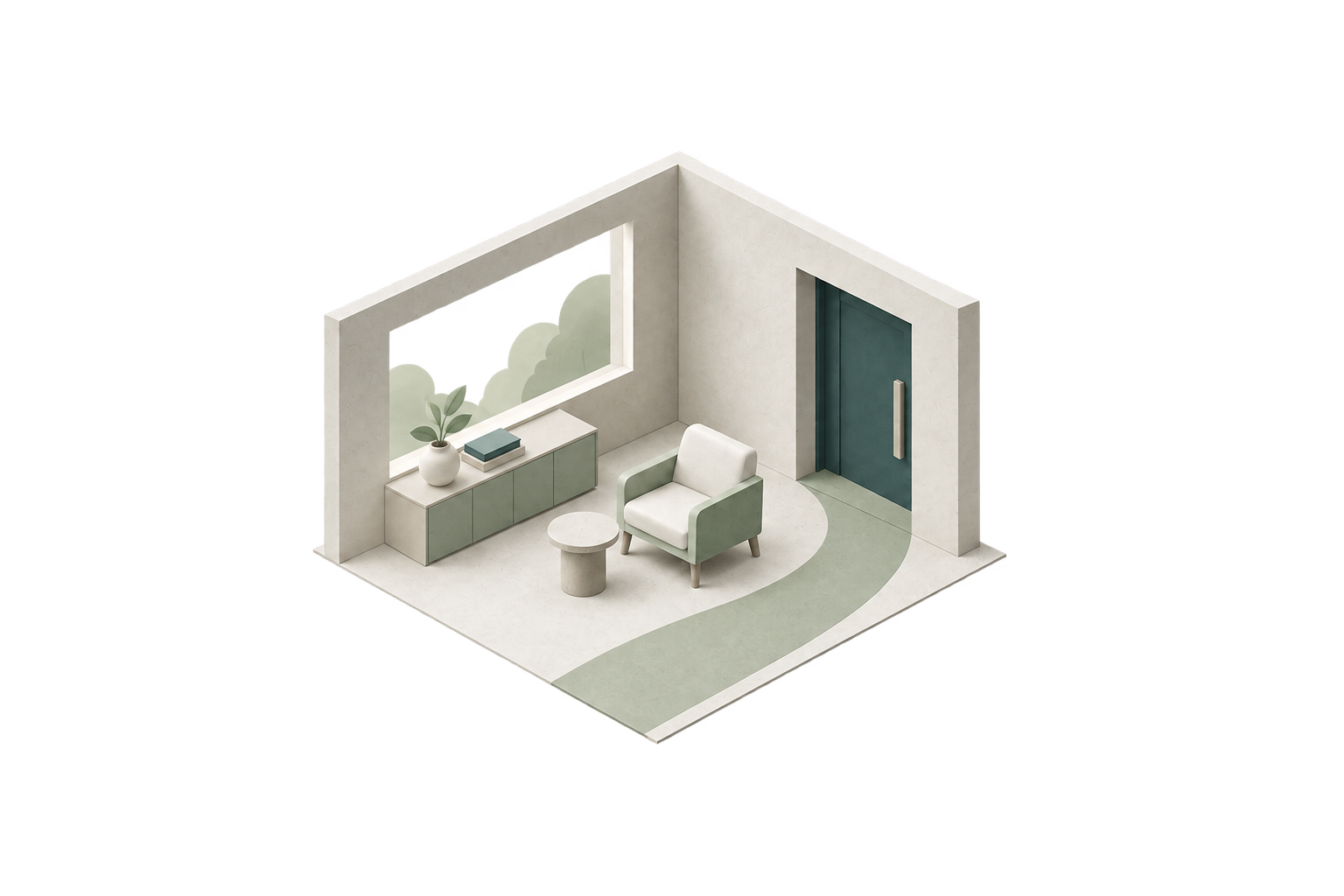
Dementia and memory-care residential community
Can familiar cues and accessible everyday places support orientation and chosen activity?
Setting-matched research3 linked sources · 2 peer-reviewedPeople & purpose
People living with dementia, families and care staff
Design question: Can familiar cues and accessible everyday places support orientation and chosen activity?
What the evidence supports
Existing lighting RCT and new cue trial; specify actual cognitive status and setting.
A dementia lighting trial supports a lighting question; wayfinding, domesticity and whole-building effects require separate evaluation.
The label describes research relevance, not study quality or a proven whole-building benefit.
Design variables to investigate
Proposed moves to develop and test for this programme.
- Recognizable room entrances
- Legible short loops
- Daytime light and glare control
- Domestic shared rooms
- Accessible secure garden
Check the trade-offs
Architectural checks, not additional findings from the cited papers.
- Distinguish useful contrast at destinations from patterns that may be mistaken for steps or obstacles.
- Legible circulation must still preserve privacy, rest and safe assistance when needed.
Evaluate with the intended users
- Supported destination-recognition tasks
- Shared and outdoor-space occupancy
- Caregiver and resident usability ratings
Choose a feasible outcome and comparison before testing. Record who used the space, occupancy, care or service changes, and environmental exposure; these can change the result.
Develop the design question
Related Atlas variables provide additional context. They do not verify this complete programme.
Peer-reviewed sources & research audit3 sources
Read study design, population and transfer limits together. A source reused for several building functions is still one study. Some newer sources have only selected sections or abstracts checked; the individual audit records show what remains unresolved.
Riemersma-van der Lek et al. — Bright light and melatonin in elderly group-care residents: randomized controlled trial (2008) ↗
Peer-reviewed research · Relevant full-paper sections checked
Reported finding or research scope: A controlled example of environmental lighting research in older group-care residents, most of whom had dementia.
Limits and contrary findings: A particular lighting and medication trial; results cannot validate a complete dementia building or a universal lighting prescription.
Research audit: Same publication already audited in the atlas. Reused its documented audit status and inspected the catalogue support/limit wording for consistency; not an independent replication.
Verification limits: Supplementary eMethods not separately inspected.
Record checked 2026-10-10WHO — Housing and health guidelines (2018) ↗
Official public-health guideline · Official guidance · overview checked
Guidance scope: Crowding, indoor temperature, accessibility and injury hazards as healthy-housing considerations.
Limits and contrary findings: Public-health housing guidance; does not establish neural outcomes or validate each residential typology in this catalogue.
Research audit: Official overview confirms housing crowding, temperatures, injury hazards and accessibility are within scope. Full guideline chapters and supporting evidence reviews were not checked in this targeted pass; this is not a neural-outcome study.
Verification limits: Detailed recommendations and underlying evidence synthesis were not independently checked in the complete guideline.
Record checked 2026-10-10A Cluster Randomized Controlled Trial of Visual Cues, Signage, and Spaced Retrieval for Wayfinding Within Long-Term Care Communities (2025) ↗
Peer-reviewed research · Abstract or limited excerpts checked
Method: Pilot cluster randomized trial
Population / setting: 15 long-term-care communities; older residents with wayfinding difficulties
Reported finding or research scope: Cues improved simple-route speed; cue groups made fewer errors, with added benefit from spaced retrieval.
Limits and contrary findings: No speed differences on moderate/complex routes and no life-space difference. Training is separate from spatial design.
Research audit: PubMed abstract and indexed result table inspected; complete body verification pending (PMC retrieval blocked)
Verification limits: Key findings and limitations were checked in the materials listed here. Exact effect estimates and supplementary analyses still require verification against the full tables and supplements.
This is a selected-source extraction, not a complete audit of every table and supplement. It does not establish numerical design thresholds or a whole-building benefit.
Record checked 2026-10-11