


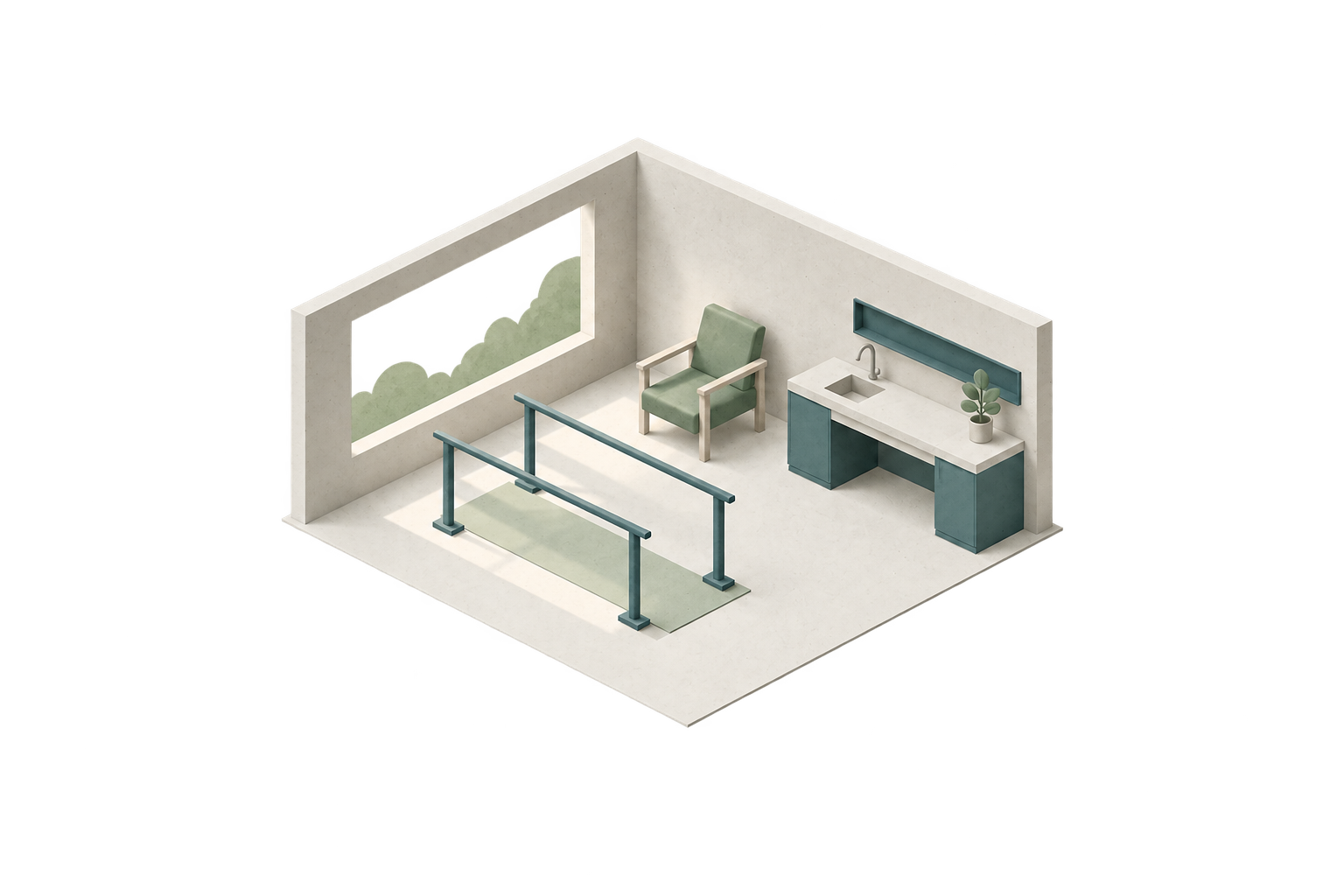
Geriatric rehabilitation and reablement centre
Can low-effort routes offer everyday practice with visible opportunities to rest?
Related-setting transfer3 linked sources · 2 peer-reviewedPeople & purpose
Older people rebuilding everyday abilities, carers and therapists
Design question: Can low-effort routes offer everyday practice with visible opportunities to rest?
What the evidence supports
Use a clearly marked design transfer from studied populations/settings; do not imply the combined building programme was evaluated.
Application is an architectural inference from related guidance or research; this typology has no validated therapeutic design effect.
The label describes research relevance, not study quality or a proven whole-building benefit.
Design variables to investigate
Proposed moves to develop and test for this programme.
- Practice domestic spaces
- Rest-point spacing
- Simple therapy routes
- Garden-to-building accessibility
Check the trade-offs
Architectural checks, not additional findings from the cited papers.
- Distinguish useful contrast at destinations from patterns that may be mistaken for steps or obstacles.
- Legible circulation must still preserve privacy, rest and safe assistance when needed.
Evaluate with the intended users
- Domestic mock-up task completion
- Rest and route choices
- Assistance requests
Choose a feasible outcome and comparison before testing. Record who used the space, occupancy, care or service changes, and environmental exposure; these can change the result.
Develop the design question
Related Atlas variables provide additional context. They do not verify this complete programme.
Peer-reviewed sources & research audit3 sources
Read study design, population and transfer limits together. A source reused for several building functions is still one study. Some newer sources have only selected sections or abstracts checked; the individual audit records show what remains unresolved.
WHO — Housing and health guidelines (2018) ↗
Official public-health guideline · Official guidance · overview checked
Guidance scope: Crowding, indoor temperature, accessibility and injury hazards as healthy-housing considerations.
Limits and contrary findings: Public-health housing guidance; does not establish neural outcomes or validate each residential typology in this catalogue.
Research audit: Official overview confirms housing crowding, temperatures, injury hazards and accessibility are within scope. Full guideline chapters and supporting evidence reviews were not checked in this targeted pass; this is not a neural-outcome study.
Verification limits: Detailed recommendations and underlying evidence synthesis were not independently checked in the complete guideline.
Record checked 2026-10-10Lipson-Smith et al. — Physical environment in stroke recovery: mixed-methods multiple case study (2023) ↗
Peer-reviewed research · Relevant full-paper sections checked
Reported finding or research scope: Patient perspectives and behavioural mapping identify legibility, variety, autonomy and privacy without isolation as design questions.
Limits and contrary findings: 36 participants at two Australian inpatient facilities; observational findings and a conceptual model, without isolated causal architectural effects.
Research audit: Body supports variety, privacy without isolation and patient-centred design as contextual research principles; the authors explicitly call the model non-prescriptive.
Record checked 2026-10-10A Cluster Randomized Controlled Trial of Visual Cues, Signage, and Spaced Retrieval for Wayfinding Within Long-Term Care Communities (2025) ↗
Peer-reviewed research · Abstract or limited excerpts checked
Method: Pilot cluster randomized trial
Population / setting: 15 long-term-care communities; older residents with wayfinding difficulties
Reported finding or research scope: Cues improved simple-route speed; cue groups made fewer errors, with added benefit from spaced retrieval.
Limits and contrary findings: No speed differences on moderate/complex routes and no life-space difference. Training is separate from spatial design.
Research audit: PubMed abstract and indexed result table inspected; complete body verification pending (PMC retrieval blocked)
Verification limits: Key findings and limitations were checked in the materials listed here. Exact effect estimates and supplementary analyses still require verification against the full tables and supplements.
This is a selected-source extraction, not a complete audit of every table and supplement. It does not establish numerical design thresholds or a whole-building benefit.
Record checked 2026-10-11