


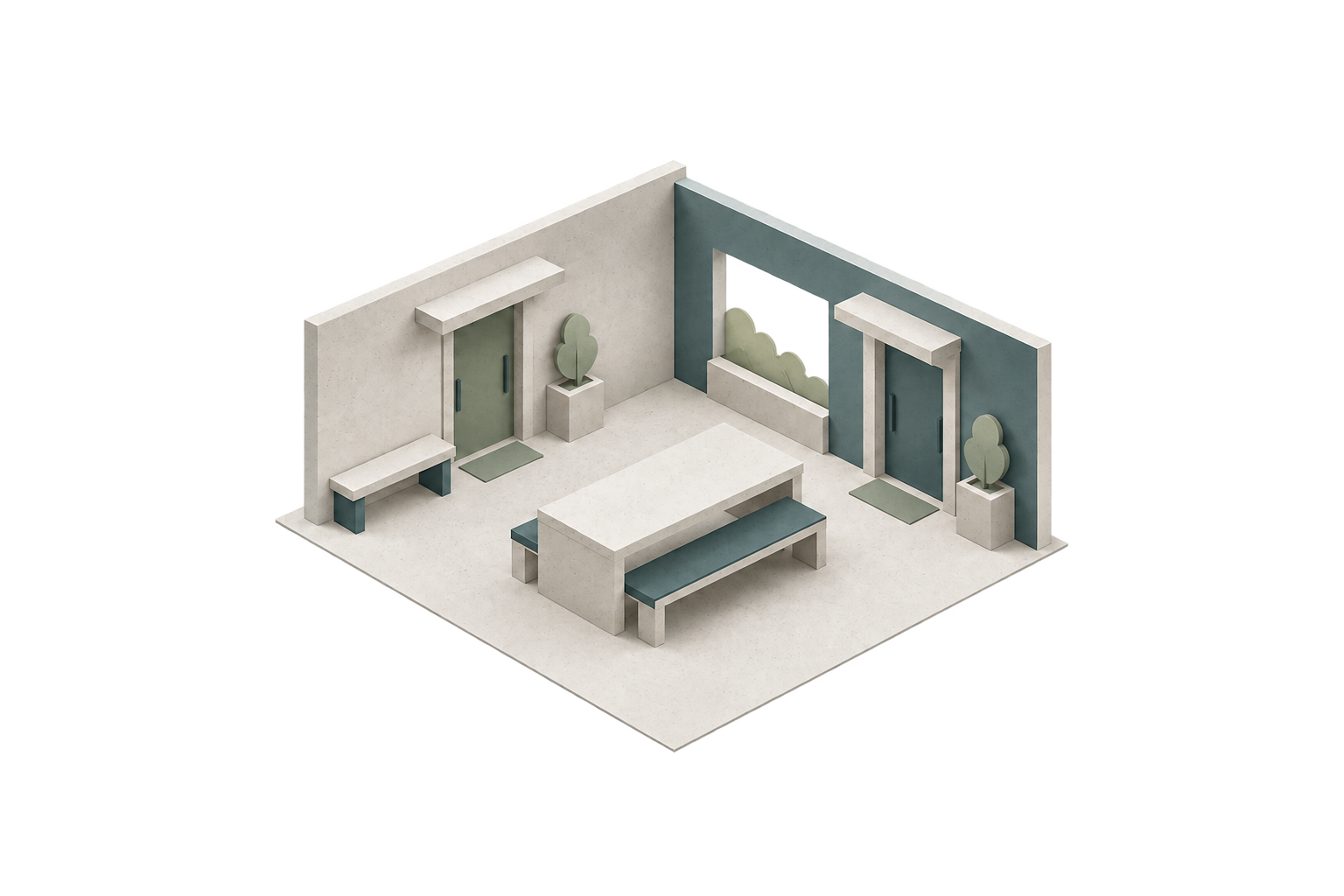
Older-adult cohousing community
Can proximity and shared amenities enable chosen company alongside a private home?
Related-setting transfer2 linked sources · 1 peer-reviewedPeople & purpose
Independent older residents, neighbours and visiting carers
Design question: Can proximity and shared amenities enable chosen company alongside a private home?
What the evidence supports
Use a clearly marked design transfer from studied populations/settings; do not imply the combined building programme was evaluated.
Application is an architectural inference from related guidance or research; this typology has no validated therapeutic design effect.
The label describes research relevance, not study quality or a proven whole-building benefit.
Design variables to investigate
Proposed moves to develop and test for this programme.
- Private homes and shared kitchen
- Step-free outdoor routes
- Visible communal destinations
- Threshold seating
Check the trade-offs
Architectural checks, not additional findings from the cited papers.
- Distinguish useful contrast at destinations from patterns that may be mistaken for steps or obstacles.
- Legible circulation must still preserve privacy, rest and safe assistance when needed.
Evaluate with the intended users
- Shared-space participation choices
- Route accessibility audit
- Resident-rated privacy
Choose a feasible outcome and comparison before testing. Record who used the space, occupancy, care or service changes, and environmental exposure; these can change the result.
Develop the design question
Related Atlas variables provide additional context. They do not verify this complete programme.
Peer-reviewed sources & research audit2 sources
Read study design, population and transfer limits together. A source reused for several building functions is still one study. Some newer sources have only selected sections or abstracts checked; the individual audit records show what remains unresolved.
WHO — Housing and health guidelines (2018) ↗
Official public-health guideline · Official guidance · overview checked
Guidance scope: Crowding, indoor temperature, accessibility and injury hazards as healthy-housing considerations.
Limits and contrary findings: Public-health housing guidance; does not establish neural outcomes or validate each residential typology in this catalogue.
Research audit: Official overview confirms housing crowding, temperatures, injury hazards and accessibility are within scope. Full guideline chapters and supporting evidence reviews were not checked in this targeted pass; this is not a neural-outcome study.
Verification limits: Detailed recommendations and underlying evidence synthesis were not independently checked in the complete guideline.
Record checked 2026-10-10The Role of Neighborhood Environments in Older Adults’ Social Relationships and Social Interactions: A Systematic Review (2026) ↗
Peer-reviewed review · Indexed article sections checked
Method: Systematic review of quantitative empirical studies
Population / setting: 32 studies of adults aged 65+; neighborhood environments
Reported finding or research scope: Maps safety, access, land use, housing and transport associations with social outcomes.
Limits and contrary findings: Indoor environments excluded; largely observational. Does not prove a community-centre plan prevents loneliness.
Research audit: Full publisher eligibility/search methods and synthesis excerpts inspected; online publication June 2025, issue 2026
Verification limits: Key findings and limitations were checked in the materials listed here. Exact effect estimates and supplementary analyses still require verification against the full tables and supplements.
This is a selected-source extraction, not a complete audit of every table and supplement. It does not establish numerical design thresholds or a whole-building benefit.
Record checked 2026-10-11