


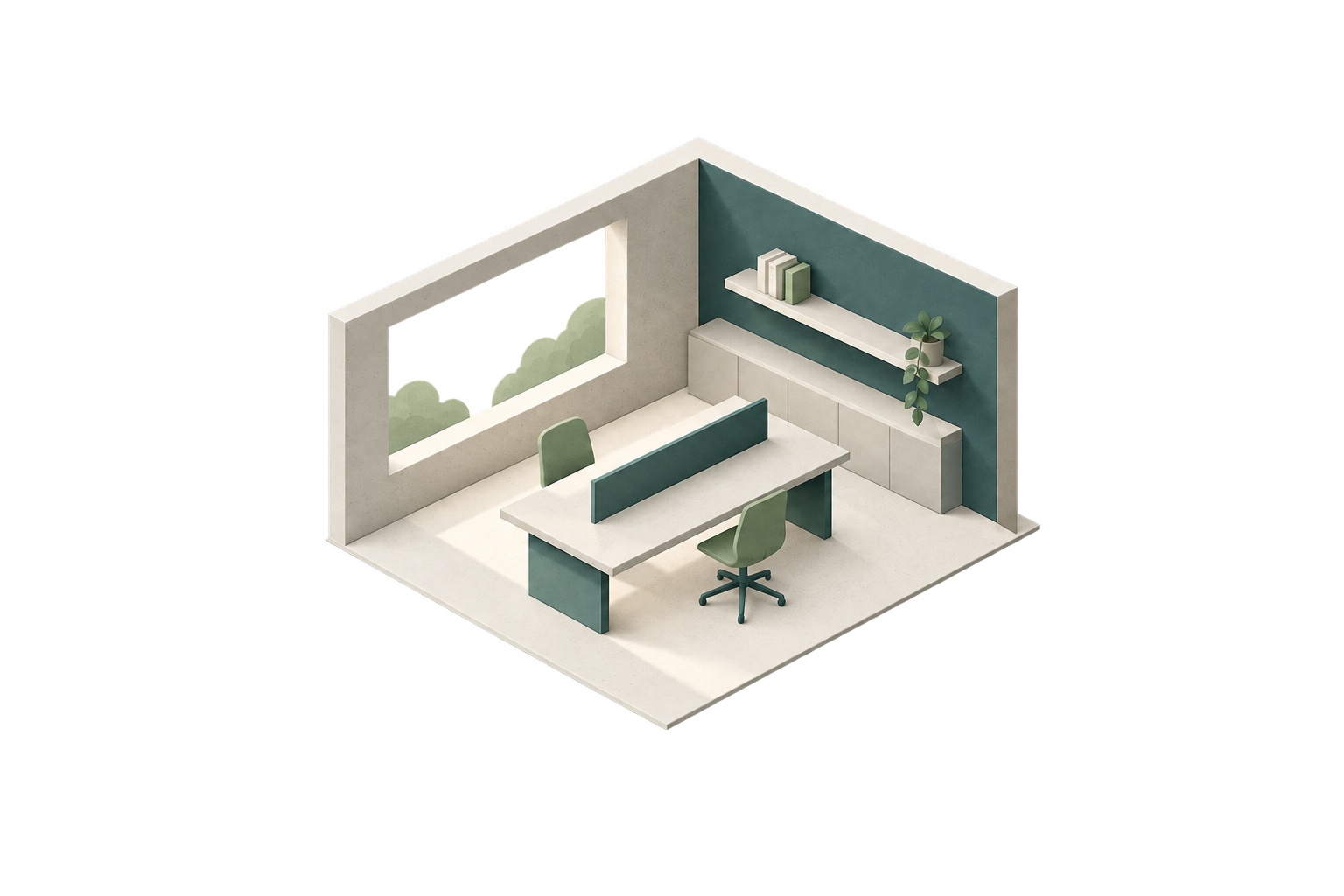
Coworking centre / shared professional studio
How can shared facilities support encounter while allowing workers control over exposure?
Related-setting transfer2 linked sources · 2 peer-reviewedPeople & purpose
Independent workers, small teams and visitors
Design question: How can shared facilities support encounter while allowing workers control over exposure?
What the evidence supports
Use a clearly marked design transfer from studied populations/settings; do not imply the combined building programme was evaluated.
Transfer from corporate offices.
The label describes research relevance, not study quality or a proven whole-building benefit.
Design variables to investigate
Proposed moves to develop and test for this programme.
- Quiet/social zoning
- Visual privacy
- Seat choice
- Entry and visitor routes
Check the trade-offs
Architectural checks, not additional findings from the cited papers.
- Collaboration and visibility can conflict with speech privacy and sustained attention.
- Adjustability is useful only when controls, training and maintenance are accessible.
Evaluate with the intended users
- Work-setting choices
- Reported interruption and comfort
Choose a feasible outcome and comparison before testing. Record who used the space, occupancy, care or service changes, and environmental exposure; these can change the result.
Develop the design question
Related Atlas variables provide additional context. They do not verify this complete programme.
Peer-reviewed sources & research audit2 sources
Read study design, population and transfer limits together. A source reused for several building functions is still one study.
Bernstein and Turban (2018) — The impact of the ‘open’ workspace on human collaboration (2018) ↗
Peer-reviewed research · Relevant full-paper sections checked
Reported finding or research scope: Two corporate-office field interventions measured changes in face-to-face and electronic communication after transitions to open layouts.
Limits and contrary findings: Two organisations; layout, privacy and organisational practice interact. Does not establish a single optimal office type.
Research audit: Same publication already audited in the atlas. Reused its documented audit status and inspected the catalogue support/limit wording for consistency; not an independent replication.
Record checked 2026-10-10Allen et al. (2016) — Associations of Cognitive Function Scores with Carbon Dioxide, Ventilation, and Volatile Organic Compound Exposures in Office Workers (2016) ↗
Peer-reviewed research · Relevant full-paper sections checked
Reported finding or research scope: Controlled exposure study in 24 office workers over six workdays; supports testing indoor air conditions alongside cognition in knowledge-work settings.
Limits and contrary findings: Small sample and simulated office exposures; scores on a decision-making test are not equivalent to productivity or clinical outcomes.
Research audit: Same publication already audited in the atlas. Reused its documented audit status and inspected the catalogue support/limit wording for consistency; not an independent replication.
Record checked 2026-10-10