


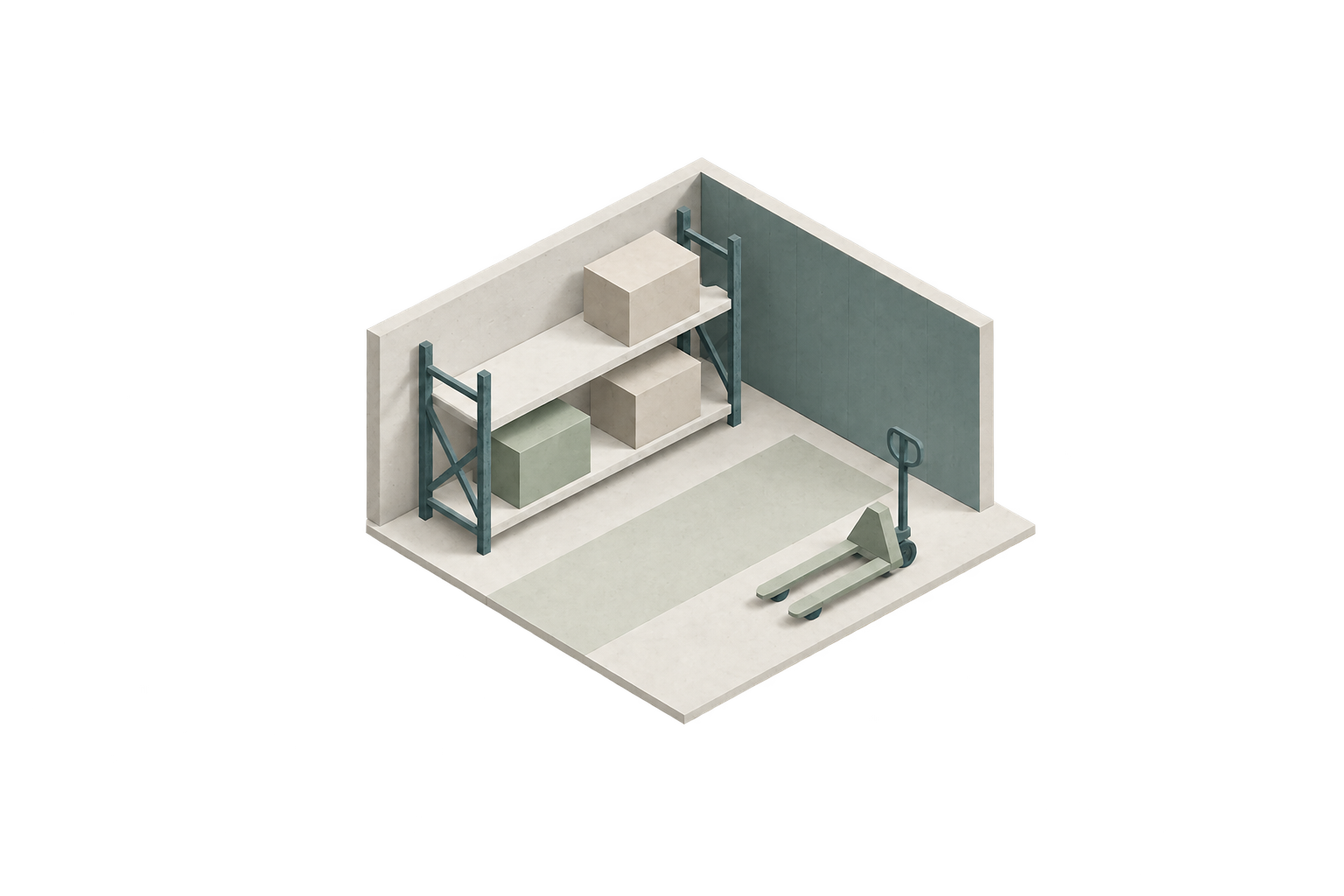
Logistics warehouse / fulfilment workplace
How can complex storage and movement routes reduce avoidable navigation demands?
Exploratory brief1 linked source · 1 peer-reviewedPeople & purpose
Warehouse staff, drivers and supervisors
Design question: How can complex storage and movement routes reduce avoidable navigation demands?
What the evidence supports
No sufficiently matched environmental-outcome evidence identified in this bounded scan. Keep as a research brief; hold benefit claims and prioritize population-specific search/co-design.
Warehouse-specific effects require testing.
The label describes research relevance, not study quality or a proven whole-building benefit.
Design variables to investigate
Proposed moves to develop and test for this programme.
- Aisle hierarchy
- Landmarks
- Lighting uniformity
- Pedestrian/vehicle route separation
Check the trade-offs
Architectural checks, not additional findings from the cited papers.
- Collaboration and visibility can conflict with speech privacy and sustained attention.
- Adjustability is useful only when controls, training and maintenance are accessible.
Evaluate with the intended users
- Wrong-route observations
- Staff ratings of route legibility
Choose a feasible outcome and comparison before testing. Record who used the space, occupancy, care or service changes, and environmental exposure; these can change the result.
Develop the design question
Related Atlas variables provide additional context. They do not verify this complete programme.
Peer-reviewed sources & research audit1 source
Read study design, population and transfer limits together. A source reused for several building functions is still one study.
Hölscher et al. (2006) — Up the down staircase: Wayfinding strategies in multi-level buildings (2006) ↗
Peer-reviewed research · Full-paper verification unresolved
Reported finding or research scope: Empirical navigation study in a complex multilevel building comparing experienced and inexperienced users; supports studying route choice, floor changes and spatial strategies.
Limits and contrary findings: Small study in one building. Transfers to terminals, retail and civic programmes are hypotheses, rather than population-specific findings.
Research audit: Publisher access did not provide the full body and the ETH institutional record is explicitly metadata-only; existing general scope remains abstract-supported.
Verification limits: Full methods, detailed findings and limitations not independently verified from a publisher or author/institutional full-text copy.
Record checked 2026-10-10