


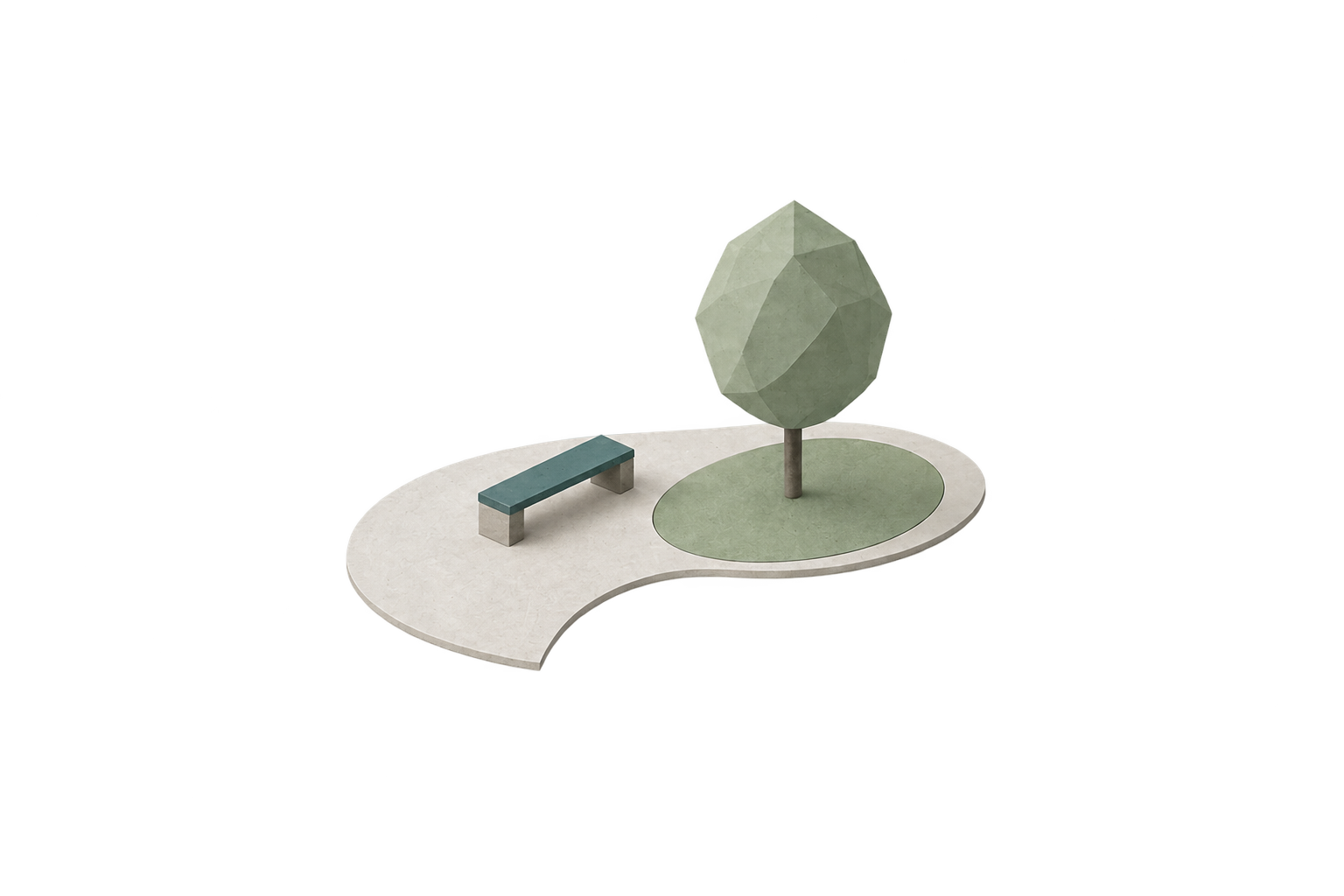
Neighbourhood park / recreation landscape
How can a park combine active use with accessible places for quiet attention?
Setting-matched research4 linked sources · 4 peer-reviewedPeople & purpose
Local residents, visitors and park staff
Design question: How can a park combine active use with accessible places for quiet attention?
What the evidence supports
Existing park programme trial; operation/programming not isolated architectural form.
Park trial; architectural variables remain hypotheses.
The label describes research relevance, not study quality or a proven whole-building benefit.
Design variables to investigate
Proposed moves to develop and test for this programme.
- Activity/rest zoning
- Shade and seating
- Route legibility
- Programme-space distribution
Check the trade-offs
Architectural checks, not additional findings from the cited papers.
- Balance restorative contact with shade, accessibility, maintenance and perceived safety.
- Water, planting and varied terrain need appropriate hygiene, supervision and safe accessible routes.
Evaluate with the intended users
- Observed park use and activity
- User-rated restfulness and accessibility
Choose a feasible outcome and comparison before testing. Record who used the space, occupancy, care or service changes, and environmental exposure; these can change the result.
Develop the design question
Related Atlas variables provide additional context. They do not verify this complete programme.
Peer-reviewed sources & research audit4 sources
Read study design, population and transfer limits together. A source reused for several building functions is still one study. Some newer sources have only selected sections or abstracts checked; the individual audit records show what remains unresolved.
Cohen et al. (2013) — Increasing Physical Activity in Parks: Results of a Randomized Controlled Intervention Trial Using Community-Based Participatory Research (2013) ↗
Peer-reviewed research · Relevant full-paper sections checked
Reported finding or research scope: Trial in 50 Los Angeles neighbourhood park/recreation centres tested community feedback, outreach, training and discretionary programme funding; used observed park use and activity.
Limits and contrary findings: A programming and management intervention, not a trial of architectural form. Supports participation measures and co-design; proposed spatial variables require independent validation.
Research audit: Body confirms programming, outreach, feedback and discretionary funding rather than isolated architectural form. Parks were randomized and observed use/activity improved in combined intervention arms; added advisory-board involvement was not separately superior.
Record checked 2026-10-10Berman, Jonides and Kaplan (2008) — The Cognitive Benefits of Interacting With Nature (2008) ↗
Peer-reviewed research · Relevant full-paper sections checked
Reported finding or research scope: Two small experiments compared nature with urban exposure: walking improved backward-span change; photograph exposure favored the executive-attention interaction, while its backward-span and alerting/orienting interactions were not reliable.
Limits and contrary findings: Short exposures and cognitive tasks; does not determine a universal planting recipe, guarantee restoration for every user or establish effects for specific buildings.
Research audit: Same publication already audited in the atlas. Reused its documented audit status and inspected the catalogue support/limit wording for consistency; not an independent replication.
Record checked 2026-10-10Effects of a community gardening intervention on diet, physical activity, and anthropometry outcomes in the USA (CAPS): an observer-blind, randomised controlled trial (2023) ↗
Peer-reviewed research · Selected full-paper sections checked
Method: Observer-blind randomized controlled trial
Population / setting: 291 adults on Colorado community-garden waiting lists
Reported finding or research scope: Gardening allocation changed activity/fibre trajectories and reduced perceived stress/anxiety; no significant BMI, waist or combined fruit/vegetable effect.
Limits and contrary findings: A plot-plus-programme package, not geometry alone. Point-in-time confidence intervals and null outcomes must remain visible.
Research audit: Full text: methods, findings, discussion and limitations inspected
Verification limits: Key findings and limitations were checked in the materials listed here. Exact effect estimates and supplementary analyses still require verification against the full tables and supplements.
This is a selected-source extraction, not a complete audit of every table and supplement. It does not establish numerical design thresholds or a whole-building benefit.
Record checked 2026-10-11The Role of Neighborhood Environments in Older Adults’ Social Relationships and Social Interactions: A Systematic Review (2026) ↗
Peer-reviewed review · Indexed article sections checked
Method: Systematic review of quantitative empirical studies
Population / setting: 32 studies of adults aged 65+; neighborhood environments
Reported finding or research scope: Maps safety, access, land use, housing and transport associations with social outcomes.
Limits and contrary findings: Indoor environments excluded; largely observational. Does not prove a community-centre plan prevents loneliness.
Research audit: Full publisher eligibility/search methods and synthesis excerpts inspected; online publication June 2025, issue 2026
Verification limits: Key findings and limitations were checked in the materials listed here. Exact effect estimates and supplementary analyses still require verification against the full tables and supplements.
This is a selected-source extraction, not a complete audit of every table and supplement. It does not establish numerical design thresholds or a whole-building benefit.
Record checked 2026-10-11