


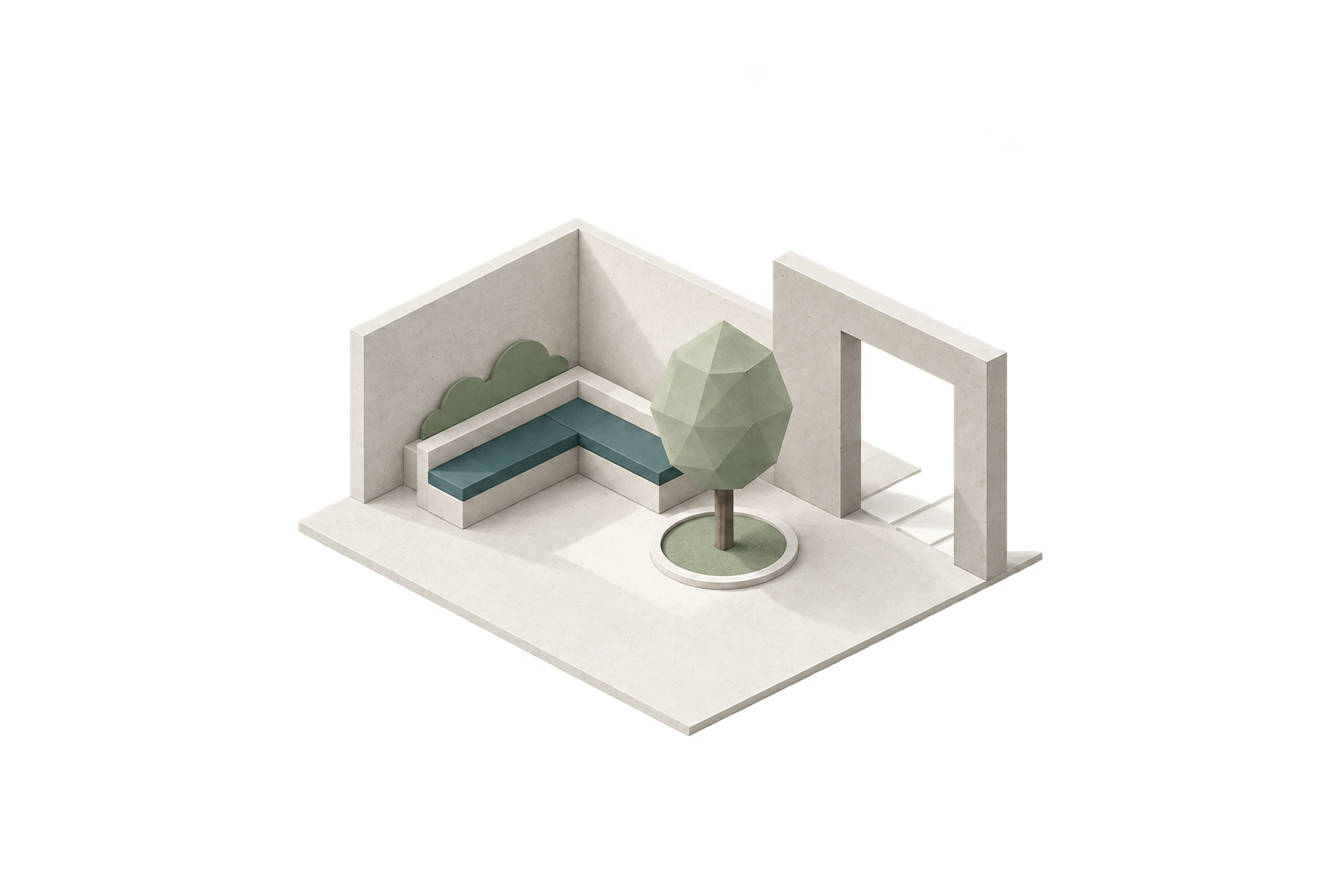
A sheltered pause in the city
Wrap a planted courtyard with a shaded pergola, communal table and seating terraces. Offer both conversation and withdrawal at the urban edge, giving visitors a choice of contact with nature and social activity while testing actual noise, heat and comfort.
People & purpose
overstimulation, restoration, nature, social interaction
Evaluate the proposal
Perceived restoration, dwell time, social choice and measured environmental comfort.
Design decisions and supporting evidence
Design move · hypothesis
Offer optional contact with nature and a place to pause.
Findings across linked studies
Rumination decreased within the nature group, but the between-group change comparison was inconclusive (p=.07). Subgenual prefrontal perfusion showed a significant group difference in change. (Bratman et al. (2015)) A separate 49-person laboratory fMRI experiment found lower pain ratings and nociceptive-signature responses during audiovisual nature; the other pain signature did not show the same differential result. (Steininger et al. (2025))
Peer-reviewed sources & research audit 9 papers
Bratman et al. (2015) · PNAS
- Method
- Arterial-spin-labeling MRI · rumination questionnaire
- Participants / setting
- 38 healthy adult urban residents randomized; 37 included in the rumination analysis and 31 in the perfusion analysis.
- Study focus
- Compares a 90-minute nature walk with an urban walk in healthy adults.
- Finding used
- Rumination decreased within the nature-walk group, but the group-by-time interaction did not reach the conventional .05 threshold (p=.07). Subgenual prefrontal perfusion showed a significant group difference in change.
- Architectural relevance
- Test accessible outdoor nature breaks; indoor planting is a separate hypothesis.
- Study-specific quantitative result
- Outdoor nature contact: Self-reported rumination before and after a walk Change over time in nature versus urban groups 38 randomized; 37 contributed rumination data (18 nature, 19 urban); 31 contributed usable perfusion data. A 90-minute nature or urban walk, approximately 5.3 km. The overall environment-by-time interaction for rumination was F(1,35)=3.51, p=.07, partial eta-squared=.09. The nature group's within-group change was -2.33 scale points (paired t(17)=-2.69, p<.05). Uncertainty: The main paper reports F, partial eta-squared, p-values and means with SEs, but no CI for the group-by-time rumination contrast. Interaction p=.07; within-group significance does not establish a between-group difference. Analysis: Outcome hierarchy not specified in the material checked. Keep the behavioral result distinct from the paper's subgenual perfusion result. A brief outdoor walk is not a trial of indoor biophilic architecture or proof of long-term mental-health benefit. Material checked: Full paper: Participants; rumination Results; Fig. 1. Outcome hierarchy not declared in reviewed Methods/analysis; no preregistration inferred.
- Interpretation limits
- Brief bundled outdoor exposures. The rumination interaction was p=.07; a significant within-group change alone does not establish a between-group effect. The perfusion result does not demonstrate treatment or mediation of rumination.
- Verification status
- Full paper · relevant sections checked
- Sections checked
- Participants; rumination Results; Fig. 1
Berman, Jonides & Kaplan (2008) · Psychological Science
- Method
- Behavioral experiments
- Participants / setting
- Experiment 1: 38 university students recruited, 37 after one exclusion; two missing mood records. Experiment 2: 12 students.
- Study focus
- Two experiments compare natural and urban experiences using walks or photographs.
- Finding used
- Nature walks improved backward-span change relative to urban walks. With photographs, the executive-attention interaction favored nature; alerting/orienting and the backward-span interaction were not reliable.
- Architectural relevance
- Supports a testable restorative-view or nature-break proposal, assessed with an attention task rather than assumed from preference.
- Interpretation limits
- Short exposures and small student samples. A within-nature improvement in Experiment 2 backward span does not establish a between-condition difference. No indoor-room intervention or long-term learning benefit was tested.
- Verification status
- Full paper · relevant sections checked
- Sections checked
- Experiment 1 Methods/Results · Experiment 2 Methods/Results · Table 1 and participant-exclusion footnote
Ulrich et al. (1991) · Journal of Environmental Psychology
- Method
- Controlled experiment · affect ratings, heart period, muscle tension, EDA and pulse transit time
- Participants / setting
- 120 participants
- Study focus
- After a stressful film, 120 participants viewed audiovisual recordings of natural or urban settings.
- Finding used
- Nature videos supported faster self-reported and physiological recovery after a stressful film.
- Architectural relevance
- Informs testing a nature-facing recovery space using both reported restoration and a relevant physiological measure.
- Interpretation limits
- Audiovisual scenes combined visual and acoustic differences and did not isolate a single design feature. Heart-period results do not directly establish a parasympathetic mechanism. Short passive recovery findings do not establish effects of long-term building exposure; later replication evidence should remain separate.
- Verification status
- Full paper · relevant sections checked
- Sections checked
- Methods: Stressor; Environments; Procedures; Measures (journal pp. 210–214) · Effects of Environments: physiological and self-rating results (pp. 218–221) · Summary and Discussion (pp. 222–224)
Hartig et al. (2003) · Journal of Environmental Psychology
- Method
- Randomized field experiment · ambulatory blood pressure, emotion and attention
- Participants / setting
- 112 young adults
- Study focus
- A field experiment compares restoration in natural and urban settings, including an initial seated window-view condition.
- Finding used
- Tree views supported a faster decline in diastolic blood pressure than a viewless room; subsequent nature and urban walks produced different restoration patterns.
- Architectural relevance
- Adds support for studying the quality of a resting view and the experience of a nearby walking route separately.
- Interpretation limits
- Seated views and later walks are different parts of the protocol. Effects cannot be attributed to every feature of a garden or window.
- Verification status
- Full paper · relevant sections checked
- Sections checked
- 2. Method (design, subjects and environments) · 3.1 Physiological effects · 4.1 Evidence of restorative effects of natural environments
Gidlow et al. (2016) · Journal of Environmental Psychology
- Method
- Randomized crossover outdoor walks · mood, cognition, salivary cortisol and HRV
- Participants / setting
- 38 adults who completed all three walks; mean age 40.9 years.
- Study focus
- Compares self-paced 30-minute walks in pleasant residential, green and green-with-water settings.
- Finding used
- Mood and cortisol improved across all three settings. Natural settings showed greater reported restoration and cognitive benefits.
- Architectural relevance
- Adds a comparison against pleasant urban space when evaluating blue-space proposals, rather than assuming all benefit comes from water.
- Interpretation limits
- Exercise and multiple environmental properties covary; HRV was recorded but a water-specific HRV benefit is not established.
- Verification status
- Full paper · relevant sections checked
- Sections checked
- 2. Method: Participants; Design and procedure · 3. Results: Participants; Psychological responses · 4. Discussion
Van den Berg et al. (2026) · Journal of Environmental Psychology
- Method
- Multisite video-exposure experiment following a stressful film, comparing forest, stream, quiet/busy pedestrian settings and quiet/busy traffic settings; affect, skin conductance and cardiac autonomic measures were analyzed.
- Participants / setting
- 1,039 volunteered; 959 randomized across ten teams in five countries. Psychological analysis: 941; physiological analysis: 858.
- Study focus
- Replicates nature-versus-urban video recovery after a stressful film across ten teams.
- Finding used
- Forest and stream videos supported aspects of affective recovery, but greater sympathetic recovery did not replicate. Initial parasympathetic recovery was more favorable for forest; stream responses resembled urban pedestrian settings.
- Architectural relevance
- Evaluate subjective and physiological outcomes separately.
- Interpretation limits
- Audiovisual conditions do not isolate scenery from sound. The paper reports preregistration before analysis and departures from planned contrasts: arousal conditions were collapsed, and forest–stream differences were exploratory. The protocol, supplements and raw data were not independently reviewed.
- Verification status
- Full paper · relevant sections checked
- Sections checked
- Participant flow and exclusions · Relevant Methods and analysis description · Results tables and Discussion
- Unresolved / verification limits
- OSF preregistration, supplements and raw data were not independently checked; preregistration and deviations are reported by the published paper.
Sereno et al. (1995) · Science
- Method
- fMRI · retinotopic mapping
- Participants / setting
- 7 participants in phase-encoded visual mapping; no architectural user population.
- Study focus
- Maps human visual areas using phase-encoded visual stimulation and cortical reconstruction.
- Finding used
- Retinotopic responses delineated several adjacent visual areas.
- Architectural relevance
- General visual-pathway context, not a measured architectural effect.
- Interpretation limits
- Functional visual maps are not the same as anatomical parcels; this experiment did not test architectural wellbeing.
- Verification status
- Full paper · relevant sections checked
- Sections checked
- Methods and sample p.889 · Retinotopic maps pp.890–892
Formisano et al. (2003) · Neuron
- Method
- High-field fMRI · sound-frequency mapping
- Participants / setting
- 6 right-handed adults (4 men, 2 women), ages 23–38, normal audition.
- Study focus
- Maps frequency-related organization in human auditory cortex.
- Finding used
- Auditory responses showed adjacent tonotopic gradients.
- Architectural relevance
- Auditory input context when the exposure includes sound.
- Interpretation limits
- Pure-tone cortical mapping; six individuals and variable anatomy. BOLD measures hemodynamics, not single-neuron firing; no room-noise or health benefit was tested.
- Verification status
- Full paper · relevant sections checked
- Sections checked
- Results p.860 · Discussion pp.865–866 · Experimental Procedures p.866
Steininger et al. (2025) · Nature Communications
- Method
- Within-person audiovisual exposure and experimental pain with fMRI
- Participants / setting
- 53 recruited; 49 analyzed healthy adults aged 20–35
- Study focus
- Within-person audiovisual exposure and experimental pain with fMRI
- Finding used
- Nature exposure reduced reported pain and the nociceptive pain signature relative to the comparison environments. The separate stimulus-independent pain signature did not show the same differential result.
- Architectural relevance
- Nature media may be an optional experience to evaluate, but experimental electrical pain in healthy adults does not establish clinical recovery or chronic-pain treatment.
- Interpretation limits
- Experimental electrical pain, virtual exposure and a young healthy sample. No clinical recovery, chronic-pain treatment or architectural prescription follows directly.
- Verification status
- Full paper · relevant sections checked
- Sections checked
- Full primary article: relevant Methods, Results and Discussion inspected; no raw-data reanalysis.
- Unresolved / verification limits
- Protocol, supplementary material and raw data were not independently reanalysed unless explicitly identified in this record.
Transfer limit: The cited nature walk does not prove that indoor pots reproduce its effects.
Design move · hypothesis
Compare a visible water element within the view.
Findings across linked studies
Scenes with water received better preference, affect and perceived-restoration ratings. (White et al. (2010)) Outdoor-health reviews report heterogeneous associations. (Gascon et al. (2017))
Peer-reviewed sources & research audit 7 papers
White et al. (2010) · Journal of Environmental Psychology
- Method
- Behavioral
- Participants / setting
- Two image-rating samples; participant counts were not available in the checked abstract.
- Study focus
- Two studies rated 120 photographs with controlled proportions of water, vegetation and built content.
- Finding used
- Water-containing scenes received higher preference, affect and perceived-restoration ratings.
- Architectural relevance
- Test visible water as a view composition option with the intended users.
- Study-specific quantitative result
- Water features / blue space: Preference, positive affect and perceived restorativeness of environmental photographs Scenes containing water versus comparison natural or built scenes 120 is the number of photographs, not participants. Participant sample sizes were not retrieved from the accessible primary abstract. Two image-rating studies using a set of 120 photographs with controlled proportions of water, greenery and built content. Water-containing scenes received more favorable preference, affect and restoration ratings. Numerical differences were not reported in the checked abstract. Uncertainty: Effect sizes, confidence intervals and exact statistical comparisons were not extracted from full text. Analysis: Outcome hierarchy not specified in the material checked. Visual image ratings support a hypothesis about water views; this study did not test audible fountains, water contact, physiological stress recovery or clinical benefit. Material checked: Publisher abstract and author-repository records at Plymouth and Vienna checked; no retrievable full manuscript found. Outcome hierarchy could not be verified. Numerical details are unextracted from full text, not established absent.
- Interpretation limits
- Image ratings, not physiological recovery, installed fountains or long-term health.
- Verification status
- Partial verification · see unresolved items
- Sections checked
- Publisher abstract; Plymouth and Vienna author-repository metadata
- Unresolved / verification limits
- Participant counts, exact comparisons, effect sizes, CIs and outcome hierarchy remain unverified. Publisher exposes abstract/section previews; Plymouth and Vienna records supplied metadata/DOI links only; no accessible PMC or author manuscript located.
Gascon et al. (2017) · International Journal of Hygiene and Environmental Health
- Method
- Systematic review of quantitative studies of outdoor blue-space exposure and health; publisher-indexed passages describe quality assessment and predominantly cross-sectional designs.
- Participants / setting
- 35 studies, with heterogeneous populations; 22 were classified as good quality in the review.
- Study focus
- Synthesizes 35 studies of outdoor water exposure and health.
- Finding used
- The balance of evidence favored associations with mental wellbeing and physical activity. Findings for general health, obesity and cardiovascular outcomes were less consistent.
- Architectural relevance
- Separate visual preference from health outcomes and assess blue-space proposals in their actual setting.
- Interpretation limits
- Exposure definitions and study designs varied. Predominantly observational evidence cannot establish causality, and outdoor blue-space findings do not demonstrate an indoor-fountain benefit. Complete extraction and appraisal tables were not accessible.
- Verification status
- Partial check · primary body excerpts
- Sections checked
- Primary abstract; publisher-indexed Results and design passages
- Unresolved / verification limits
- Full study-selection, appraisal and outcome tables remain unverified after publisher, PubMed and targeted repository searches.
Gidlow et al. (2016) · Journal of Environmental Psychology
- Method
- Randomized crossover outdoor walks · mood, cognition, salivary cortisol and HRV
- Participants / setting
- 38 adults who completed all three walks; mean age 40.9 years.
- Study focus
- Compares self-paced 30-minute walks in pleasant residential, green and green-with-water settings.
- Finding used
- Mood and cortisol improved across all three settings. Natural settings showed greater reported restoration and cognitive benefits.
- Architectural relevance
- Adds a comparison against pleasant urban space when evaluating blue-space proposals, rather than assuming all benefit comes from water.
- Interpretation limits
- Exercise and multiple environmental properties covary; HRV was recorded but a water-specific HRV benefit is not established.
- Verification status
- Full paper · relevant sections checked
- Sections checked
- 2. Method: Participants; Design and procedure · 3. Results: Participants; Psychological responses · 4. Discussion
Van den Berg et al. (2026) · Journal of Environmental Psychology
- Method
- Multisite video-exposure experiment following a stressful film, comparing forest, stream, quiet/busy pedestrian settings and quiet/busy traffic settings; affect, skin conductance and cardiac autonomic measures were analyzed.
- Participants / setting
- 1,039 volunteered; 959 randomized across ten teams in five countries. Psychological analysis: 941; physiological analysis: 858.
- Study focus
- Replicates nature-versus-urban video recovery after a stressful film across ten teams.
- Finding used
- Forest and stream videos supported aspects of affective recovery, but greater sympathetic recovery did not replicate. Initial parasympathetic recovery was more favorable for forest; stream responses resembled urban pedestrian settings.
- Architectural relevance
- Consider the sound of a water feature, not only its appearance.
- Interpretation limits
- Audiovisual conditions do not isolate scenery from sound. The paper reports preregistration before analysis and departures from planned contrasts: arousal conditions were collapsed, and forest–stream differences were exploratory. The protocol, supplements and raw data were not independently reviewed.
- Verification status
- Full paper · relevant sections checked
- Sections checked
- Participant flow and exclusions · Relevant Methods and analysis description · Results tables and Discussion
- Unresolved / verification limits
- OSF preregistration, supplements and raw data were not independently checked; preregistration and deviations are reported by the published paper.
Jeon, Lee, You & Kang (2012) · Journal of the Acoustical Society of America
- Method
- Laboratory listening and audiovisual experiments · preference and adjective ratings · acoustic analysis
- Participants / setting
- Same 40 normal-hearing adults in both main preference and semantic-differential experiments: 23 men/17 women, ages 21–33, mean 25.1 (SD 3.4). Adjective pretests involved 20 participants.
- Study focus
- Laboratory comparisons used recorded water features in audio-only and audiovisual conditions with urban noise.
- Finding used
- Water/traffic combinations received higher preference than traffic alone; added images usually improved ratings, but not for every water feature. Sound sharpness related positively to freshness and negatively to calmness.
- Architectural relevance
- Supports an auditory route for audible water features; test sound quality as well as appearance.
- Interpretation limits
- Laboratory preference and adjective ratings, not physiological stress or installed-fountain health effects. Exact preference differences and CIs were not extracted from graphs. Outcome hierarchy not declared.
- Verification status
- Full paper · relevant sections checked
- Sections checked
- Author-uploaded published text; MethodsB–C; ResultsB; TablesII–IV
Sereno et al. (1995) · Science
- Method
- fMRI · retinotopic mapping
- Participants / setting
- 7 participants in phase-encoded visual mapping; no architectural user population.
- Study focus
- Maps human visual areas using phase-encoded visual stimulation and cortical reconstruction.
- Finding used
- Retinotopic responses delineated several adjacent visual areas.
- Architectural relevance
- General visual-pathway context, not a measured architectural effect.
- Interpretation limits
- Functional visual maps are not the same as anatomical parcels; this experiment did not test architectural wellbeing.
- Verification status
- Full paper · relevant sections checked
- Sections checked
- Methods and sample p.889 · Retinotopic maps pp.890–892
Formisano et al. (2003) · Neuron
- Method
- High-field fMRI · sound-frequency mapping
- Participants / setting
- 6 right-handed adults (4 men, 2 women), ages 23–38, normal audition.
- Study focus
- Maps frequency-related organization in human auditory cortex.
- Finding used
- Auditory responses showed adjacent tonotopic gradients.
- Architectural relevance
- Auditory input context when the exposure includes sound.
- Interpretation limits
- Pure-tone cortical mapping; six individuals and variable anatomy. BOLD measures hemodynamics, not single-neuron firing; no room-noise or health benefit was tested.
- Verification status
- Full paper · relevant sections checked
- Sections checked
- Results p.860 · Discussion pp.865–866 · Experimental Procedures p.866
Transfer limit: Photo ratings do not establish physiological benefit from a real water feature.
Design move · hypothesis
Test a sheltered seat with an outward view.
Findings across linked studies
The computational anchor found partial but inconsistent spatial patterns. (Dawes & Ostwald (2014)) Related preference research does not establish a universal prospect–refuge rule. (Dosen & Ostwald (2016))
Peer-reviewed sources & research audit 4 papers
Dawes & Ostwald (2014) · Building and Environment
- Method
- Computational isovist analysis of paths through five houses; two-dimensional visual fields supplemented with ceiling heights.
- Participants / setting
- No human participants; five Frank Lloyd Wright houses
- Study focus
- Study focus: Sequences of outlook and enclosure along paths.
- Finding used
- Computational analysis found inconsistent support for the proposed Wright Space pattern; no human comfort measured.
- Architectural relevance
- Treat prospect–refuge as a testable spatial hypothesis, not a biological formula.
- Study-specific quantitative result
- Prospect–refuge: Computational spatio-visual pattern, not a human outcome Ten geometric measures assessed against four proposed prospect–refuge properties Five houses; no human participants Isovist analysis along paths through five textile-block houses A human effect size is not applicable: the analysis measures geometry and reports inconsistent support for the proposed pattern. Uncertainty: No physiological, comfort or preference effect or CI was estimated in this study. Analysis: Outcome hierarchy not specified in the material checked. Cannot establish a preferred refuge ratio, a universal safety response or a health benefit. Material checked: Author-uploaded full text: method scope, house analyses and §§6–7. Primary/secondary refers to geometric indicators; no human outcome hierarchy or effect estimate applies.
- Interpretation limits
- Geometric indicators cannot model individual perception, emotions or health. The paper distinguishes primary/secondary geometric indicators; these are not human clinical endpoints.
- Verification status
- Full paper · relevant sections checked
- Sections checked
- Method scope and limitations · §5 house analyses · §6 Discussion · §7 Conclusion
- Unresolved / verification limits
- Human effect sizes and confidence intervals are inapplicable; there are no human participants.
Dosen & Ostwald (2016) · City, Territory and Architecture
- Method
- Review / classification of quantitative preference research
- Participants / setting
- 34 quantitative studies spanning natural, urban and interior settings.
- Study focus
- Critically classifies quantitative findings about prospect, refuge, complexity and mystery across natural and built settings.
- Finding used
- Prospect received more support in urban and interior studies; refuge findings were more neutral. Evidence was inconsistent and venue-specific.
- Architectural relevance
- Keeps prospect and refuge as separately testable choices rather than treating the theory as a proven design formula.
- Interpretation limits
- Classifies findings without a formal study-rigour assessment; preference evidence is inconsistent and setting-specific.
- Verification status
- Full paper · relevant sections checked
- Sections checked
- Methods · Results: urban, landscape and interior preference · Discussion
Stamps (2008) · Perceptual and Motor Skills
- Method
- Two scene-rating experiments examining view depth, refuge cues, lighting direction and natural versus built settings; detailed procedure and analysis have not been verified in full text.
- Participants / setting
- Abstract reports 29 participants rating 16 landscapes in experiment 1 and 18 participants rating 16 landscapes and 14 rooms in experiment 2.
- Study focus
- Tests view depth, refuge cues, lighting direction and setting in scene ratings.
- Finding used
- Abstract supports a preference for distant mountain views; refuge and lighting predictions were not consistently supported. These results do not establish a general interior prospect–refuge rule.
- Architectural relevance
- Compare outlook and enclosure separately, using user ratings rather than a fixed biological formula.
- Interpretation limits
- Small image-based samples measure ratings rather than health or safety. Full Methods, Results tables, exclusions and outcome hierarchy remain unverified.
- Verification status
- Abstract only · full text unresolved
- Sections checked
- Primary abstract; publisher and author-copy availability checked
- Unresolved / verification limits
- Full paper could not be retrieved through publisher and author-copy links; sampling, analysis details and hierarchy remain unresolved.
Park et al. (2011) · Journal of Neuroscience 31(4), 1333–1340
- Method
- fMRI · multivoxel classification
- Participants / setting
- 7 analyzed main participants; control groups of 6 and 7.
- Study focus
- Separates scene-boundary and content information.
- Finding used
- PPA patterns emphasized boundaries; LOC emphasized content.
- Architectural relevance
- Context for outlook; not proof of refuge theory.
- Interpretation limits
- Scene images, not tested refuge or safety. Functional PPA exceeds a single anatomical parcel.
- Verification status
- Earlier full-text extraction retained
Transfer limit: The cited spatial analysis had no human participants: benefit remains an untested hypothesis.
Color & personal experience
Give the sheltered pause area an identity within the courtyard. The proposed benefit is making places to sit and meet easier to recognize.
Test with users: Compare seating choices, perceived comfort and willingness to meet or pause at different times of day.
Application boundary. Nature-walk and image-rating findings do not prove that this courtyard restores users; prospect–refuge in the cited record is theoretical. An outdoor nature walk and an indoor planted room are different exposures; test the actual place.