


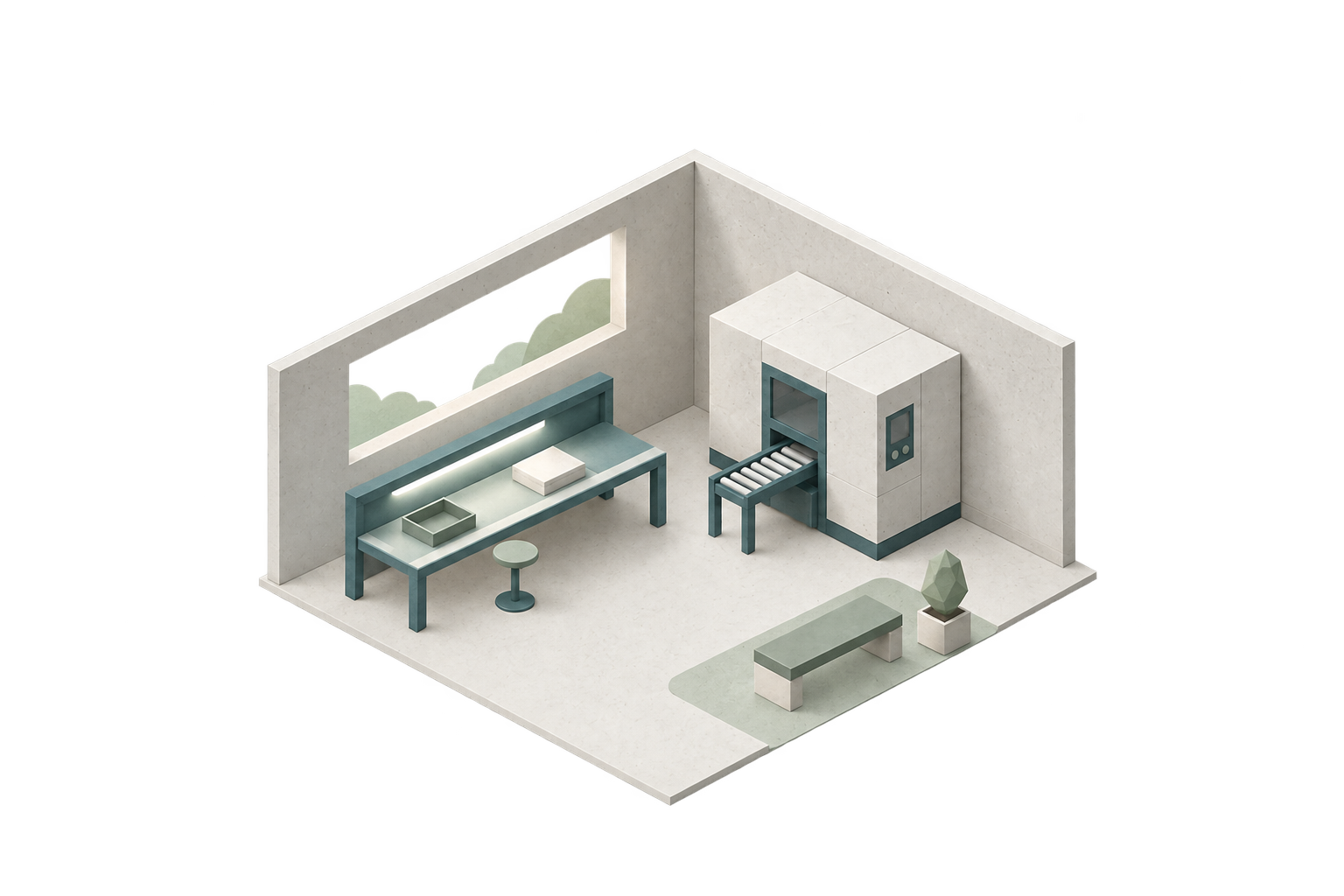
Industrial production / assembly workplace
How can repetitive work areas remain legible and offer accessible recovery spaces?
Exploratory brief2 linked sources · 2 peer-reviewedPeople & purpose
Shift workers, supervisors and maintenance staff
Design question: How can repetitive work areas remain legible and offer accessible recovery spaces?
What the evidence supports
No sufficiently matched environmental-outcome evidence identified in this bounded scan. Keep as a research brief; hold benefit claims and prioritize population-specific search/co-design.
Industrial transfer requires specialist testing.
The label describes research relevance, not study quality or a proven whole-building benefit.
Design variables to investigate
Proposed moves to develop and test for this programme.
- Work-zone legibility
- Glare control
- Noise-zone boundaries
- Break-room access
Check the trade-offs
Architectural checks, not additional findings from the cited papers.
- Collaboration and visibility can conflict with speech privacy and sustained attention.
- Adjustability is useful only when controls, training and maintenance are accessible.
Evaluate with the intended users
- Reported environmental comfort
- Observed break-space accessibility
Choose a feasible outcome and comparison before testing. Record who used the space, occupancy, care or service changes, and environmental exposure; these can change the result.
Develop the design question
Related Atlas variables provide additional context. They do not verify this complete programme.
Peer-reviewed sources & research audit2 sources
Read study design, population and transfer limits together. A source reused for several building functions is still one study.
Allen et al. (2016) — Associations of Cognitive Function Scores with Carbon Dioxide, Ventilation, and Volatile Organic Compound Exposures in Office Workers (2016) ↗
Peer-reviewed research · Relevant full-paper sections checked
Reported finding or research scope: Controlled exposure study in 24 office workers over six workdays; supports testing indoor air conditions alongside cognition in knowledge-work settings.
Limits and contrary findings: Small sample and simulated office exposures; scores on a decision-making test are not equivalent to productivity or clinical outcomes.
Research audit: Same publication already audited in the atlas. Reused its documented audit status and inspected the catalogue support/limit wording for consistency; not an independent replication.
Record checked 2026-10-10Hölscher et al. (2006) — Up the down staircase: Wayfinding strategies in multi-level buildings (2006) ↗
Peer-reviewed research · Full-paper verification unresolved
Reported finding or research scope: Empirical navigation study in a complex multilevel building comparing experienced and inexperienced users; supports studying route choice, floor changes and spatial strategies.
Limits and contrary findings: Small study in one building. Transfers to terminals, retail and civic programmes are hypotheses, rather than population-specific findings.
Research audit: Publisher access did not provide the full body and the ETH institutional record is explicitly metadata-only; existing general scope remains abstract-supported.
Verification limits: Full methods, detailed findings and limitations not independently verified from a publisher or author/institutional full-text copy.
Record checked 2026-10-10