


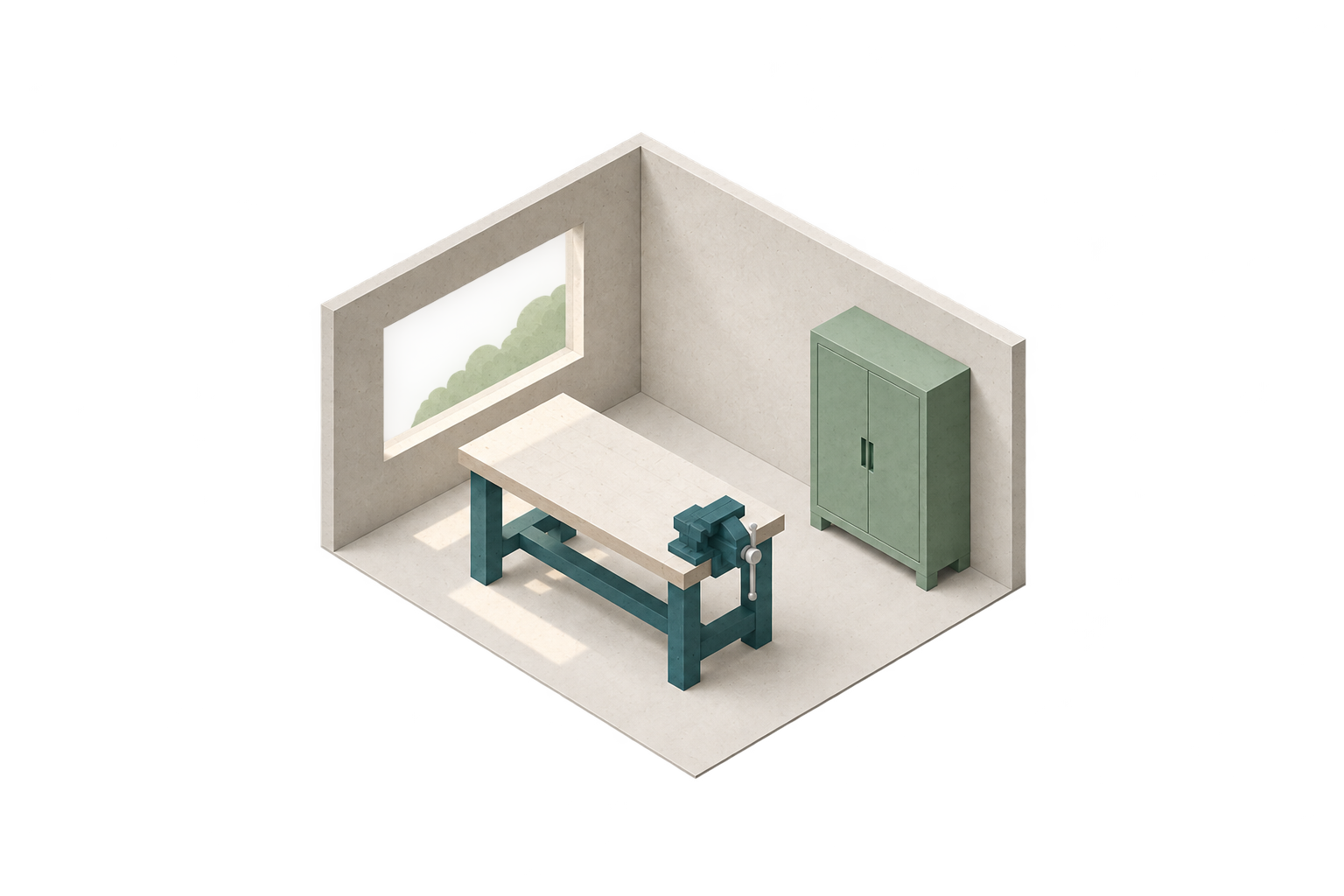
Vocational college / skills-training workshop
How can demonstration, practice and retreat remain clear within a busy training environment?
Related-setting transfer3 linked sources · 3 peer-reviewedPeople & purpose
Apprentices, instructors and technical staff
Design question: How can demonstration, practice and retreat remain clear within a busy training environment?
What the evidence supports
Use a clearly marked design transfer from studied populations/settings; do not imply the combined building programme was evaluated.
Transfer to practical-learning environments.
The label describes research relevance, not study quality or a proven whole-building benefit.
Design variables to investigate
Proposed moves to develop and test for this programme.
- Demonstration sightlines
- Noisy/quiet separation
- Spatial sequencing
- Tool-storage legibility
Check the trade-offs
Architectural checks, not additional findings from the cited papers.
- Keep speech and task conditions suitable across ages and hearing needs.
- Flexible or open layouts may introduce distraction; include usable quiet alternatives and teacher sightlines.
Evaluate with the intended users
- Requests for spatial guidance
- User ratings of distraction
Choose a feasible outcome and comparison before testing. Record who used the space, occupancy, care or service changes, and environmental exposure; these can change the result.
Develop the design question
Related Atlas variables provide additional context. They do not verify this complete programme.
Peer-reviewed sources & research audit3 sources
Read study design, population and transfer limits together. A source reused for several building functions is still one study. Some newer sources have only selected sections or abstracts checked; the individual audit records show what remains unresolved.
Barrett et al. (2015) — The impact of classroom design on pupils’ learning: Final results of a holistic, multi-level analysis (2015) ↗
Peer-reviewed research · Relevant full-paper sections checked
Reported finding or research scope: Observational multilevel study of 153 classrooms and 3,766 primary pupils; links classroom light, temperature, air quality, ownership, flexibility, complexity and colour to learning progress.
Limits and contrary findings: UK primary classrooms; observational associations do not prove a universal design rule or transfer to other ages and diagnoses.
Research audit: Same publication already audited in the atlas. Reused its documented audit status and inspected the catalogue support/limit wording for consistency; not an independent replication.
Verification limits: No single-feature causal estimate or adult-learning transfer established.
Record checked 2026-10-10Hölscher et al. (2006) — Up the down staircase: Wayfinding strategies in multi-level buildings (2006) ↗
Peer-reviewed research · Full-paper verification unresolved
Reported finding or research scope: Empirical navigation study in a complex multilevel building comparing experienced and inexperienced users; supports studying route choice, floor changes and spatial strategies.
Limits and contrary findings: Small study in one building. Transfers to terminals, retail and civic programmes are hypotheses, rather than population-specific findings.
Research audit: Publisher access did not provide the full body and the ETH institutional record is explicitly metadata-only; existing general scope remains abstract-supported.
Verification limits: Full methods, detailed findings and limitations not independently verified from a publisher or author/institutional full-text copy.
Record checked 2026-10-10Experimental assessment of impact of different ventilation modes on cognitive and academic performance: A study based on classrooms in Türkiye (2024) ↗
Peer-reviewed research · Abstract or limited excerpts checked
Method: School ventilation-mode comparison across seasons
Population / setting: 120 second-grade children in two school buildings
Reported finding or research scope: Examines classroom ventilation modes alongside cognitive and academic task performance. Detailed outcome and causal interpretation remain unresolved.
Limits and contrary findings: Season, masks, building properties and multiple indoor conditions varied. Detailed causal conclusions require full methods/results audit.
Research audit: Publisher abstract inspected; full paper pending
Verification limits: Key findings and limitations were checked in the materials listed here. Exact effect estimates and supplementary analyses still require verification against the full tables and supplements.
This is a selected-source extraction, not a complete audit of every table and supplement. It does not establish numerical design thresholds or a whole-building benefit.
Record checked 2026-10-11