


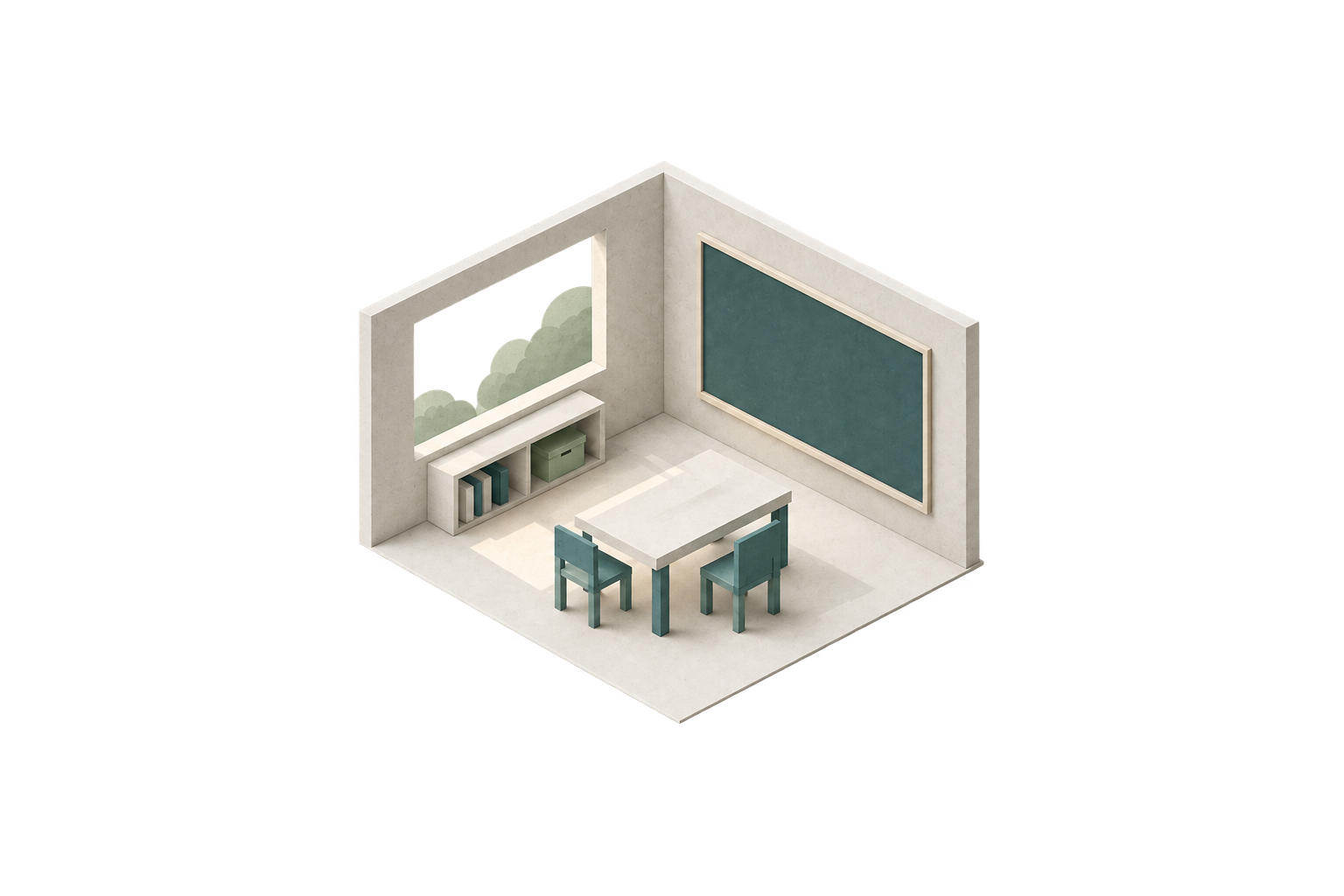
Primary school
How can classroom design support attention while allowing individual choice?
Setting-matched research4 linked sources · 4 peer-reviewedPeople & purpose
Primary pupils and teachers
Design question: How can classroom design support attention while allowing individual choice?
What the evidence supports
Existing classroom study plus school ventilation and playground trials; each supports separate variables.
Primary-classroom evidence; verify locally.
The label describes research relevance, not study quality or a proven whole-building benefit.
Design variables to investigate
Proposed moves to develop and test for this programme.
- Daylight
- Ventilation and temperature
- Layout flexibility
- Visual complexity
Check the trade-offs
Architectural checks, not additional findings from the cited papers.
- Keep speech and task conditions suitable across ages and hearing needs.
- Flexible or open layouts may introduce distraction; include usable quiet alternatives and teacher sightlines.
Evaluate with the intended users
- Task participation observations
- Pupil and teacher comfort ratings
Choose a feasible outcome and comparison before testing. Record who used the space, occupancy, care or service changes, and environmental exposure; these can change the result.
Develop the design question
Related Atlas variables provide additional context. They do not verify this complete programme.
Peer-reviewed sources & research audit4 sources
Read study design, population and transfer limits together. A source reused for several building functions is still one study. Some newer sources have only selected sections or abstracts checked; the individual audit records show what remains unresolved.
Barrett et al. (2015) — The impact of classroom design on pupils’ learning: Final results of a holistic, multi-level analysis (2015) ↗
Peer-reviewed research · Relevant full-paper sections checked
Reported finding or research scope: Observational multilevel study of 153 classrooms and 3,766 primary pupils; links classroom light, temperature, air quality, ownership, flexibility, complexity and colour to learning progress.
Limits and contrary findings: UK primary classrooms; observational associations do not prove a universal design rule or transfer to other ages and diagnoses.
Research audit: Same publication already audited in the atlas. Reused its documented audit status and inspected the catalogue support/limit wording for consistency; not an independent replication.
Verification limits: No single-feature causal estimate or adult-learning transfer established.
Record checked 2026-10-10Experimental assessment of impact of different ventilation modes on cognitive and academic performance: A study based on classrooms in Türkiye (2024) ↗
Peer-reviewed research · Abstract or limited excerpts checked
Method: School ventilation-mode comparison across seasons
Population / setting: 120 second-grade children in two school buildings
Reported finding or research scope: Examines classroom ventilation modes alongside cognitive and academic task performance. Detailed outcome and causal interpretation remain unresolved.
Limits and contrary findings: Season, masks, building properties and multiple indoor conditions varied. Detailed causal conclusions require full methods/results audit.
Research audit: Publisher abstract inspected; full paper pending
Verification limits: Key findings and limitations were checked in the materials listed here. Exact effect estimates and supplementary analyses still require verification against the full tables and supplements.
This is a selected-source extraction, not a complete audit of every table and supplement. It does not establish numerical design thresholds or a whole-building benefit.
Record checked 2026-10-11Increasing physical activity in young primary school children—it's child's play: a cluster randomised controlled trial (2013) ↗
Peer-reviewed research · Abstract or limited excerpts checked
Method: School-cluster randomized trial
Population / setting: 226 children aged 5–7 sampled from 12 Australian primary schools
Reported finding or research scope: Loose materials plus adult risk-perception intervention produced a small increase in break-time activity.
Limits and contrary findings: Bundled social and physical intervention; not proof all play equipment or terrain works.
Research audit: PubMed abstract inspected; full paper pending
Verification limits: Key findings and limitations were checked in the materials listed here. Exact effect estimates and supplementary analyses still require verification against the full tables and supplements.
This is a selected-source extraction, not a complete audit of every table and supplement. It does not establish numerical design thresholds or a whole-building benefit.
Record checked 2026-10-11The effect of increasing risk and challenge in the school playground on physical activity and weight in children: a cluster randomised controlled trial (PLAY) (2017) ↗
Peer-reviewed research · Abstract or limited excerpts checked
Method: School-cluster randomized trial
Population / setting: Schoolchildren; longer follow-up of playground change
Reported finding or research scope: An important counterweight: increasing challenge/risk in playgrounds did not reliably increase physical activity/alter weight.
Limits and contrary findings: Do not generalize the positive Sydney trial to every playground redesign; methods/sample extraction still required.
Research audit: Publisher body discussion excerpt inspected; full trial extraction pending
Verification limits: Key findings and limitations were checked in the materials listed here. Exact effect estimates and supplementary analyses still require verification against the full tables and supplements.
This is a selected-source extraction, not a complete audit of every table and supplement. It does not establish numerical design thresholds or a whole-building benefit.
Record checked 2026-10-11