


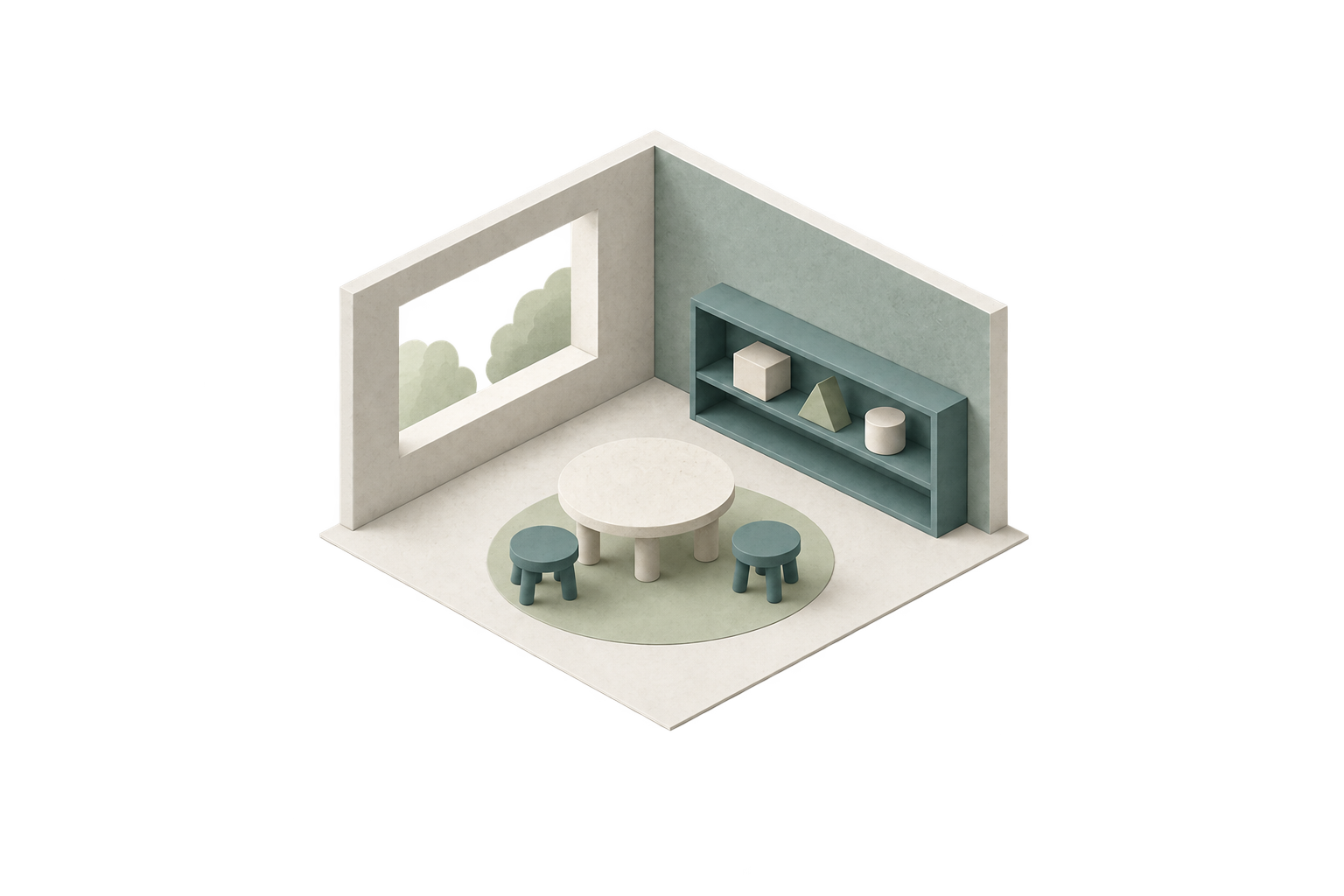
Small worlds for learning together
Gather children on a circle-time carpet, then offer low activity tables, recognizable storage and a calmer edge. Combine speech-friendly acoustics with manageable displays and opportunities to personalize the room, aiming to make instructions clearer and participation easier.
People & purpose
learning, attention, social behaviour, sensory development
Evaluate the proposal
Speech comprehension, on-task behavior and children’s use of activity zones.
Design decisions and supporting evidence
Design move · hypothesis
Compare sound-absorbing surfaces around a listening activity.
Findings across linked studies
Longer reverberation amplified noise-related speech impairment; children were more vulnerable. Speech in silence showed no reverberation effect. (Klatte, Lachmann & Meis (2010)) In reproduced classroom noise, children and adults reported greater listening effort; behavioral dual-task effects depended on age. (Seitz, Loh & Fels (2024)) A 30-person simulated-office study found better recall in free field than in either office condition, with no significant difference between the two office conditions. Reaction times suggested greater listening effort with reverberation. (Ermert et al. (2026))
Peer-reviewed sources & research audit 8 papers
Klatte, Lachmann & Meis (2010) · Noise & Health
- Method
- Virtual-classroom between-group sound/reverberation experiment; word-to-picture matching; listening comprehension only in shorter-reverberation room.
- Participants / setting
- 94 adults, 108 first graders and 149 third graders enrolled. Speech perception used 94 adults, 108 first graders and 102 third graders; one first grader was excluded (303 analyzed). A separate 47 third graders performed listening comprehension.
- Study focus
- Tests speech perception and instruction following in classroom-like acoustic conditions.
- Finding used
- Longer reverberation increased noise-related speech-perception impairment; listening-comprehension results separately compare noise types in the favorable room.
- Architectural relevance
- Evaluate absorption and speech clarity for the intended learners and listening distances.
- Study-specific quantitative result
- Reverberation & speech clarity: Speech-perception impairment caused by background sound Longer versus shorter reverberation, conditional on background sound and age group 94 adults, 108 first graders and 149 third graders enrolled. Speech perception used 94 adults, 108 first graders and 102 third graders; one first grader was excluded (303 analyzed). A separate 47 third graders performed listening comprehension. Speech-perception tests in virtual classrooms with mean reverberation times 0.47 versus 1.1 seconds. Listening comprehension was tested only in the favorable (shorter-reverberation) room. Reverberation increased speech-perception impairment from background speech: F(1,135)=65.7, partial eta-squared=.33, p<.001; from classroom noise: F(1,132)=75.37, partial eta-squared=.36, p<.001. Speech perception in silence showed no reverberation effect (F<1). Uncertainty: Full results give ANOVA effect sizes and figures with SEs; no CI for these reverberation effects is reported. These are standardized ANOVA magnitudes, not percentage changes in everyday learning. Analysis: Outcome hierarchy not specified in the material checked. The evidence concerns interaction between reverberation, masking sounds and listener age; it is not a universal 0.47-second design standard or a direct measure of brain activation. Material checked: Full paper: Participants; speech-perception Results, pp. 273–275; Figures 2–3. Outcome hierarchy not declared in the reviewed Methods/analysis; planned comparisons alone do not establish preregistration.
- Interpretation limits
- Reverberation was not manipulated for listening comprehension; results depend on sound, seat position and age.
- Verification status
- Full paper · relevant sections checked
- Sections checked
- Participants; speech-perception Results, pp. 273–275; Figures 2–3
Prodi & Visentin (2022) · Ear and Hearing
- Method
- Controlled classroom experiment · speech/comprehension/arithmetic · response times
- Participants / setting
- 302 children, 11–13 years, with normal hearing
- Study focus
- Tests a modest reverberation change in real classrooms.
- Finding used
- Effects appeared with classroom noise and varied by age and task; quiet-condition effects were not significant.
- Architectural relevance
- Evaluate absorption in realistic occupied sound conditions.
- Interpretation limits
- Response time is a behavioral proxy, not measured neural effort. Early reflections and task difficulty also matter.
- Verification status
- Partial verification · see unresolved items
- Sections checked
- Publisher/PubMed abstract and author repository file access metadata
- Unresolved / verification limits
- Full Methods/Results, exact outcome estimates/CIs and hierarchy remain unverified. Publisher not retrievable; SFERA marks its PDF private/restricted and returned403. No PMC copy located; no access controls bypassed.
Picou et al. (2019) · Frontiers in Psychology
- Method
- Dual-task experiment · word recognition · subjective effort and fatigue
- Participants / setting
- 20 normal-hearing children aged 10–17 (5 male), mean 13.25 (SD2.34); rooms T30<.1s and .834s.
- Study focus
- Separates noise and moderate reverberation in listening tasks.
- Finding used
- Reverberation contrast: word recognition .94 RAU (95% CI −2.79 to4.67; p=.62), dual-task response time20.5ms (95% CI −50.4 to91.4; p=.57). Noise increased effort; fatigue increased similarly across rooms.
- Architectural relevance
- Do not assume improved speech recognition automatically means reduced fatigue.
- Interpretation limits
- Authors explicitly report preregistration (osf.io/9dj2q); primary/secondary dual tasks are task priorities, not outcome hierarchy. Null CIs permit some effects. Correlation analyses pooled repeated observations without participant adjustment.
- Verification status
- Full paper · relevant sections checked
- Sections checked
- Participants; Procedures; Data Analysis; Results; preregistration statement
Klatte, Bergström & Lachmann (2013) · Frontiers in Psychology
- Method
- Review · experimental and observational behavioral evidence
- Participants / setting
- Children, adult comparisons and specific learner groups across studies
- Study focus
- Reviews acute and chronic noise effects in children.
- Finding used
- Speech access and some cognitive tasks are vulnerable to noise; effects depend on sound structure, task and age.
- Architectural relevance
- Supports evaluating speech clarity with the intended learners and distinguishing acoustic access from broad claims about intelligence.
- Interpretation limits
- A review may include the original listening study and is not independent replication of each effect.
- Verification status
- Full paper · relevant sections checked
- Sections checked
- Effects of acute noise on children's performance in auditory tasks · Effects of acute noise on children's performance in nonauditory tasks · Chronic effects of noise on children's cognitive development · Conclusions
Tola et al. (2021) · International Journal of Environmental Research and Public Health
- Method
- Scoping review with eligibility screening and thematic data charting, combining case studies, surveys, participatory and post-occupancy/intervention work.
- Participants / setting
- 21 included studies from 801 identified; studies published 2008–2019 and include autistic people, professionals and caregivers.
- Study focus
- Maps research on the design of spaces for autistic users.
- Finding used
- Mapped sensory quality, intelligibility and orientation/predictability criteria for design.
- Architectural relevance
- Evaluate acoustic experience with intended users.
- Interpretation limits
- Design recommendations are heterogeneous; two papers required the reviewers to infer recommendations. No pooled intervention effect or universal sensory prescription.
- Verification status
- Full paper · relevant sections checked
- Sections checked
- Methods: eligibility and data extraction · Results: selection and study designs · Discussion/Table 3
- Unresolved / verification limits
- Supplementary evidence table not separately inspected.
Bidelman, Davis & Pridgen (2018) · Hearing Research
- Method
- 64-channel EEG · estimated sources/connectivity · speech tests
- Participants / setting
- 11 normal-hearing adults, mean age 24.7 years
- Study focus
- Compares neural speech encoding in matched noise and reverberation.
- Finding used
- Reverberation was less disruptive than matched noise; auditory, frontal and brainstem interactions related to listening performance.
- Architectural relevance
- Supplemental auditory-network evidence.
- Interpretation limits
- Small sample; source-model uncertainty; neither pediatric classroom imaging nor a room-acoustics design trial.
- Verification status
- Earlier full-text extraction retained
Seitz, Loh & Fels (2024) · Scientific Reports
- Method
- Laboratory word-recognition and digit-recall task in reproduced classroom noise
- Participants / setting
- 44 children recruited, 35 analyzed; 25 adults. Typical-hearing German-speaking sample
- Study focus
- Laboratory word-recognition and digit-recall task in reproduced classroom noise
- Finding used
- Subjective effort was greater in noise; behavioral dual-task effects varied with age. This supports distinguishing listening effort from word recognition alone.
- Architectural relevance
- Evaluate absorption and speech clarity for the intended learners and listening distances. Read the study-specific population and limits before transferring the finding.
- Interpretation limits
- Headphone task and selected sample; no automatic transfer to children with hearing loss or neurodevelopmental conditions.
- Verification status
- Partial verification · see unresolved items
- Sections checked
- Full published PDF retrieved; participant Methods and summary results inspected. Detailed outcome tables require extraction before adding numerical claims.
- Unresolved / verification limits
- Complete final-paper Methods, statistical tables and analysis hierarchy have not all been independently checked. No numerical claim beyond the material identified above is inferred.
Ermert et al. (2026) · Trends in Hearing
- Method
- VR open-plan office experiment with recall and a vibrotactile secondary task
- Participants / setting
- 30 participants
- Study focus
- VR open-plan office experiment with recall and a vibrotactile secondary task
- Finding used
- Recall was better in free field than in either simulated office; the two office conditions did not significantly differ. Reaction-time results suggested greater effort with reverberation.
- Architectural relevance
- Evaluate absorption and speech clarity for the intended learners and listening distances. Read the study-specific population and limits before transferring the finding.
- Interpretation limits
- The treated 0.5-second and untreated 1.0-second conditions do not establish a universal architectural target. Full tables and analysis hierarchy still need verification.
- Verification status
- Abstract only · full text unresolved
- Sections checked
- Primary structured abstract and figure captions only; full-paper verification pending.
- Unresolved / verification limits
- Complete final-paper Methods, statistical tables and analysis hierarchy have not all been independently checked. No numerical claim beyond the material identified above is inferred.
Transfer limit: Panel quantity is illustrative; acoustic modeling and testing are still required.
Design move · hypothesis
Compare a restrained display field with a visually busy one.
Findings across linked studies
Image statistics changed viewing behavior. (Valtchanov & Ellard (2015)) Decorated classroom walls increased off-task behavior and reduced learning gains in short lessons. (Fisher, Godwin & Seltman (2014))
Peer-reviewed sources & research audit 6 papers
Valtchanov & Ellard (2015) · Journal of Environmental Psychology
- Method
- Controlled image-viewing experiment; head-mounted display, monocular eye tracking and pleasantness ratings.
- Participants / setting
- 55 University of Waterloo participants (27 male, 28 female), fluent English speakers reporting normal 20/20 vision and no visual disorder.
- Study focus
- Tests altered and unaltered natural and urban photographs.
- Finding used
- Natural and urban images and their spatial-frequency alterations differed in gaze, blink rate and pleasantness. Cognitive load was inferred from blink rate rather than directly tested with a cognitive task.
- Architectural relevance
- Test visual hierarchy and task relevance with direct attention and performance measures.
- Interpretation limits
- Eight original scenes and 32 alterations; image statistics do not isolate furnished-room clutter. Blink rates are an indirect cognitive-load measure; no neural recording or health outcome.
- Verification status
- Full paper · relevant sections checked
- Sections checked
- §2.3 hypotheses · §3.1 Participants · §3.2 Materials · §3.4 Procedure · §4 Results
- Unresolved / verification limits
- No formal primary/secondary outcome hierarchy identified; amplitude-scrambling is explicitly exploratory.
Fisher, Godwin & Seltman (2014) · Psychological Science
- Method
- Within-child comparison of alternating decorated/sparse lessons; blinded behavioral coders and instructor, immediate pre/post lesson tests.
- Participants / setting
- 24 kindergarten children recruited (mean age 5.37 years); 23 analyzed after excluding one child absent from four of six lessons. One predominantly White, high-socioeconomic-status university laboratory school.
- Study focus
- Varies classroom wall displays during six introductory science lessons.
- Finding used
- Children showed more off-task behavior and smaller learning gains with highly decorated walls.
- Architectural relevance
- Keep teaching sightlines focused and test display relevance, distraction and learning.
- Study-specific quantitative result
- Visual complexity: Off-task time and immediate lesson learning Decorated versus sparse laboratory-classroom walls 24 kindergarten pupils enrolled; 23 analyzed Six 5–7-minute science lessons across 2 weeks Off-task time: 38.58% versus 28.42%, d = 0.85. Learning gains: 18 versus 33 percentage points, d = 0.73. Uncertainty: Off-task SDs 10.49 and 13.19 percentage points, p < .0001; learning-gain SDs 19 and 22 points, p = .002. CIs not reported for these contrasts. Analysis: Outcome hierarchy not specified in the material checked. Brief lessons in one predominantly affluent kindergarten sample; this does not establish that all displays or long-term classroom decoration impair learning. Material checked: Publisher full-issue PDF: Method pp.1363–1365 and Results p.1366 inspected; means, SDs and effect sizes verified. Outcome hierarchy not declared.
- Interpretation limits
- Short lessons in one kindergarten; lessons were assigned to conditions using pretest scores. SEM bars are not confidence intervals; novelty and lesson content limit transfer.
- Verification status
- Full paper · relevant sections checked
- Sections checked
- Method pp.1363–1365 · Results p.1366 · Figures 3–4
- Unresolved / verification limits
- Formal primary/secondary outcome hierarchy not declared in the inspected sections.
Taylor et al. (2011) · Frontiers in Human Neuroscience
- Method
- Research review · eye tracking, behavioral ratings, EDA and EEG
- Participants / setting
- Participants across visual-pattern experiments; no pooled sample extracted
- Study focus
- Reviews the authors’ research on visual fractal patterns, including eye tracking, preference, skin conductance and EEG.
- Finding used
- The reviewed experiments describe perceptual and physiological responses to fractal complexity and discuss their possible artistic implications.
- Architectural relevance
- Informs testing visual pattern complexity with user ratings and appropriate measures; it does not prescribe an optimal fractal dimension for wellbeing.
- Interpretation limits
- An author-group review is not an independent replication. Spatial fractals are not temporal rhythm, and image responses do not establish benefits of a façade.
- Verification status
- Full paper · relevant sections checked
- Sections checked
- The Esthetics of Fractals · Neurophysiological Response to Fractals · Conclusion
Tola et al. (2021) · International Journal of Environmental Research and Public Health
- Method
- Scoping review with eligibility screening and thematic data charting, combining case studies, surveys, participatory and post-occupancy/intervention work.
- Participants / setting
- 21 included studies from 801 identified; studies published 2008–2019 and include autistic people, professionals and caregivers.
- Study focus
- Maps research on the design of spaces for autistic users.
- Finding used
- Mapped sensory quality, intelligibility and orientation/predictability criteria for design.
- Architectural relevance
- Test visual information demands and predictability.
- Interpretation limits
- Design recommendations are heterogeneous; two papers required the reviewers to infer recommendations. No pooled intervention effect or universal sensory prescription.
- Verification status
- Full paper · relevant sections checked
- Sections checked
- Methods: eligibility and data extraction · Results: selection and study designs · Discussion/Table 3
- Unresolved / verification limits
- Supplementary evidence table not separately inspected.
Barrett et al. (2015) · Building and Environment
- Method
- Observational classroom assessments and two-level pupil/classroom modeling of annual reading, writing and maths progress.
- Participants / setting
- 4,924 pupils initially sampled in 203 classrooms/30 schools; final analysis: 3,766 pupils, 153 classrooms, 27 English schools.
- Study focus
- Relates classroom conditions to pupils’ academic progress.
- Finding used
- Seven environmental parameters produced a modeled classroom-effect range of 7.93 progress points, 16% of the observed 50-point pupil-progress range.
- Architectural relevance
- Test display complexity in the teaching context.
- Interpretation limits
- The 16% headline is a range-based model summary, not a causal improvement or 16% R². Overall model R² was 58%; teaching and environmental features covary.
- Verification status
- Full paper · relevant sections checked
- Sections checked
- §3 data collection/statistics · §4 Results, especially p.126 · §6 Conclusion
- Unresolved / verification limits
- No single-feature causal estimate or adult-learning transfer established.
Kastner et al. (1999) · Neuron
- Method
- fMRI · covert visual-attention task
- Participants / setting
- Human participants; sample details not extracted from the checked abstract.
- Study focus
- Tests covert spatial attention while participants expect peripheral visual stimuli.
- Finding used
- Expectation-related signals appeared in visual, frontal and parietal areas.
- Architectural relevance
- General visual/attention-system interpretation; not a neural result from the architectural anchors.
- Interpretation limits
- A laboratory attention experiment does not localize effects of classroom decoration or prescribe an optimum complexity.
- Verification status
- Abstract only · full text unresolved
- Sections checked
- Author institution’s abstract and bibliographic record
- Unresolved / verification limits
- Full participant characteristics, exclusions and statistical procedures remain unverified. No precise effect or architectural benefit is inferred.
Transfer limit: Object count is only a visual prototype, not the study’s spatial-frequency manipulation.
Design move · hypothesis
Let users choose and arrange a limited set of furnishings or displays.
Findings across linked studies
Enrichment and participant input improved selected short-task and self-report outcomes; overriding input weakened benefits. Experiment 1 task-error rates did not differ. (Knight & Haslam (2010))
Peer-reviewed sources & research audit 4 papers
Knight & Haslam (2010) · Journal of Experimental Psychology: Applied
- Method
- Two four-condition office experiments; task times/errors and self-report; between-participant ANOVAs and hypothesis-linked planned contrasts.
- Participants / setting
- Experiment 1: 112 participants; Experiment 2: 47.
- Study focus
- Two office experiments distinguish decoration from participants’ authority over that decoration.
- Finding used
- Enrichment and input into decoration related to shorter task times and improved subjective outcomes; task errors did not differ in Experiment 1.
- Architectural relevance
- Prototype meaningful occupant choices over furniture and decoration.
- Study-specific quantitative result
- Workspace personalization & agency: Time to complete a card-sorting task Lean, enriched, empowered and disempowered workspace conditions 112 participants in Experiment 1; separate Experiment 2 included 47 Experiment 1: brief work in an experimentally arranged office Mean minutes (SD): lean 15.24 (3.20), enriched 12.91 (3.19), empowered 10.94 (2.64), disempowered 12.76 (2.70). Uncertainty: Results: F(3, 108) = 10.07, p < .01, η² = .22. Table 3 instead labels the denominator df 103; this internal discrepancy remains unresolved. No pairwise CI reported. Analysis: Outcome hierarchy not specified in the material checked. A short task-time outcome; does not establish a universal percentage gain in real-world productivity or separate all decoration/agency mechanisms. Material checked: Author-provided published full text: Experiment 1 analytic strategy, productivity Results and Table 3; planned contrasts but no formal outcome hierarchy.
- Interpretation limits
- Brief tasks and combined decoration/agency manipulations. Experiment 1 productivity Results use F(3, 108), while Table 3 is headed F(3, 103); retain this unresolved reporting discrepancy.
- Verification status
- Full paper · relevant sections checked
- Sections checked
- Experiment 1 analytic strategy and productivity Results · Table 3
- Unresolved / verification limits
- Results denominator df 108 versus Table 3 header df 103; no correction located. Hypotheses and planned contrasts stated; formal primary/secondary outcome hierarchy not declared.
Wells (2000) · Journal of Environmental Psychology
- Method
- Cross-sectional employee survey, followed by interviews and workspace observation; abstract describes indirect relationships through workspace and job satisfaction.
- Participants / setting
- 338 office workers at 20 Orange County companies; 23 participated in interviews and workspace observation.
- Study focus
- Examines office personalization and employee wellbeing.
- Finding used
- Personalization related indirectly to employee wellbeing through satisfaction with the physical work environment and job satisfaction.
- Architectural relevance
- Offer genuine display choices and ask users whether they support identity and comfort.
- Interpretation limits
- Associations do not establish causality; organizational policy and job satisfaction may confound relationships. Full path-model estimates, exclusions and outcome hierarchy were not retrieved.
- Verification status
- Abstract only · full text unresolved
- Sections checked
- Primary abstract; author-uploaded copy identified but inaccessible
- Unresolved / verification limits
- Publisher full text and author-uploaded PDF were inaccessible; detailed Methods and Results remain unverified.
Zhang, Du & Chow (2023) · Building and Environment
- Method
- Systematic review · environmental perception and work outcomes
- Participants / setting
- 55 office studies in 22 countries; 30 were cross-sectional surveys.
- Study focus
- Reviews 55 office studies connecting perceived environmental characteristics with wellbeing and work outcomes.
- Finding used
- Indoor climate, naturalness, space and privacy were frequently associated with satisfaction and wellbeing. Cognitive-performance findings were inconsistent.
- Architectural relevance
- Supports evaluating comfort, privacy and user choice together, while keeping perceived productivity separate from tested cognition.
- Interpretation limits
- Heterogeneous measures and mostly nonrandomized evidence; perceived productivity is not objectively tested cognition.
- Verification status
- Full paper · relevant sections checked
- Sections checked
- 2. Method: search and eligibility · 3.1 Summary of included studies · 4.3 Strengths and limitations · 5. Conclusion
Barrett et al. (2015) · Building and Environment
- Method
- Observational classroom assessments and two-level pupil/classroom modeling of annual reading, writing and maths progress.
- Participants / setting
- 4,924 pupils initially sampled in 203 classrooms/30 schools; final analysis: 3,766 pupils, 153 classrooms, 27 English schools.
- Study focus
- Relates classroom conditions to pupils’ academic progress.
- Finding used
- Seven environmental parameters produced a modeled classroom-effect range of 7.93 progress points, 16% of the observed 50-point pupil-progress range.
- Architectural relevance
- Evaluate ownership and flexibility together with teaching practice.
- Interpretation limits
- The 16% headline is a range-based model summary, not a causal improvement or 16% R². Overall model R² was 58%; teaching and environmental features covary.
- Verification status
- Full paper · relevant sections checked
- Sections checked
- §3 data collection/statistics · §4 Results, especially p.126 · §6 Conclusion
- Unresolved / verification limits
- No single-feature causal estimate or adult-learning transfer established.
Transfer limit: The model shows a possible arrangement; agency requires actual user choice.
Research for this population or setting
Barrett et al. (2015) · Building and Environment
- Method
- Observational classroom assessments and two-level pupil/classroom modeling of annual reading, writing and maths progress.
- Participants / setting
- 4,924 pupils initially sampled in 203 classrooms/30 schools; final analysis: 3,766 pupils, 153 classrooms, 27 English schools.
- Study focus
- Relates classroom conditions to pupils’ academic progress.
- Finding used
- Seven environmental parameters produced a modeled classroom-effect range of 7.93 progress points, 16% of the observed 50-point pupil-progress range.
- Architectural relevance
- Evaluate light together with other classroom conditions. Include thermal conditions in classroom assessment. Assess actual air quality rather than infer it from opening size. Test display complexity in the teaching context. Treat color as one correlated classroom parameter. Evaluate ownership and flexibility together with teaching practice.
- Interpretation limits
- The 16% headline is a range-based model summary, not a causal improvement or 16% R². Overall model R² was 58%; teaching and environmental features covary.
- Verification status
- Full paper · relevant sections checked
- Sections checked
- §3 data collection/statistics · §4 Results, especially p.126 · §6 Conclusion
- Unresolved / verification limits
- No single-feature causal estimate or adult-learning transfer established.
Color & personal experience
Give activity areas a consistent identity while keeping displays legible. The proposed benefit is a manageable visual field.
Test with users: Compare age-appropriate task performance and reported preference; include observations of distraction and zone recognition.
Application boundary. School-age listening and classroom observations are relevant; kindergarten transfer and developmental benefits are not established by this model. School-age findings do not automatically generalize to kindergarten or prove sensory-development changes.