


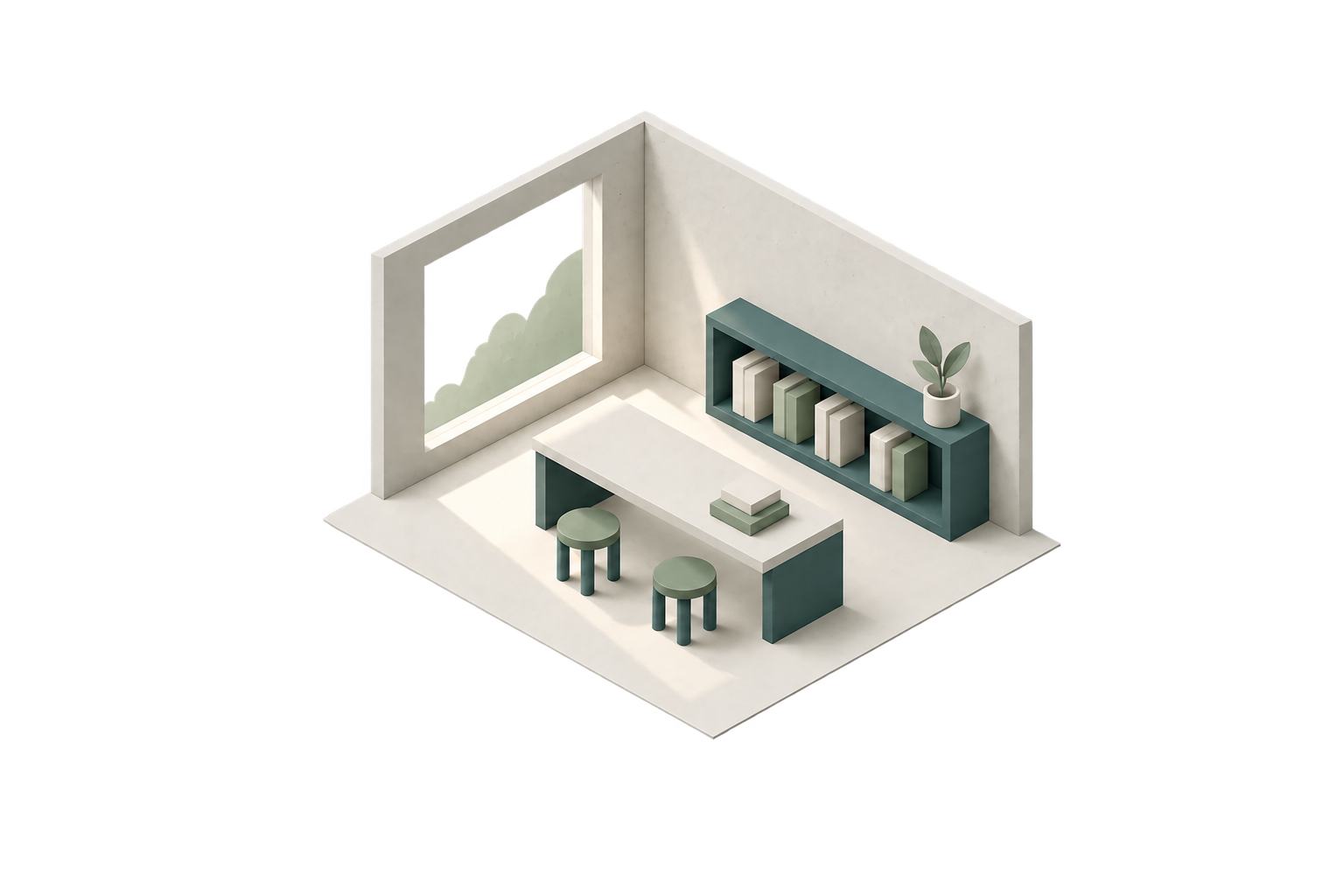
A landscape for different kinds of thinking
Place collaborative project benches around a shared forum, with quieter study edges and adjustable desks. Let people move between discussion, concentrated work and a brief restorative pause instead of asking one room to support every task.
People & purpose
attention, memory, creativity, cognitive fatigue
Evaluate the proposal
Task performance, interruptions and use of alternative work settings.
Design decisions and supporting evidence
Design move · hypothesis
Offer a quiet retreat users can choose to enter.
Findings across linked studies
Negative stress and collaboration outcomes emerged in the office with fewer quiet rooms. (Haapakangas et al. (2018))
Peer-reviewed sources & research audit 7 papers
Haapakangas et al. (2018) · Journal of Environmental Psychology
- Method
- Behavioral · Survey
- Participants / setting
- Two workplace relocations; pre samples 65/64, post 135/71
- Study focus
- Two office relocations compare environments with different availability of quiet rooms.
- Finding used
- Distractions increased at both organizations; poorer stress and collaboration ratings emerged where quiet rooms were scarce.
- Architectural relevance
- Test user-controlled retreat options before proposing automated sensor-driven adaptation.
- Study-specific quantitative result
- Environmental choice & quiet-space access: Perceived noise distraction, stress and collaboration after office relocation Before and after relocation; workplaces with more versus fewer quiet rooms Organization samples reported as 65 and 64 before relocation, 135 and 71 afterward; these are survey response counts, not a fully paired cohort. Two organizational relocations to open-plan offices with differing availability of quiet workspaces. Noise distraction increased in both organizations. Worsening stress and collaboration were reported in the office with fewer quiet rooms. A numerical effect-size estimate was not retrieved from the accessible abstract. Uncertainty: Confidence intervals and exact outcome contrasts were not extracted; inaccessible full-text tables should not be treated as having no numerical results. Analysis: Outcome hierarchy not specified in the material checked. Evidence about quiet-workspace access in an office relocation, not a test of automated adaptive buildings or a causal demonstration that environmental control changes neural physiology. Material checked: Publisher and author-repository abstracts checked. Full-paper retrieval attempted at publisher and Theseus (handle 10024/165953, accepted manuscript, sequence=2), but full body remained unavailable; no PMC copy located. Outcome hierarchy could not be verified; numerical details are unextracted, not established absent.
- Interpretation limits
- Nonrandomized organizational changes; quiet-room access is not automated adaptation or biofeedback.
- Verification status
- Partial verification · see unresolved items
- Sections checked
- Publisher abstract; indexed author manuscript abstract and repository record
- Unresolved / verification limits
- Full Methods/Results/tables, exact contrasts, effect sizes, CIs and outcome hierarchy remain unverified. Publisher access was limited to indexed abstract; Theseus accepted-manuscript bitstream and alternative handle/download URLs repeatedly returned 403; no PMC copy located.
Zhang, Du & Chow (2023) · Building and Environment
- Method
- Systematic review · environmental perception and work outcomes
- Participants / setting
- 55 office studies in 22 countries; 30 were cross-sectional surveys.
- Study focus
- Reviews 55 office studies connecting perceived environmental characteristics with wellbeing and work outcomes.
- Finding used
- Indoor climate, naturalness, space and privacy were frequently associated with satisfaction and wellbeing. Cognitive-performance findings were inconsistent.
- Architectural relevance
- Supports evaluating comfort, privacy and user choice together, while keeping perceived productivity separate from tested cognition.
- Interpretation limits
- Heterogeneous measures and mostly nonrandomized evidence; perceived productivity is not objectively tested cognition.
- Verification status
- Full paper · relevant sections checked
- Sections checked
- 2. Method: search and eligibility · 3.1 Summary of included studies · 4.3 Strengths and limitations · 5. Conclusion
Li et al. (2023) · Journal of Building Engineering
- Method
- Review · cognitive tests and physiological sensing
- Participants / setting
- Occupants in the reviewed thermal studies; no pooled population extracted
- Study focus
- Reviews thermal conditions, cognitive testing, physiological sensors and prediction models.
- Finding used
- Skin temperature is frequently informative for thermal sensation; personal control appears relevant to satisfaction.
- Architectural relevance
- Informs testing thermal controls against actual comfort and task outcomes, rather than assuming a sensor reading proves benefit.
- Interpretation limits
- Prediction accuracy is not proof of improved cognition. Thermal sensation, satisfaction and task performance are separate outcomes.
- Verification status
- Full paper · relevant sections checked
- Sections checked
- 2. Review methods · 5. Applications of machine learning in indoor environment assessment · 6. Conclusion · 7. Implications for Future Research
Bernstein & Turban (2018) · Philosophical Transactions of the Royal Society B
- Method
- Before–after field studies · wearable interaction sensing and communication metadata
- Participants / setting
- Employees at two corporate headquarters
- Study focus
- Two corporate field studies track face-to-face and electronic communication before and after a move to more open offices.
- Finding used
- Face-to-face interaction fell by about 70% in both cases, while electronic interaction increased.
- Architectural relevance
- Challenges the assumption that fewer spatial boundaries automatically increase collaboration; test privacy and actual interaction patterns.
- Interpretation limits
- Open-plan relocation changes several factors. Interaction volume is not a direct measure of collaboration quality, cognition or neural change.
- Verification status
- Full paper · relevant sections checked
- Sections checked
- Study 1 design and results · Study 2 design and volume-of-interaction results · Discussion
Taylor, Card & Piatkowski (2018) · HERD
- Method
- Systematic review with independent dual evidence-level and methodological-quality appraisal; lower-quality studies were excluded from synthesis according to the abstract.
- Participants / setting
- 43 studies qualified for appraisal, concerning adult inpatient single-occupancy rooms and their users.
- Study focus
- Reviews adult inpatient outcomes and opinions about single-occupancy rooms.
- Finding used
- The review reports strongest support for communication, infection control, noise/perceived sleep quality and user preferences.
- Architectural relevance
- Assess user choice together with care workflow.
- Interpretation limits
- Staffing, workflow and privacy–isolation trade-offs limit a universal single-room prescription. Individual-study effects, appraisal tables and a declared outcome hierarchy could not be checked in full text.
- Verification status
- Abstract only · full text unresolved
- Sections checked
- Primary abstract and appraisal description; publisher, author-center and author-copy availability checks
- Unresolved / verification limits
- Publisher full text and supplements were inaccessible; the author-copy page offered no full text. Full Methods and Results tables remain unverified.
Tola et al. (2021) · International Journal of Environmental Research and Public Health
- Method
- Scoping review with eligibility screening and thematic data charting, combining case studies, surveys, participatory and post-occupancy/intervention work.
- Participants / setting
- 21 included studies from 801 identified; studies published 2008–2019 and include autistic people, professionals and caregivers.
- Study focus
- Maps research on the design of spaces for autistic users.
- Finding used
- Mapped sensory quality, intelligibility and orientation/predictability criteria for design.
- Architectural relevance
- Provide meaningful setting choice.
- Interpretation limits
- Design recommendations are heterogeneous; two papers required the reviewers to infer recommendations. No pooled intervention effect or universal sensory prescription.
- Verification status
- Full paper · relevant sections checked
- Sections checked
- Methods: eligibility and data extraction · Results: selection and study designs · Discussion/Table 3
- Unresolved / verification limits
- Supplementary evidence table not separately inspected.
Janssen et al. (2022; online 2021) · International Journal of Stroke
- Method
- Phase II nonrandomized cluster trial with blinded measurement, comparing communal and individual environmental enrichment with usual rehabilitation; activity was observed over ten days and clinical outcomes at three months.
- Participants / setting
- 193 stroke survivors in four rehabilitation units: 91 intervention and 102 control.
- Study focus
- Tests feasibility, safety and outcomes of communal/individual enrichment after stroke.
- Finding used
- Social activity increased modestly. No between-group benefit appeared in clinical outcomes at three months; communal enrichment was widely available, but individual materials were often out of reach or sight.
- Architectural relevance
- Check availability and accessibility of choices.
- Interpretation limits
- Equipment, access and organization formed a combined intervention. Nonrandomized allocation and implementation limitations prevent attributing a clinical benefit to any room feature. Full tables, participant flow and analysis hierarchy were inaccessible.
- Verification status
- Abstract only · full text unresolved
- Sections checked
- Primary structured abstract Methods, Results and Conclusions; publisher and repository availability checks
- Unresolved / verification limits
- Full Methods and Results, missing-data handling and prespecified outcome hierarchy remain unverified after publisher and author-repository searches.
Transfer limit: Quiet-room access and workplace relocation involve multiple changing factors.
Design move · hypothesis
Provide adjustable work surfaces and seated/standing choices.
Findings across linked studies
The intervention reduced occupational sitting at 12 months. (Edwardson et al. (2018))
Peer-reviewed sources & research audit 4 papers
Edwardson et al. (2018) · BMJ
- Method
- Cluster-randomized multicomponent intervention; blinded assessors, thigh accelerometry and generalized estimating equations accounting for clusters.
- Participants / setting
- 146 workers randomized in 37 office clusters; 109 attended 12-month follow-up. Availability of valid accelerometry determined the complete-case analysis sample.
- Study focus
- Tests adjustable desks within a program of prompts, feedback and coaching.
- Finding used
- The program reduced workplace sitting at 12 months; this does not isolate the desk from the surrounding support.
- Architectural relevance
- Provide usable posture choices supported by workplace practice.
- Study-specific quantitative result
- Adjustable workstations & posture: Occupational sitting duration Multicomponent SMArT Work program versus usual practice 146 desk workers in 37 office clusters at baseline 12-month cluster-randomized workplace intervention Complete-case adjusted between-group difference at 12 months: −83.28 minutes per actual workday. Uncertainty: 95% CI −116.57 to −49.98 minutes; p = .001; model accounts for clustering and baseline sitting. Analysis: primary Supports the combined program, including a height-adjustable desk and behavioral support. It does not isolate a desk-only effect or establish brain change. Material checked: Primary full-text Methods and Results/Table 2 passages: occupational sitting at 12 months explicitly primary; selected estimate is complete-case, with covariate and cluster adjustment.
- Interpretation limits
- Selected estimate is complete-case minutes per actual workday; standardizing to 8 hours yielded a smaller difference. Multicomponent program does not isolate a desk effect.
- Verification status
- Full paper · relevant sections checked
- Sections checked
- Study design · Primary outcome Methods · Primary outcome Results/Table 2 passages
- Unresolved / verification limits
- Table 2 main-row participant denominator not reliably extracted in this pass; do not substitute follow-up attendance n 109 for analysis n.
Shrestha et al. (2018) · Cochrane Database of Systematic Reviews
- Method
- Systematic review · randomized and controlled before–after studies
- Participants / setting
- Workers in sedentary occupations across 34 studies
- Study focus
- Reviews 34 studies of workplace interventions including sit–stand desks and multicomponent programs.
- Finding used
- Sit–stand desks reduced sitting in short and medium follow-up; the review rated much of the evidence low or very low quality.
- Architectural relevance
- Supports offering posture options and measuring actual sitting time, while avoiding a claim that a standing desk itself improves brain function.
- Interpretation limits
- Reduced sitting does not demonstrate better cognition or long-term health benefits. Evidence for other intervention types was inconsistent.
- Verification status
- Full paper · relevant sections checked
- Sections checked
- Methods: Criteria for considering studies · Discussion: Summary of main results; Quality of the evidence · Authors conclusions: Implications for practice
- Method
- Three-arm cluster randomized trial; activPAL daily sitting, complete-case multilevel primary analysis; desk-versus-program comparison designated secondary exploratory.
- Participants / setting
- 756 workers in 78 clusters across six councils: control 267, SWAL 249, SWAL+desk 240; these are baseline counts.
- Study focus
- Compares a workplace behavior program with and without adjustable desks against usual practice.
- Finding used
- At 12 months, adjusted daily sitting was lower by 22.2 minutes with SWAL and 63.7 with SWAL+desk versus control.
- Architectural relevance
- Provide adjustable furniture alongside practical support and measure actual posture changes.
- Interpretation limits
- Supported programs; no isolated desk-only or neural effect. Planned 24-month follow-up removed because of COVID-19.
- Verification status
- Full paper · relevant sections checked
- Sections checked
- Methods: outcomes and analysis · Results: primary outcome · Table 2 and notes
- Unresolved / verification limits
- Methods/Table 2 note label primary-comparison CIs 97.5%; Results prose labels the same bounds 95%. Preserve this labeling discrepancy. Primary contrast is daily sitting, not occupational sitting alone.
Bulea et al. (2014) · Frontiers in Neuroscience 8, 376
- Method
- EEG classification · synchronized EMG
- Participants / setting
- 10 healthy adults (6 men, 4 women).
- Study focus
- Tests pre-movement EEG during sit/stand transitions.
- Finding used
- Scalp signals classified upcoming posture transitions above chance.
- Architectural relevance
- Movement-preparation context only.
- Interpretation limits
- Movement classification from scalp EEG is not a localized cortical activation map. This does not establish a health benefit of furniture or posture changes.
- Verification status
- Full paper · relevant sections checked
- Sections checked
- Methods: participants, movement tasks and classification · Results: pre-movement classification · Discussion: movement artefacts
Transfer limit: The trial combined desks with education and coaching; desk height alone was not isolated.
Design move · hypothesis
Compare access to window light and views while controlling glare.
Findings across linked studies
Window access associated with better reported sleep and longer actigraphic sleep. (Boubekri et al. (2014))
Peer-reviewed sources & research audit 7 papers
Boubekri et al. (2014) · Journal of Clinical Sleep Medicine
- Method
- Case-control pilot · sleep and health questionnaires · actigraphy
- Participants / setting
- 49 workers total (22 window, 27 windowless); 21 had actigraphy (11 window, 10 windowless).
- Study focus
- Compares office workers with and without access to windows and daylight.
- Finding used
- Window access was associated with better reported sleep and longer actigraphic sleep.
- Architectural relevance
- Study daylight access with glare control and measured exposure timing.
- Study-specific quantitative result
- Daylight: Workweek sleep duration measured by wrist actigraphy Window access versus no window access 49 office workers; actigraphy subset 21 (11 with windows, 10 without). Habitual work in offices with windows versus windowless workstations; observations extended beyond work hours. Workday sleep averaged 476.31 minutes (SD 45.23) with windows versus 429.65 (SD 39.84) without; p=.02. The paper summarizes this as approximately 46 extra minutes. Other workday actigraphic sleep measures were nonsignificant. Uncertainty: Table 3 reports group SDs and p-values; a CI for the sleep-duration difference is not reported in the full paper. This is an observational group comparison. Analysis: Outcome hierarchy not specified in the material checked. A small nonrandomized pilot association; daylight, views, workplace and personal factors cannot be separated. It does not predict a 46-minute benefit from any particular window design. Material checked: Full paper: Statistical Methods; Results; visually inspected Table 3. Outcome hierarchy not declared in reviewed Methods/analysis; no preregistration inferred.
- Interpretation limits
- Nonrandomized groups; daylight, views and work setting covary. No brain imaging.
- Verification status
- Full paper · relevant sections checked
- Sections checked
- Statistical Methods; Results; visually inspected Table 3
Boubekri et al. (2020) · IJERPH
- Method
- Case-crossover · actigraphy · cognitive simulation
- Participants / setting
- 30 workers for cognitive tests; sleep analysis retained 24 participants and 147 nights after six exclusions. One workweek per condition.
- Study focus
- Compares electrochromic glazing with blinds in otherwise similar offices.
- Finding used
- Adjusted total sleep was 36.96 minutes longer (p<.001); normalized decision-simulation scores were 0.42 higher (p<.0001). Sleep and cognitive samples differ.
- Architectural relevance
- Assess daytime light exposure and view access together, then isolate them where feasible.
- Interpretation limits
- Daylight and views changed together; sleep exclusions and baseline imbalance matter. Manufacturer funding and employee authors disclosed. Tables 3/5 give coefficients and p-values but no effect CIs. Outcome hierarchy not declared.
- Verification status
- Full paper · relevant sections checked
- Sections checked
- Methods 2.1–2.7; Results 3.1–3.2; Tables 3–5; funding
- Method
- Crossover · calibrated light sensors · sleep measures · melatonin · ratings
- Participants / setting
- 20 residents completed both eight-day interventions; three baseline dropouts were replaced. Phasor analysis used 15.
- Study focus
- Tests two residential window conditions.
- Finding used
- EC glass advanced weekday sleep onset by 22.2 minutes (p=.050) and increased sleep regularity by .88 points (p=.001). Duration, efficiency and latency did not differ significantly. Melatonin timing was more stable.
- Architectural relevance
- Links residential daylight design with measured circadian timing, not just subjective brightness.
- Interpretation limits
- Short, manufacturer-sponsored crossover with several outcomes. Anxiety improved but depression and stress did not significantly differ. Tables report estimates and p-values, not effect CIs. Outcome hierarchy not declared.
- Verification status
- Full paper · relevant sections checked
- Sections checked
- Methods 2.1–2.5; Results 3.1–3.8; Tables 3–4
Riemersma-van der Lek et al. (2008) · JAMA
- Method
- 2×2 randomized factorial trial; light randomized by facility, melatonin by resident; repeated mixed-effect analyses; cognition primary, depression secondary.
- Participants / setting
- 189 residents of 12 Dutch facilities; 170 women, 19 men; mean age 85.8; 87% dementia; 129 enrolled before lighting, 60 afterward.
- Study focus
- Tests long-term daytime light and melatonin in group care.
- Finding used
- Daytime bright light modestly attenuated cognitive decline, depressive symptoms and increasing functional limitations; melatonin and combined-treatment findings are separate.
- Architectural relevance
- Study adequate daytime light exposure; larger windows are not an equivalent dose.
- Interpretation limits
- Six facilities per light condition, variable follow-up/missing assessments; measured indoor-light exposure is not equivalent to window size.
- Verification status
- Full paper · relevant sections checked
- Sections checked
- Methods: participants/randomization/assessments · Results: Cognition · Table 3 · Missing-data analyses
- Unresolved / verification limits
- Supplementary eMethods not separately inspected.
Barrett et al. (2015) · Building and Environment
- Method
- Observational classroom assessments and two-level pupil/classroom modeling of annual reading, writing and maths progress.
- Participants / setting
- 4,924 pupils initially sampled in 203 classrooms/30 schools; final analysis: 3,766 pupils, 153 classrooms, 27 English schools.
- Study focus
- Relates classroom conditions to pupils’ academic progress.
- Finding used
- Seven environmental parameters produced a modeled classroom-effect range of 7.93 progress points, 16% of the observed 50-point pupil-progress range.
- Architectural relevance
- Evaluate light together with other classroom conditions.
- Interpretation limits
- The 16% headline is a range-based model summary, not a causal improvement or 16% R². Overall model R² was 58%; teaching and environmental features covary.
- Verification status
- Full paper · relevant sections checked
- Sections checked
- §3 data collection/statistics · §4 Results, especially p.126 · §6 Conclusion
- Unresolved / verification limits
- No single-feature causal estimate or adult-learning transfer established.
Haynes, Lotto & Rees (2004) · PNAS
- Method
- fMRI · eye tracking · brightness judgments
- Participants / setting
- 9 adults across imaging experiments, 30–36 years
- Study focus
- Manipulates uniform-surface luminance during fMRI.
- Finding used
- Early visual responses tracked retinal illumination changes; pupil dynamics mattered.
- Architectural relevance
- Visual pathway context.
- Interpretation limits
- Small sample; no room-size, glare-discomfort or daylight intervention.
- Verification status
- Earlier full-text extraction retained
Schoonderwoerd et al. (2022) · PNAS
- Method
- 7T fMRI · controlled retinal light
- Participants / setting
- 12 men, 22–58 years, scanned awake at night
- Study focus
- Tests short colored-light pulses with high-resolution fMRI.
- Finding used
- SCN BOLD decreased for blue, green and orange light; violet was not significant.
- Architectural relevance
- Circadian pathway reference.
- Interpretation limits
- Small male sample; not a workplace or sleeping-room intervention.
- Verification status
- Earlier full-text extraction retained
Transfer limit: Window size is not a daylight or circadian-dose calculation.
Research for this population or setting
Barrett et al. (2015) · Building and Environment
- Method
- Observational classroom assessments and two-level pupil/classroom modeling of annual reading, writing and maths progress.
- Participants / setting
- 4,924 pupils initially sampled in 203 classrooms/30 schools; final analysis: 3,766 pupils, 153 classrooms, 27 English schools.
- Study focus
- Relates classroom conditions to pupils’ academic progress.
- Finding used
- Seven environmental parameters produced a modeled classroom-effect range of 7.93 progress points, 16% of the observed 50-point pupil-progress range.
- Architectural relevance
- Evaluate light together with other classroom conditions. Include thermal conditions in classroom assessment. Assess actual air quality rather than infer it from opening size. Test display complexity in the teaching context. Treat color as one correlated classroom parameter. Evaluate ownership and flexibility together with teaching practice.
- Interpretation limits
- The 16% headline is a range-based model summary, not a causal improvement or 16% R². Overall model R² was 58%; teaching and environmental features covary.
- Verification status
- Full paper · relevant sections checked
- Sections checked
- §3 data collection/statistics · §4 Results, especially p.126 · §6 Conclusion
- Unresolved / verification limits
- No single-feature causal estimate or adult-learning transfer established.
Color & personal experience
Give individual study and collaborative work distinguishable settings. The proposed benefit is easier choice of a setting suited to the task, with learning outcomes assessed separately.
Test with users: Compare reading errors, task completion and perceived distraction for both individual and group activities.
Application boundary. School and workplace findings inform the proposal; adult research performance and creativity need separate evaluation. Distinguish learning, concentration and creativity; one task score does not establish all three.