


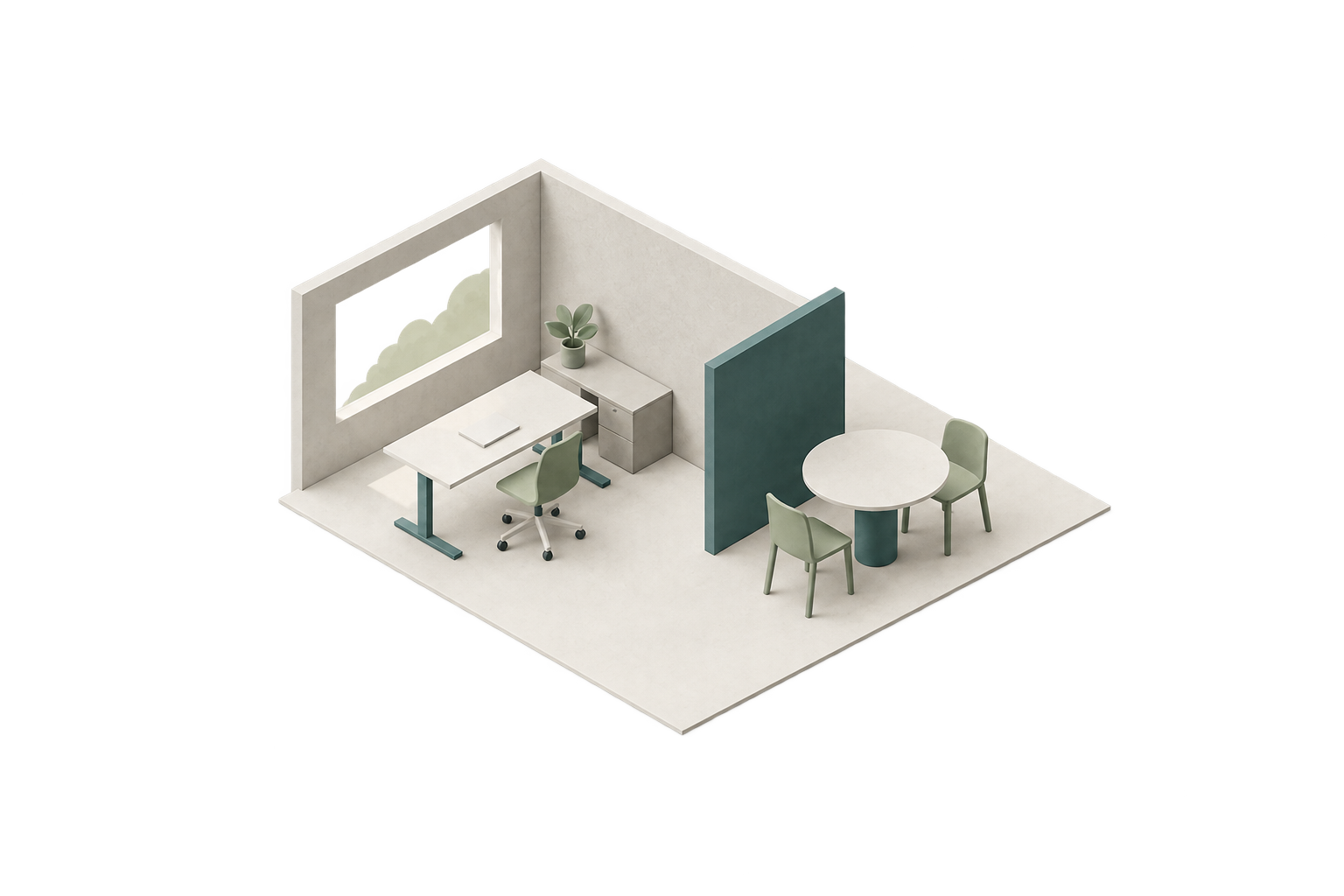
A choice of places to work
Pair open workstations with a glazed meeting pod, a focus booth and informal seating. Let teams choose a setting for the task while reducing unwanted interruptions; add environmental controls and adjustable surfaces that people can actually use.
People & purpose
focus, creativity, collaboration, stress
Evaluate the proposal
Privacy satisfaction, interruption rates, posture use and task-specific outcomes.
Design decisions and supporting evidence
Design move · hypothesis
Offer a screened seat alongside shared space.
Findings across linked studies
Enclosed offices scored better on privacy and acoustics; interaction benefits did not offset penalties. (Kim & de Dear (2013)) In a nonrandomized comparison of two NICUs, family rooms were associated with more parental presence and some better parental distress scores; later anxiety, stress and attachment differences were nonsignificant. (Tandberg et al. (2019))
Peer-reviewed sources & research audit 6 papers
Kim & de Dear (2013) · Journal of Environmental Psychology
- Method
- Cross-sectional post-occupancy database comparison of five office-layout categories, with ANOVA and satisfaction regressions.
- Participants / setting
- 42, 764 respondents in a post-occupancy office survey dataset.
- Study focus
- Study focus: Private vs open-plan workplace layouts.
- Finding used
- Private enclosed offices had higher privacy/acoustic satisfaction; reported interaction benefits did not offset the disadvantages of open-plan layouts.
- Architectural relevance
- Provide accessible quiet and private options with suitable shared areas.
- Study-specific quantitative result
- Privacy: Dissatisfaction with sound privacy High-partition cubicles, low-partition cubicles and private enclosed offices 42,764 survey respondents in five office-layout groups Cross-sectional office occupancy survey Sound-privacy dissatisfaction: 59% in high-partition cubicles, 58% in low-partition cubicles and 18% in private offices. Uncertainty: Dissatisfaction means the bottom two categories of a seven-point scale. CIs for these percentages were not reported in the inspected results. Analysis: Outcome hierarchy not specified in the material checked. Associations across workplaces; layout assignment was not randomized, and partitions alone did not guarantee acoustic privacy. Material checked: Published full text: Methods and Results §3.1/Figure 2; percentages verified; formal outcome hierarchy not declared.
- Interpretation limits
- Layout was not randomized; dissatisfaction uses the lowest two of seven scale points. Figure 1 mean-rating CIs are not CIs for the selected dissatisfaction percentages.
- Verification status
- Full paper · relevant sections checked
- Sections checked
- Methods §2 · Results §3.1 · Figure 2 dissatisfaction definition
- Unresolved / verification limits
- Formal primary/secondary outcome hierarchy not declared in the inspected Methods/Results.
Zhang, Du & Chow (2023) · Building and Environment
- Method
- Systematic review · environmental perception and work outcomes
- Participants / setting
- 55 office studies in 22 countries; 30 were cross-sectional surveys.
- Study focus
- Reviews 55 office studies connecting perceived environmental characteristics with wellbeing and work outcomes.
- Finding used
- Indoor climate, naturalness, space and privacy were frequently associated with satisfaction and wellbeing. Cognitive-performance findings were inconsistent.
- Architectural relevance
- Supports evaluating comfort, privacy and user choice together, while keeping perceived productivity separate from tested cognition.
- Interpretation limits
- Heterogeneous measures and mostly nonrandomized evidence; perceived productivity is not objectively tested cognition.
- Verification status
- Full paper · relevant sections checked
- Sections checked
- 2. Method: search and eligibility · 3.1 Summary of included studies · 4.3 Strengths and limitations · 5. Conclusion
Bernstein & Turban (2018) · Philosophical Transactions of the Royal Society B
- Method
- Before–after field studies · wearable interaction sensing and communication metadata
- Participants / setting
- Employees at two corporate headquarters
- Study focus
- Two corporate field studies track face-to-face and electronic communication before and after a move to more open offices.
- Finding used
- Face-to-face interaction fell by about 70% in both cases, while electronic interaction increased.
- Architectural relevance
- Challenges the assumption that fewer spatial boundaries automatically increase collaboration; test privacy and actual interaction patterns.
- Interpretation limits
- Open-plan relocation changes several factors. Interaction volume is not a direct measure of collaboration quality, cognition or neural change.
- Verification status
- Full paper · relevant sections checked
- Sections checked
- Study 1 design and results · Study 2 design and volume-of-interaction results · Discussion
Taylor, Card & Piatkowski (2018) · HERD
- Method
- Systematic review with independent dual evidence-level and methodological-quality appraisal; lower-quality studies were excluded from synthesis according to the abstract.
- Participants / setting
- 43 studies qualified for appraisal, concerning adult inpatient single-occupancy rooms and their users.
- Study focus
- Reviews adult inpatient outcomes and opinions about single-occupancy rooms.
- Finding used
- The review reports strongest support for communication, infection control, noise/perceived sleep quality and user preferences.
- Architectural relevance
- Consider privacy alongside isolation and staff visibility.
- Interpretation limits
- Staffing, workflow and privacy–isolation trade-offs limit a universal single-room prescription. Individual-study effects, appraisal tables and a declared outcome hierarchy could not be checked in full text.
- Verification status
- Abstract only · full text unresolved
- Sections checked
- Primary abstract and appraisal description; publisher, author-center and author-copy availability checks
- Unresolved / verification limits
- Publisher full text and supplements were inaccessible; the author-copy page offered no full text. Full Methods and Results tables remain unverified.
Tola et al. (2021) · International Journal of Environmental Research and Public Health
- Method
- Scoping review with eligibility screening and thematic data charting, combining case studies, surveys, participatory and post-occupancy/intervention work.
- Participants / setting
- 21 included studies from 801 identified; studies published 2008–2019 and include autistic people, professionals and caregivers.
- Study focus
- Maps research on the design of spaces for autistic users.
- Finding used
- Mapped sensory quality, intelligibility and orientation/predictability criteria for design.
- Architectural relevance
- Evaluate accessible retreat options.
- Interpretation limits
- Design recommendations are heterogeneous; two papers required the reviewers to infer recommendations. No pooled intervention effect or universal sensory prescription.
- Verification status
- Full paper · relevant sections checked
- Sections checked
- Methods: eligibility and data extraction · Results: selection and study designs · Discussion/Table 3
- Unresolved / verification limits
- Supplementary evidence table not separately inspected.
Tandberg et al. (2019) · PLOS ONE
- Method
- Prospective nonrandomized comparison of single-family rooms and open-bay care. · parent presence diaries, depression/anxiety/stress/attachment questionnaires
- Participants / setting
- 132 parents of 77 very preterm infants at two Norwegian units.
- Study focus
- Prospective nonrandomized comparison of single-family rooms and open-bay care. · parent presence diaries, depression/anxiety/stress/attachment questionnaires
- Finding used
- Parental presence was greater; maternal depression scores and inpatient parental stress favored single-family care. No statistically significant differences in post-discharge anxiety, stress or attachment were detected.
- Architectural relevance
- Offer quiet/private options and evaluate speech privacy, task fit and satisfaction. Read the study-specific population and limits before transferring the finding.
- Interpretation limits
- Building layout and care organization co-varied. The paper discusses conflicting prior results, including isolation and adverse infant findings where family presence was limited; no universal infant neurodevelopment benefit.
- Verification status
- Partial check · primary body excerpts
- Sections checked
- Primary abstract and extensive indexed Methods/Results/Discussion
- Unresolved / verification limits
- Complete final-paper Methods, statistical tables and analysis hierarchy have not all been independently checked. No numerical claim beyond the material identified above is inferred.
Transfer limit: Office survey findings are associations; enclosure also changes light and visibility.
Design move · hypothesis
Offer a quiet retreat users can choose to enter.
Findings across linked studies
Negative stress and collaboration outcomes emerged in the office with fewer quiet rooms. (Haapakangas et al. (2018))
Peer-reviewed sources & research audit 7 papers
Haapakangas et al. (2018) · Journal of Environmental Psychology
- Method
- Behavioral · Survey
- Participants / setting
- Two workplace relocations; pre samples 65/64, post 135/71
- Study focus
- Two office relocations compare environments with different availability of quiet rooms.
- Finding used
- Distractions increased at both organizations; poorer stress and collaboration ratings emerged where quiet rooms were scarce.
- Architectural relevance
- Test user-controlled retreat options before proposing automated sensor-driven adaptation.
- Study-specific quantitative result
- Environmental choice & quiet-space access: Perceived noise distraction, stress and collaboration after office relocation Before and after relocation; workplaces with more versus fewer quiet rooms Organization samples reported as 65 and 64 before relocation, 135 and 71 afterward; these are survey response counts, not a fully paired cohort. Two organizational relocations to open-plan offices with differing availability of quiet workspaces. Noise distraction increased in both organizations. Worsening stress and collaboration were reported in the office with fewer quiet rooms. A numerical effect-size estimate was not retrieved from the accessible abstract. Uncertainty: Confidence intervals and exact outcome contrasts were not extracted; inaccessible full-text tables should not be treated as having no numerical results. Analysis: Outcome hierarchy not specified in the material checked. Evidence about quiet-workspace access in an office relocation, not a test of automated adaptive buildings or a causal demonstration that environmental control changes neural physiology. Material checked: Publisher and author-repository abstracts checked. Full-paper retrieval attempted at publisher and Theseus (handle 10024/165953, accepted manuscript, sequence=2), but full body remained unavailable; no PMC copy located. Outcome hierarchy could not be verified; numerical details are unextracted, not established absent.
- Interpretation limits
- Nonrandomized organizational changes; quiet-room access is not automated adaptation or biofeedback.
- Verification status
- Partial verification · see unresolved items
- Sections checked
- Publisher abstract; indexed author manuscript abstract and repository record
- Unresolved / verification limits
- Full Methods/Results/tables, exact contrasts, effect sizes, CIs and outcome hierarchy remain unverified. Publisher access was limited to indexed abstract; Theseus accepted-manuscript bitstream and alternative handle/download URLs repeatedly returned 403; no PMC copy located.
Zhang, Du & Chow (2023) · Building and Environment
- Method
- Systematic review · environmental perception and work outcomes
- Participants / setting
- 55 office studies in 22 countries; 30 were cross-sectional surveys.
- Study focus
- Reviews 55 office studies connecting perceived environmental characteristics with wellbeing and work outcomes.
- Finding used
- Indoor climate, naturalness, space and privacy were frequently associated with satisfaction and wellbeing. Cognitive-performance findings were inconsistent.
- Architectural relevance
- Supports evaluating comfort, privacy and user choice together, while keeping perceived productivity separate from tested cognition.
- Interpretation limits
- Heterogeneous measures and mostly nonrandomized evidence; perceived productivity is not objectively tested cognition.
- Verification status
- Full paper · relevant sections checked
- Sections checked
- 2. Method: search and eligibility · 3.1 Summary of included studies · 4.3 Strengths and limitations · 5. Conclusion
Li et al. (2023) · Journal of Building Engineering
- Method
- Review · cognitive tests and physiological sensing
- Participants / setting
- Occupants in the reviewed thermal studies; no pooled population extracted
- Study focus
- Reviews thermal conditions, cognitive testing, physiological sensors and prediction models.
- Finding used
- Skin temperature is frequently informative for thermal sensation; personal control appears relevant to satisfaction.
- Architectural relevance
- Informs testing thermal controls against actual comfort and task outcomes, rather than assuming a sensor reading proves benefit.
- Interpretation limits
- Prediction accuracy is not proof of improved cognition. Thermal sensation, satisfaction and task performance are separate outcomes.
- Verification status
- Full paper · relevant sections checked
- Sections checked
- 2. Review methods · 5. Applications of machine learning in indoor environment assessment · 6. Conclusion · 7. Implications for Future Research
Bernstein & Turban (2018) · Philosophical Transactions of the Royal Society B
- Method
- Before–after field studies · wearable interaction sensing and communication metadata
- Participants / setting
- Employees at two corporate headquarters
- Study focus
- Two corporate field studies track face-to-face and electronic communication before and after a move to more open offices.
- Finding used
- Face-to-face interaction fell by about 70% in both cases, while electronic interaction increased.
- Architectural relevance
- Challenges the assumption that fewer spatial boundaries automatically increase collaboration; test privacy and actual interaction patterns.
- Interpretation limits
- Open-plan relocation changes several factors. Interaction volume is not a direct measure of collaboration quality, cognition or neural change.
- Verification status
- Full paper · relevant sections checked
- Sections checked
- Study 1 design and results · Study 2 design and volume-of-interaction results · Discussion
Taylor, Card & Piatkowski (2018) · HERD
- Method
- Systematic review with independent dual evidence-level and methodological-quality appraisal; lower-quality studies were excluded from synthesis according to the abstract.
- Participants / setting
- 43 studies qualified for appraisal, concerning adult inpatient single-occupancy rooms and their users.
- Study focus
- Reviews adult inpatient outcomes and opinions about single-occupancy rooms.
- Finding used
- The review reports strongest support for communication, infection control, noise/perceived sleep quality and user preferences.
- Architectural relevance
- Assess user choice together with care workflow.
- Interpretation limits
- Staffing, workflow and privacy–isolation trade-offs limit a universal single-room prescription. Individual-study effects, appraisal tables and a declared outcome hierarchy could not be checked in full text.
- Verification status
- Abstract only · full text unresolved
- Sections checked
- Primary abstract and appraisal description; publisher, author-center and author-copy availability checks
- Unresolved / verification limits
- Publisher full text and supplements were inaccessible; the author-copy page offered no full text. Full Methods and Results tables remain unverified.
Tola et al. (2021) · International Journal of Environmental Research and Public Health
- Method
- Scoping review with eligibility screening and thematic data charting, combining case studies, surveys, participatory and post-occupancy/intervention work.
- Participants / setting
- 21 included studies from 801 identified; studies published 2008–2019 and include autistic people, professionals and caregivers.
- Study focus
- Maps research on the design of spaces for autistic users.
- Finding used
- Mapped sensory quality, intelligibility and orientation/predictability criteria for design.
- Architectural relevance
- Provide meaningful setting choice.
- Interpretation limits
- Design recommendations are heterogeneous; two papers required the reviewers to infer recommendations. No pooled intervention effect or universal sensory prescription.
- Verification status
- Full paper · relevant sections checked
- Sections checked
- Methods: eligibility and data extraction · Results: selection and study designs · Discussion/Table 3
- Unresolved / verification limits
- Supplementary evidence table not separately inspected.
Janssen et al. (2022; online 2021) · International Journal of Stroke
- Method
- Phase II nonrandomized cluster trial with blinded measurement, comparing communal and individual environmental enrichment with usual rehabilitation; activity was observed over ten days and clinical outcomes at three months.
- Participants / setting
- 193 stroke survivors in four rehabilitation units: 91 intervention and 102 control.
- Study focus
- Tests feasibility, safety and outcomes of communal/individual enrichment after stroke.
- Finding used
- Social activity increased modestly. No between-group benefit appeared in clinical outcomes at three months; communal enrichment was widely available, but individual materials were often out of reach or sight.
- Architectural relevance
- Check availability and accessibility of choices.
- Interpretation limits
- Equipment, access and organization formed a combined intervention. Nonrandomized allocation and implementation limitations prevent attributing a clinical benefit to any room feature. Full tables, participant flow and analysis hierarchy were inaccessible.
- Verification status
- Abstract only · full text unresolved
- Sections checked
- Primary structured abstract Methods, Results and Conclusions; publisher and repository availability checks
- Unresolved / verification limits
- Full Methods and Results, missing-data handling and prespecified outcome hierarchy remain unverified after publisher and author-repository searches.
Transfer limit: Quiet-room access and workplace relocation involve multiple changing factors.
Design move · hypothesis
Provide adjustable work surfaces and seated/standing choices.
Findings across linked studies
The intervention reduced occupational sitting at 12 months. (Edwardson et al. (2018))
Peer-reviewed sources & research audit 4 papers
Edwardson et al. (2018) · BMJ
- Method
- Cluster-randomized multicomponent intervention; blinded assessors, thigh accelerometry and generalized estimating equations accounting for clusters.
- Participants / setting
- 146 workers randomized in 37 office clusters; 109 attended 12-month follow-up. Availability of valid accelerometry determined the complete-case analysis sample.
- Study focus
- Tests adjustable desks within a program of prompts, feedback and coaching.
- Finding used
- The program reduced workplace sitting at 12 months; this does not isolate the desk from the surrounding support.
- Architectural relevance
- Provide usable posture choices supported by workplace practice.
- Study-specific quantitative result
- Adjustable workstations & posture: Occupational sitting duration Multicomponent SMArT Work program versus usual practice 146 desk workers in 37 office clusters at baseline 12-month cluster-randomized workplace intervention Complete-case adjusted between-group difference at 12 months: −83.28 minutes per actual workday. Uncertainty: 95% CI −116.57 to −49.98 minutes; p = .001; model accounts for clustering and baseline sitting. Analysis: primary Supports the combined program, including a height-adjustable desk and behavioral support. It does not isolate a desk-only effect or establish brain change. Material checked: Primary full-text Methods and Results/Table 2 passages: occupational sitting at 12 months explicitly primary; selected estimate is complete-case, with covariate and cluster adjustment.
- Interpretation limits
- Selected estimate is complete-case minutes per actual workday; standardizing to 8 hours yielded a smaller difference. Multicomponent program does not isolate a desk effect.
- Verification status
- Full paper · relevant sections checked
- Sections checked
- Study design · Primary outcome Methods · Primary outcome Results/Table 2 passages
- Unresolved / verification limits
- Table 2 main-row participant denominator not reliably extracted in this pass; do not substitute follow-up attendance n 109 for analysis n.
Shrestha et al. (2018) · Cochrane Database of Systematic Reviews
- Method
- Systematic review · randomized and controlled before–after studies
- Participants / setting
- Workers in sedentary occupations across 34 studies
- Study focus
- Reviews 34 studies of workplace interventions including sit–stand desks and multicomponent programs.
- Finding used
- Sit–stand desks reduced sitting in short and medium follow-up; the review rated much of the evidence low or very low quality.
- Architectural relevance
- Supports offering posture options and measuring actual sitting time, while avoiding a claim that a standing desk itself improves brain function.
- Interpretation limits
- Reduced sitting does not demonstrate better cognition or long-term health benefits. Evidence for other intervention types was inconsistent.
- Verification status
- Full paper · relevant sections checked
- Sections checked
- Methods: Criteria for considering studies · Discussion: Summary of main results; Quality of the evidence · Authors conclusions: Implications for practice
- Method
- Three-arm cluster randomized trial; activPAL daily sitting, complete-case multilevel primary analysis; desk-versus-program comparison designated secondary exploratory.
- Participants / setting
- 756 workers in 78 clusters across six councils: control 267, SWAL 249, SWAL+desk 240; these are baseline counts.
- Study focus
- Compares a workplace behavior program with and without adjustable desks against usual practice.
- Finding used
- At 12 months, adjusted daily sitting was lower by 22.2 minutes with SWAL and 63.7 with SWAL+desk versus control.
- Architectural relevance
- Provide adjustable furniture alongside practical support and measure actual posture changes.
- Interpretation limits
- Supported programs; no isolated desk-only or neural effect. Planned 24-month follow-up removed because of COVID-19.
- Verification status
- Full paper · relevant sections checked
- Sections checked
- Methods: outcomes and analysis · Results: primary outcome · Table 2 and notes
- Unresolved / verification limits
- Methods/Table 2 note label primary-comparison CIs 97.5%; Results prose labels the same bounds 95%. Preserve this labeling discrepancy. Primary contrast is daily sitting, not occupational sitting alone.
Bulea et al. (2014) · Frontiers in Neuroscience 8, 376
- Method
- EEG classification · synchronized EMG
- Participants / setting
- 10 healthy adults (6 men, 4 women).
- Study focus
- Tests pre-movement EEG during sit/stand transitions.
- Finding used
- Scalp signals classified upcoming posture transitions above chance.
- Architectural relevance
- Movement-preparation context only.
- Interpretation limits
- Movement classification from scalp EEG is not a localized cortical activation map. This does not establish a health benefit of furniture or posture changes.
- Verification status
- Full paper · relevant sections checked
- Sections checked
- Methods: participants, movement tasks and classification · Results: pre-movement classification · Discussion: movement artefacts
Transfer limit: The trial combined desks with education and coaching; desk height alone was not isolated.
Color & personal experience
Distinguish focus settings from meeting or social areas. The proposed benefit is easier task-based choice.
Test with users: Compare task errors and concentration reports separately from collaboration comfort and meeting use.
Application boundary. Several studies concern workplaces directly, but relocation and desk interventions combine factors; no single layout guarantees productivity. Assess focus and collaboration separately; comfort and reported productivity are not interchangeable.